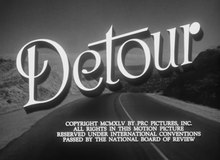
The 1945 film for this week was Detour, directed by Edgar G. Ulmer. This low budget film noir is classified as a B-Movie. B-Movies usually have no stars, low budgets, short shooting times, and massive creative liberty. Ulmer was a King among the B-Movie circuit. He worked best with these conditions and produced enough higher-quality films that he could have graduated to A-Movies, however, a few personal issues got him black balled from the major studios.
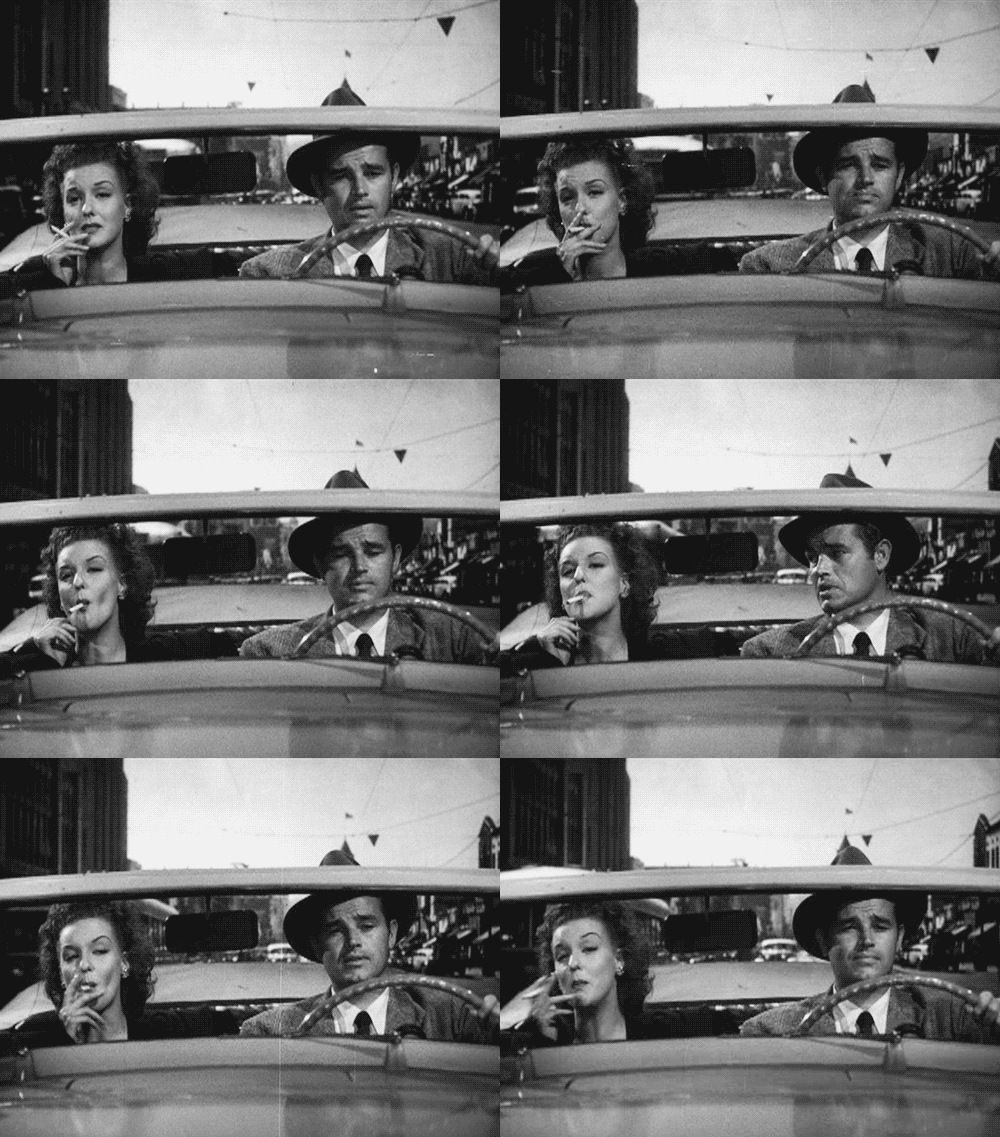
Detour is a quick film, with a fast paced plot and a lot of very bad decisions. Al Roberts is the self absorbed main character. He cares very little for those he surrounds himself with, and for those who care about him. The only thing he seems to truly care about is himself and what he can get from other people. His girlfriend, Sue, wants to up and go to Hollywood, a wonderful dream. Yet Al turns it into this bad idea, making it seem like she is abandoning him, rather than encouraging her to follow her dreams, or even offer to go with her. His mood becomes sour and he all but pouts as he walks Sue home. It isn’t until after she’s gone and his life is bad that he misses her, or rather, misses the fame she could get when she makes it to the top, so he goes across country to be with her. That is where we meet Mr. Haskell, the man who picks him up hitch hiking and takes him to California. How could he possibly mess this up? Haskell dies and Al abandons the body in a gully and robs him of his clothes, money, identification, and car, taking off on his own. And finally, we meet Vera. Vera is the one true match for Al, and the only one who doesn’t put up with him, taking over the role of the dominant one in their almost relationship. She won’t put up with any of his usual tricks or actions, and she doesn’t believe half of the stories he tells either. Vera is a lot smarter than Al, and she knows it, but she is a woman, and during this time a woman was nothing in the patriarchal world. Perhaps they’ve finally met their match, their partner, and can be happy together. Wrong. Money gets in the way again. Al’s assumed identity of Haskell has an inheritance, and selling off the car could bring in nearly $2,000. Al continues to make bad decisions and the cards are severely stacked against him. What is a guy to do? He accidentally hangs Vera with a phone cord, then runs away, leaving a dead wife in bed. Everyone believes Al Roberts is dead because he disguised Haskell as himself. Everyone thinks Vera was Haskell’s wife and that Haskell murdered her so they are looking for Charlie Haskell. So now he is no one and in the middle of nowhere. He is free to be anything and to be nothing. Yet he has never been more trapped than in the last few minutes of the film, sitting in that Nevada diner.
It is hard to believe anything that Al has narrated is the truth. In his book of criticism, Andrew Britton has deemed Al Robert’s as an unreliable narrator. It is made very clear in the beginning that Al is very self focused and only cares about himself. His demeanor is often cynical and outright rude. Several instances that are recalled by Al are questionable to say the least. Haskell and Vera’s death scenes are clearly misrepresented by accidents that he couldn’t control, and he would never do such a thing, when it is quite clear that his horrible decisions are the direct link to all of his hardships. The circumstances that Al continues to find himself in is unbelievable, which is exactly what Ulmer is trying to do. Al’s world is supposed to be seen as completely ruled by fate and that he is merely a pawn in a pile of bad deals, but from our point of view we can clearly see that Al’s own subconscious has rewritten his life to benefit himself, and maybe evoke a hint of pity in whoever his internal monologue is for. Like most unreliable narrators Al has turned himself into the victim of fate, rather than accepting the consequences of his own actions and owning up to the hardships of life. Ulmer directs this beautiful fate driven story, but because of the narrator, Al, it is impossible to believe any of it. I firmly believe that Ulmer knew what he was doing when he had Al narrate the flashbacks.

The effects of shadows is an interesting one. Ulmer is known for the risks and liberties he takes with shadow casting and lighting maneuvers. The shadows cast over Al in the opening scene evoke a mystery about the man in the diner. Ulmer uses his lighting to show Al slip into his own memory, making the scene darker to show we are leaving the present time. There was a minimal budget with this film and Ulmer worked with what he had so beautifully. It was hard to understand that the little money he used to make the film itself could result in such a masterpiece of film.

Detour is an interesting film and a must see. Although the main characters motivations are questionable, watching fate interacting and mapping out their lives is rather intriguing and even comical. The ways “fate” ruins the life of Al Roberts is a journey like no other. I would definitely watch it again.
 Cult Movies
I really liked the part you have in here about Ulmer’s use of lighting and the effect of shadows, and I agree that with the budget he had he pulled it off brilliantly. It’s a shame that he was pretty much blacklisted from Hollywood. It would have been amazing to see what he could do with a real budget. I also really like your description of Vera as “the one true match” for Al, because honestly the power dynamic she provided, with her constantly calling Al out and not putting up with any of his delusions, gives us so much insight into what’s reality and what’s the work of the unreliable narrator.
LikeLike