

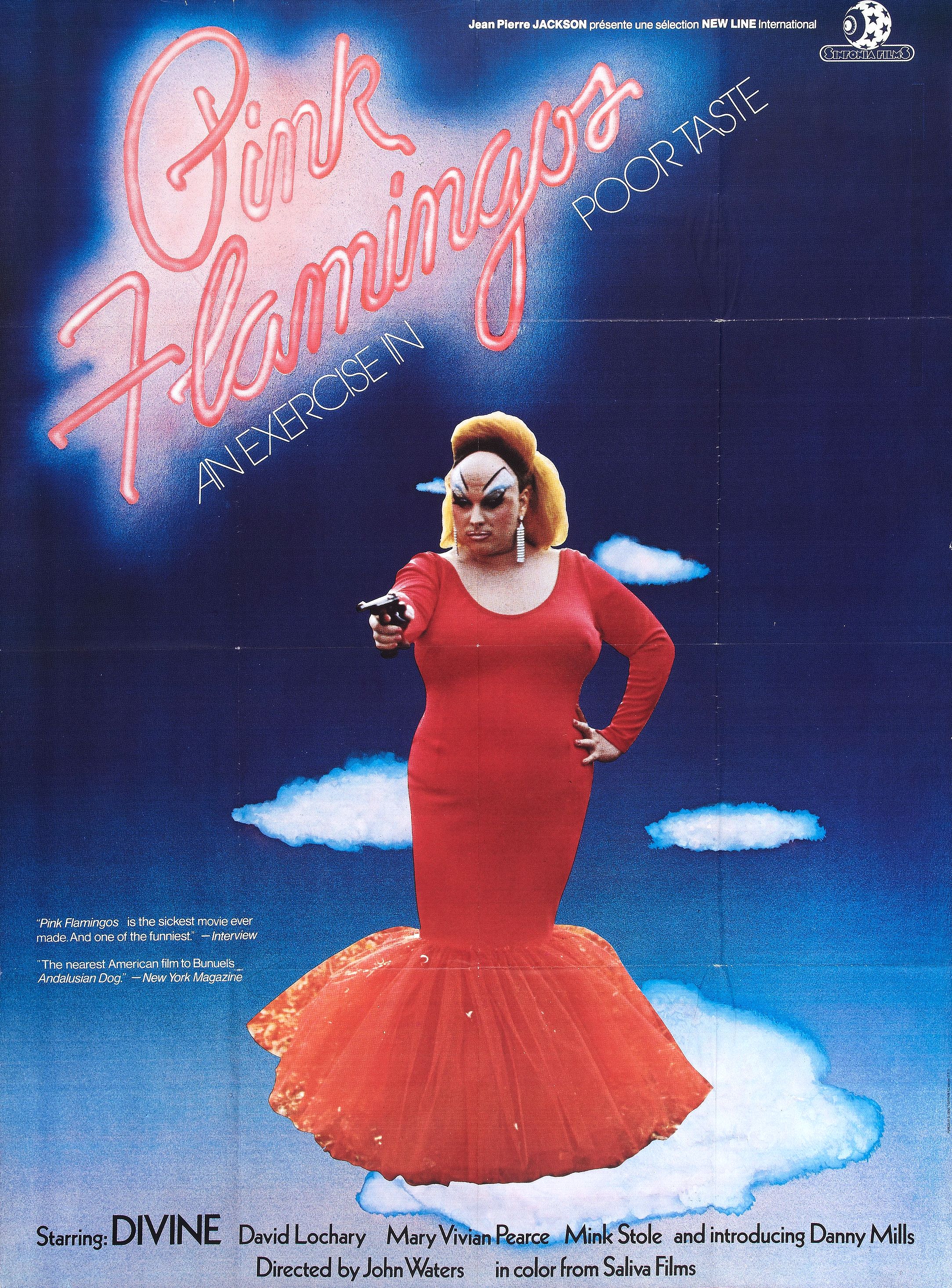
John Waters directed, produced, and wrote the 1972 cult film Pink Flamingos. The film is called “an exercise of poor taste” as it’s filled with “outrageousness ” with its transgressive nature. This was the perfect film to pair with our readings on transgression and freakery. Divine, our main character, a well-known Drag Queen, has been deemed “the filthiest person alive,” a title that seems to be very important to them and their rivals, the Marbles, Connie and Raymond, played by David Lochary and Mink Stole. The film is transgressive in the sense it exploits several taboo topics of the human body including: nudity, voyeurism, sodomy, masturbation, incest, rape, cannibalism, and murder. These harsh and intense topics are normally hard to talk about, which only furthers Waters’s pride in his truly disgusting film.

“Transgression and Freakery” by Ernest Mathiijs and Jamie Sexton was an enlightening reading. They define transgression as “any act that violates law or morality; more broadly it refers to the act of passing beyond any imposed limits” (Mathijs and Sexton). With the strict rules that society dictates that isn’t very hard to do. In Pink Flamingos transgression is set to an extreme octave, including freakery and abhorant topics that in turn categorizes the film as a “sick film.” Freakery shifts social ideologies to obscure naturalism and show the abject, the grotesque, and the impure. These major factors give way to the film, giving the audience an escape into a disturbing alternative reality. The challenges of reality faced in this film show how shallow the pool of normalcy is. Waters’s film makes one question how people can behave in such a way. The film goes to these extremes to reassure the audience that they are normal, this isn’t real, and that they get to enjoy these sick and twisted story lines in this cult film without fear of judgement.
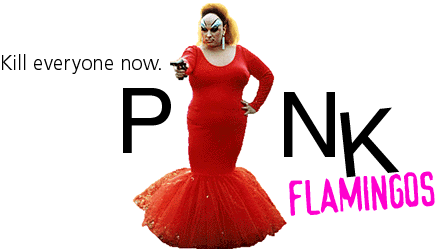
To truly identify this film as a sick film we have to pause and look at the very last scene of it. Divine picks up dog feces and ingests it. A disturbing and disgusting moment that brings the incredulous movie to a close. The narrator, Mr. J, then calls Divine not only the filthiest person alive, but also the world’s filthiest actress.

What were they thinking? The film is still shocking in modern times, let alone in 1972. Although sex was a very public thing in the 1970s the other topics, like dressing in drag, were not considered socially appropriate, whereas now being a Drag Queen is more commonly accepted and empowered as we keep sex behind closed doors. As stated in class the world is becoming sanitized of sex. This cultural transformation is shocking, yet also exciting. The flip in social changes is enlightening, now that we keep sex hidden and encourage dressing in drag, among other ways of expressing oneself. It begs the question what Waters was trying to show. He is seemingly ahead of his time, capturing this glimpse of a different world, but even his extreme ideas in 1972 send us in 2020 for a loop. So where was he headed? What was he trying to say about the people then, and the people now? Pink Flamingos is a very new and very intense experience. However, its disturbing images and ideas are a gate way into understanding cult topics of sick films, freakery, and transgression.

Taboo, the discussion of impurity in the world, often relates to bodily fluids. The unknown, the inside is all impure because we don’t know about it. Society has dictated that the unknown is to be feared because it can’t be predicted or classified as anything. If taboo was looked up in the dictionary Pink Flamingos would be listed beside it. Although the film explores this freak show through humor it is touching on numerous taboo topics. The form of taboo we see in this film is abjection, “where cultural meaning collapses.” Anything considered normal does not exist. it is difficult to describe because language barely scratches the surface trying to accurately convey what is happening on screen.

Reception is the most important part of transgression. Culture changes and has drastically changed since the film was released in 1972. In 1972 the film shocked audiences as it does now. Pink Flamingos gained a cult following rapidly in the midnight circuit and still has one now. Modernity couldn’t tarnish Waters’s extreme ideas. His obscene film is still relevant and gets the reaction he was aiming for, which is the exact reason we appreciate and study the film academically. The film has more to say about us than we do about it.
 Cult Movies
I must disagree with you on how to see this as a sick film. You could pause at so many more moments than just at the end of this film. I mean right away with Cotton bringing a chicken into his sex scene and you watch as this chicken gets killed. Or later when Mr. Marbles goes to flash any one of those times. I mean why was another sausage tied to his wiener. Last, but not least when Divine chose to give her son, Cotton, a blowjob in the house. I think when you put this all together it is just twisted. So, to only pause at the final scene as the worst I must disagree. I will say it was messed up and left me wondering why she kept staring at the screen for so long. It was just gross. I see Waters as a strange fellow, but others could see him as the mastermind of such a wonderful film.
LikeLiked by 1 person