I am not a HUGE horror fan, but I enjoy the genre and appreciate how open it is to creativity. My parents are big fans of older horror films like the The WolfMan and Creature from The Black Lagoon. So, whenever I think about old-world characters, Frankenstein or Dracula, I think of dimly lit black-and-white castles, usually in Transylvania or somewhere with lots of fog and cobwebs. Curiously, though, the word vampire doesn’t spark that relationship in my head. I think the reason for that has to do with how much the portrayal of vampires has changed since Bela Lugosi’s Dracula. Speaking on the genre as a whole, there was a shift in the way monsters are portrayed in the media.  But because this week has been about Blacula, I’m speaking about vampires specifically. Blacula is a great example of a changing approach taken for the portrayal of monsters, who begin to become dynamic characters. The reading “Deadlier than Dracula!” states that monsters were typically used to elicit pity in early horror stories, including their film adaptations, taking on the trope of a “good-hearted sacrificial lamb”. While Blacula uses Dracula’s character within the movie, it differs from previous monster films within the horror genre because the monster’s sole purpose is no longer to make the audience feel bad for them. Instead Blacula’s character, Mamuwalde, acts as a leader and revolutionary; he is a hero of the mistreated, standing up to their opposers. Harry Benshoff’s “Blaxploitation Horror Films”, discusses the role of the monster within the blaxploitation horror genre well:
“unlike most Hollywood horror films of previous eras, audience sympathy is often redirected away from those figures (those of “normality”) and toward the figure of the monster, a specifically black avenger who justifiably fights against the dominant order – which is often explicitly racist.”
It is the shift from monsters being either completely scary or doomed to suffer from the uncontrollable misfortunes brought upon them by others, to characters that try to function within normal society and even fight for their ability to despite their monstrous abnormalities.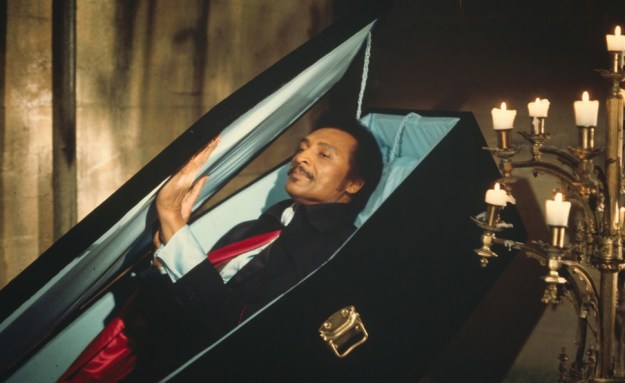
On top of being a new take on a classic monster, Mamuwalde’s character is also progressive for the movies being made during its time. Not only is he one of the first black monsters on screen, but he also expresses political and social views related to the socio-political atmosphere at the time. From the first scene, Blacula becomes an allegory for slavery, Mamuwalde is literally enslaved by Dracula’s curse and, as if dooming him to eternal bloodlust wasn’t enough, renamed “Blacula”. The “Deadlier than Dracula!” reading makes a good point of, “Ironically, much like the slaves he was attempting to free, Blacula finds himself transported to America by no choice of his own.” When Mamuwalde is freed from the confines of his coffin he must feed his hunger some way, so he does what any vampire must do and he sucks the blood from others. But he only does this when he needs to eat, I’m basing this assumption on the few times we actually see him bite someone and the way his appearance changes i.e. the unkempt facial hair and fangs. Mamuwalde doesn’t abandon those he bites, instead he welcomes them and their newfound vampireness into his own community.
Overall, I enjoyed the Blacula. It had an entertaining plot and had the right amount of horror with a sprinkle of humor to create a fun experience. Plus, there was the added bonus of a good soundtrack and unique title sequence. And I appreciated the relationship between Tina and Mamuwalde, though fast-developed, it’s hard not to be a fan of truly romantic relationship.

Tina’s cape was clearly a hint that she was connected to Mamuwalde
 Cult Movies
Hi Reilly! Great blog post! I enjoyed how you mentioned how Mamuwalde was not the typical horror monster that you feel bad for but instead he becomes a leader of the mistreated. I liked how you mentioned the quote from the Deadlier than Dracula reading that mentioned how just like slaves Mamuwalde came to America against his will. I agreed that was interesting point that really showed how he was enslaved by this curse.
LikeLike