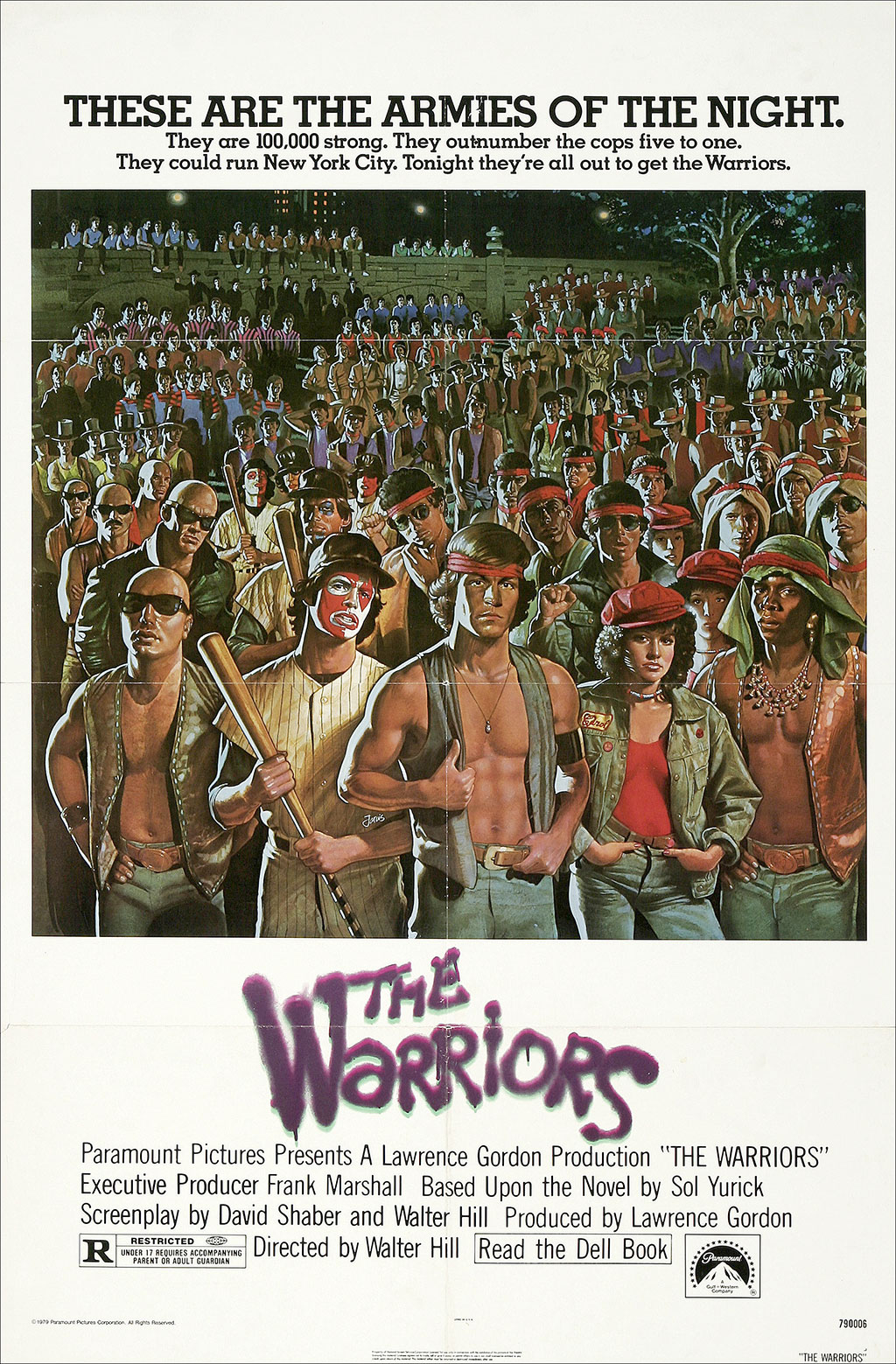
This week we watched the classic cult film The Warriors, a 1979 film directed by Walter Hill. The Warriors was based on the novel by Sol Yurick. This amazing film is a must watch. The congregation of gangs in the park, all lead by Cyrus, is a cacophony of noise and mania. Cyrus presented a gang utopia, where everyone ruled New York City, and claimed it from the cops, something progressive yet terrifying to some. This results in him being shot by Luther, the Warlord of the Rogues, played by David Patrick Kelly. In an interesting twist Luther claims the gang, the Warriors, killed Cyrus, starting the massive hunt for the nine representatives that came to the rally. The Warriors’s Warlord, Cleon, played by Dorsey Wright, is killed immediately, leaving only eight members to make it home to Coney Island. The wild ride of watching the gang escape the 100,000s of gang soldiers in a desolate New York City atmosphere isn’t what you would expect. The action and comedy keeps you on the edge of your seat, wondering what curve ball is about to come around the corner. It is not surprising that this film has gained such a following, to the point where a video game was developed.
While studying this film we also studied fandoms, as they are a very large part of cult culture. It is important to understand the many layers of fandom and its impact on not only the economy, but on cult culture. One of our readings was “The Cultural Economy of Fandom” by John Fiske. Fiske claims there are three main characteristics of Fandom and they are: discrimination and distinction, productivity and participation, and capital accumulation.
Discrimination and Distinction: Discrimination is the lines clearly drawn to decide what is fandom and what is not. Fan discrimination has two affinities the socially relevant pop culture and “aesthetic discrimination of the dominant” (448). The key difference is that the subordinate has to be for something, making it functional. The aesthetic discrimination talks about hierarchical power and categorizing things, such as canonization, deciding between who and what is canon and what should be excluded. Nothing that doesn’t make the mark gets let in. Its a cut throat nature, yet also very inclusive. It becomes its own community.

Productivity and Participation: The three types of productivity are semiotic, textual, and enunciative. “Fan productivity is not limited to the production of new texts.” It includes the original texts construction, pop culture performance, and the commercial narrative. (451) Without the fans participation and their own production of content in regards to their fandom the stars and work would be lost. Stars owe their stardom to their fans. This productive nature for the fandoms only further the fame and fortune of the culture.
“Semiotic productivity is characteristic of popular culture as a whole rather than a fan culture specifically. […] An enunciation is the use of a semiotic system (typically, but not exclusively, verbal language) which is specific to its speaker and its social and temporal context. […] Fans produce and circulate among themselves texts which are often crafted with production values as high as any in official culture. [Textual production is when] fan texts are not produced for profit, they do not need to be mass-marketed, so unlike official culture, fan culture makes no attempt to circulate its texts outside its own community. They are ‘narrowcast,’ not broadcast, texts.” (450)

Capital Accumulation: In fan culture they accumulate knowledge, collections, and cultural and economic capital. As fandoms are a widespread network system that shares and collects data, whether it be canon information, new discoveries, or memorabilia. This wide range of people and ideas makes this capital accumulation endless. By having a massive fandom it brings in a massive amount of money. Producing something people love and thrive on will accumulate massive amounts of money for stars and those who produce it. There is a mass market in fandoms and making money will always be a major motivator in society. Any time corporations and companies can make the big dollar they will.
 Cult Movies
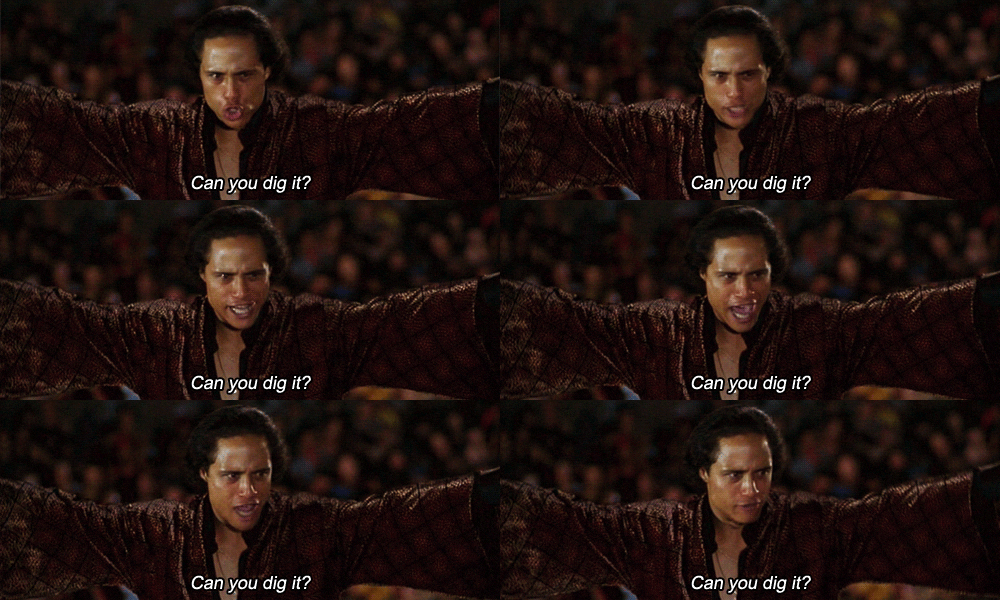
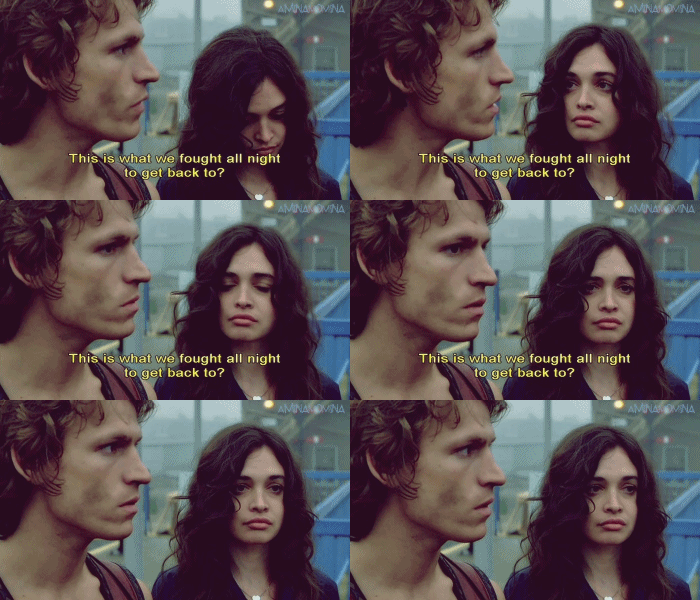
I was a little upset to see that you use the gif for “Can you dig it”, if there is one line I walk away from the film thing of. It was that one. The other one is the “Warriors, come out to play” with the bottle. I know professor spoke about this one and his buddy doing this, but now I can see myself doing this as well. I originally thought that we were going to see a take over of the city by all these gangs uniting together, but with such a big dream there is always someone who will ruin it for the group. That is exactly what happened when Cyrus got shot. His ideas were too big for the pack of lawless juveniles running wild in New York City. I found this to be relatable to another film, Poseidon’s Adventure, because it seems like nothing can go right for our Warriors until the end when the truth is revealed.
I think it is interesting to hear the other side of the argument because I just completely over-looked the discrimination or even some of the abuse in the film. In class we spoke of the aggressive nature and the way women are portrayed in the film. From the lonely undercover cop, to the all-female gang. In each situation we saw the boys attempt to take advantage of the girls. The only thing is that each time it did not work out for the Warriors and either got them almost killed or arrest.
LikeLike
“Can you dig it?!” What an iconic line, right? Another great post. I love how you break down the three main characteristics of fandom. You pay attention to the details from the writings and give them your own unique spin. What kind of fandoms you enjoy?
LikeLike