I hope everyone is feeling healthy and not having too much trouble adjusting to online classes. I think our first week went really well, props to the presenters for amazing presentations despite the switch-up of learning/teaching style (might have to watch Blade Runner 2049 tonight). Now, to jump down the rabbit-hole, or in this case vampire dungeon, of Valerie and Her Week of Wonders. This was such a different film from what we have viewed this semester, not just because it was a Czech film but also because of the subject matter and narrative. There are many aspects of the film that I enjoy but, overall, the film left me feeling a bit uneasy. Understanding that a confusing narrative adds to the surrealist nature of it, I can live with my uncertainty.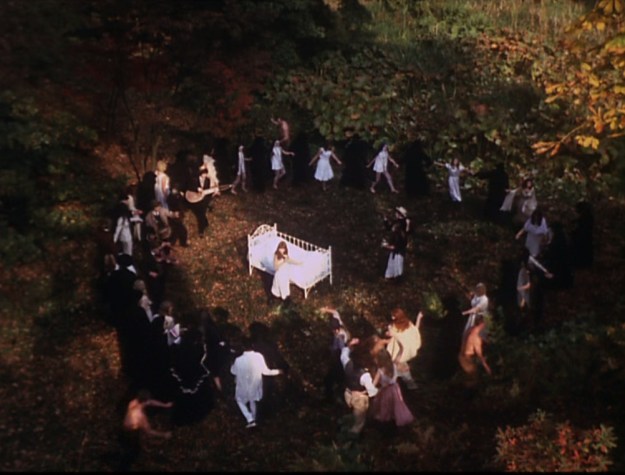
Valerie was such a beautiful film to watch, it was visually stunning. There were multiple moments I had to pause the movie so I could take in the compositional qualities of the shots, the use of setting and props should be recognized for their contribution to the overall dreamlike essence of the film (I feel like this is a common takeaway from films with pastoral settings). We talked about how popular the movie score is, the trancelike choral music reminded me a lot of the soundtrack for The Wicker Man (1973) if you want to check it out (this might also be from the pagan undertones of Valerie).
Valerie and Her Week of Wonders is a coming of age story that follows a girl’s discovery of familial secrets during the week of her first period. Now, getting your period for the first time is already pretty rough but Valerie really had a crazy first run. At first, I didn’t see why this was called a coming of age movie, starting your menstrual period is only one step in transitioning into adolescence, but after sitting with it for a few days it makes more sense to me now. Adolescence is an odd stage in human growth; the waiting period between childhood and adulthood. No one wants to acknowledge you as an adult, but

my face during that weird puberty church speech
you’re not treated with the same forgiveness as children. This film is compared to Alice in Wonderland, probably because they both are about young girls (though I believe Alice was around age 11) but also because Alice longs to be recognized as an adult but does not want to partake in the responsibilities that come with it. Where the stories differ, is how adulthood is introduced to them, I think Valerie’s story is more accurate to adolescence. I know that sounds crazy but let me explain (and ignore the vampire part).
During the first half of the film, Valerie spends a lot of time watching other people, usually engaging in sexual acts but also the way the adults speak to each other. The Tanya Kryzwinska piece discusses the role of family relations in adolescence in depth, but one of the main points that I found relevant to this specific theme was,
“As Freud argues in his 1909 essay ‘Family Romances,’ it is common for children to fantasize about family intrigues and secrets. Jean Laplanche expands on this idea by suggesting that the coded speech and actions of family members present enigmas to children that have their impetus in a drive to knowledge. These putative, puzzle-laden messages become repressed and thereby structure unconscious fantasy, only to re-emerge in retrospective form during adolescence.” (pg. 4, paragraph 4)
In short, observed conversations and behaviors amongst family members or other adults that were once confusing to us as children become understandable during adolescence. Of course, this is a theory; but Valerie did a really great job of exploring it. Along with the sexual transitions Valerie experiences (although somewhat intense), she is faced with her 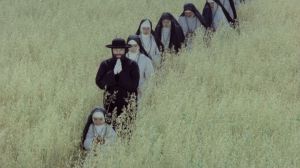 grandmother’s thirst for power and the possibility of losing her inherited home. These are all big changes for Valerie to unfold in just one week. It makes me wonder if her family members were actually vampires or if it was a fantasy she created in the midst of being exposed to more mature topics, as suggested in the Kryzwinska reading. In the podcast and in class we discussed how highly edited this film was, most of the shots lasting only a few seconds, this might be related 1) how fast these new epiphanies are occurring 2) Valerie’s own confusion. I feel like I’m running circles around the meanings of this film; what’s a symbol and what isn’t? I still have so many questions. Coming of age movies are a favorite of mine, this one was a different experience but a good one.

My fav scene was when she started laughing as they tried to burn her her, little did they know, she has some magic earrings
 Cult Movies
This blog was Awesome! the title made me laugh outright, and the caption on the picture of the weird grinning-ish polecat sent me rolling.
You had a great use of quotes including citing a work of Freud. This was a great injection of philosophy, and a much welcomed connection.
Once again, great work, and thank you for making me laugh.
LikeLike
I really cannot get over your caption, because SAME. I watched so many scenes of this film making that face. My first walkthrough, my mother came into them mentioning a ripe fruit and she asked what on earth we were watching.
I agree. Valerie’s transition seems closer to the reality of puberty than Alice’s journey did. Perhaps we weren’t all watching our grandmothers flagellate themselves, or have evil vampires running around(or maybe y’all did, never know), but we did observe adults and base our actions off of theirs, forming who we become.
LikeLike