"If one adopts this definition of the term “expressionist” for Suspiria, it proves useful to analyse the peculiarities of cinematography and set design in German Expressionism and to demonstrate whether and to what extent these peculiarities are applicable to Argento’s film. By doing this, the present article seeks to discuss how colour and set design in Suspiria also function as projections of the characters’ bodily and mental states to such an extent as to determine both the development and the several nuances of the story itself."
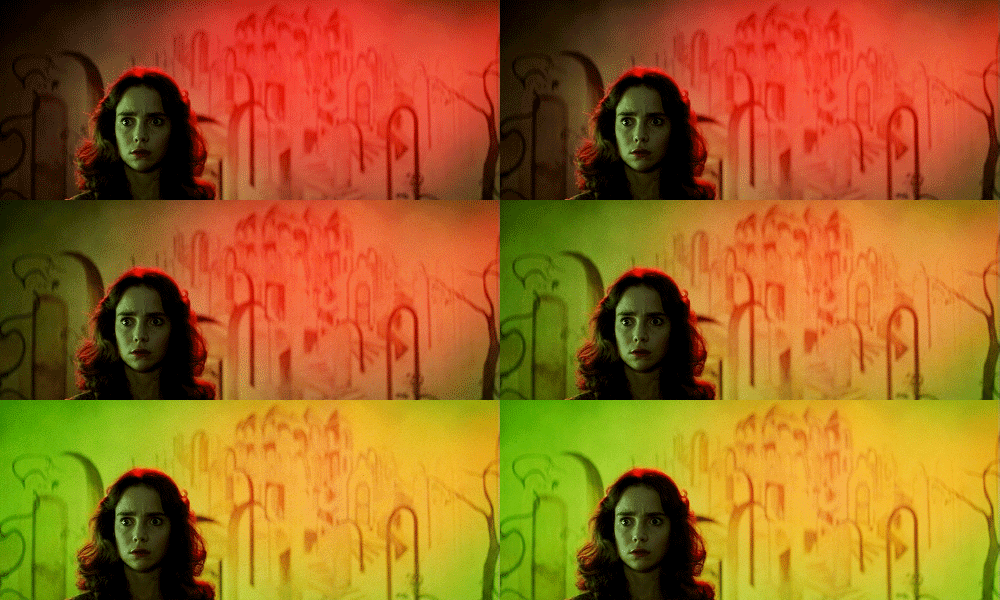
Without a doubt, the first thing that draws you into “Suspiria” is the color palette. The vibrancy of the colors that surround this movie is astounding. When you think of the horror genre, you don’t generally tend to picture bright any sort of brightness. You expect muted tones, dark and dreary hues that add to the suspenseful and unsettling ambiance of the film. Somehow Argento is able to take the use of primary color and turn death and horror into something beautiful to watch – this is the magic of Suspiria, and this technique makes it impossible to look away from the screen because no matter how gruesome the death, it’s always somehow shrouded by a veil of beauty. The concept of artistic horror is something that heightens the experience of this film, truly taking it beyond just another thriller and transforming it into a work of art.
Giusti divides the spaces in Suspiria by diving the color palette into three main categories: the magical, the daylight, and the monochrome.
"The first two categories are highlighted by the presence of a blue-red-yellow scale, sometimes alternated and sometimes all present in a single shot. While the magical spaces are the ones taking place at night, in which the supernatural is perceived by the medium of the IB stock, the daylight are the ones taking place during the day, although the presence of the supernatural is still evident. In this case, the co-existence of blue, red, and yellow is not identified by the IB stock, but by a diegetic use of colour palette through the architecture and the décor."
I found this article so interesting because it talks about how the setting and color palette aren’t simply there for aesthetics- they’re working on a whole other level, to reflect both bodily and mental states of being in the film. Argento himself has stated that the house where the story takes place is a living organism. The concept of both architecture and decor as being alive presents us with the idea of the building as a body of some kind, embodying the states of both body and mind that are based on bodily sensation. Thus, the environment as a whole is “endowed with bodily or organic characteristics.” I feel like this article is the one that spoke to me the most simply because I’m fascinated by the director’s approach and his desire to make the film work on so many levels. Nothing that is placed into this film is done so by accident. Everything works together to ensure that ultimately, the film is so much more than the sum of its parts. Having read this article, I look at “Suspiria” in an entirely new light and appreciate the complexity behind both the design and the vision.

"[The setting is] rendered through unrealistically distorted and exaggerated architectural shapes and through a series of curving, oblique, and rectilinear lines converging across an undefi ned expanse toward the background, for the expressionist purposes of reproducing the dreamlike atmosphere seen through the eyes of a madman20. As a result, these spaces achieve a dramatic status as they “do indeed seem to vibrate with an extraordinary spirituality”, creating the animation of the inorganic through bodily and mental projections."
Overall, I feel like “Suspiria” is worth the watch. I found it a little hard to follow, but I feel like it has to be approached the same way we found ourselves approaching Valerie – not for its cohesiveness, but for the experience we get by watching it. So unlike any other “horror” movie I’ve ever known, it’s an artistic medium all its own.
 Cult Movies