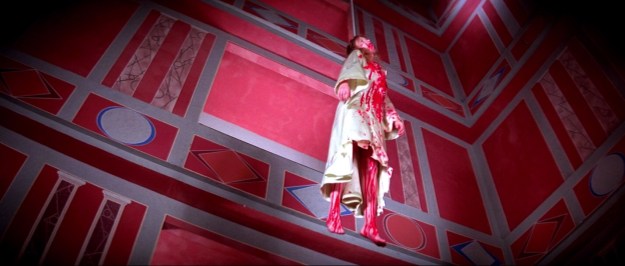
This week we watched the classic horror film Suspiria (1977). Set in Germany, a young American girl named Suzy, played by Jessica Harper, travels to join a ballet company where as she arrives she sees a woman leave the building who was found killed, and was not allowed in until the next morning. After strange things keep happening and more people die, Suzy eventually starts looking around and discovers the company’s secret plot.

This instantly became my new favorite horror film as I was absolutely amazed by how captivating the colors, soundtrack and ultimately its ability to keep me on the edge of my seat. Without over doing anything or trying to be too scary the film used its mysteriousness to just hold the feeling of something else going on above the viewers nose. I couldn’t help but keep watching as it slowly dragged me more and more into it as I felt I was in the film myself.
Yassa and Avery presented this week and one topic that was focused on was the Italian horror film. I’m the reading “A (Sadistic) Night at the Opera Notes on the Italian horror film” by Leon Hunt he takes a deeper look at why he classify’s as the four categories of Italian horror.
Horror as ‘bad object’: “Seemingly mindful of the genre’s dubious reputation, Clarens’s book epitomizes longstanding critical orthodoxy – ‘good’ horror movies do not show much actual horror (Universal, Lewton, Tourneur), but ‘bad’ ones do (Hammer, the Italians) because they lack imagination, taste, and restraint. Specifically, such an agenda could not help but react strongly against the ‘new gothic’ that emerged in Britain, Italy, and, to a lesser extent, America, where it was largely confined to Corman’s Poe films. These gothic cycles were more overtly about sex (or perverse sexuality) than horror had ever been before. They were more graphic, less tied to the big studios’ ‘good’ taste, and more eager to indulge in excess.”
Exploitation/art cinema: David Bordwell spoke about Argento’s work saying “frequently displays ‘patterned violations of the classical norm. . . an unusual angle, a stressed bit of cutting, a prohibited camera movement . . . [a] failure to motivate cinematic space and time by cause-effect logic.’ Prominent as well are enigmas of narration –’ Who is telling the story? How is this story being told? Why tell the story this way?”
The gothic and the giallo: “While the gothic horror cycle employed a female archetype epitomized by the erotic ambivalence of Barbara Steele, the giallo centers on a chic fetishistic object who embodies the implicit logic of this much-quoted statement by Dario Argento: ‘I like women, especially beautiful ones. If they have a good face and figure, I would much prefer to watch them being murdered than an ugly girl or a man”
Pornography/sadism/masochism: “Italian horror is particularly extreme and symptomatic, from the sexually charged scene when Asa’srotting body is ‘revealed’ in Black Sunday to the disgust registered in Lucio Fulci’s films. A film like The New York Ripper/Lo Squartore di New York (1982) displays its fear of the hostility toward the female body with a violent, numbing realism that would be difficult to equal”
 Cult Movies