We should begin with the basics. What is cult? Why does it matter? The best definition I have read comes from Welch Everman’s essay “What is a cult horror film?”: “cult suggests a small group of loyal fans, so a cult horror film would seem to be one made strictly for the horror audience, the audience that will literally watch anything as long as it’s a horror flick” (213). This definition suggests the extreme and is completely exclusive. The dedication and work that goes into being a cult is extensive. This work further separates the cult from the mainstream. However, this is not all bad. Being part of a cult fan base brings about a whole community, giving someone an immediate friend. Someone walks into a room with an Insidious shirt and it is an immediate conversation topic, giving a connection to a complete stranger, forming a bond one never would’ve formed otherwise. It is one of the many reasons people love horror.

Classic films are unique works of cinema that have transcended time and trends, with indefinable quality. Classic films are often universal favorites that constitute rescreening. Cult classics are a bit different. Cult films are known for their dedicated, passionate fan base, quoting dialogue, and audience participation. But the term cult allows for major studio productions, especially box office bombs, or films that are more on the obscure side and are usually transgressive in nature, causing the films to be shunned by the mainstream. Cult films in themselves are a wide band idea that covers just about every aspect of cinema, by narrowing in different sections and distinguishing them from what constitutes as mainstream.
“Cult horror films, then, are not classics and never will be. Classic horror films are those that have influenced the entire history of horror movies—James Whale’s Frankenstein, Tod Browning’s Dracula, George Wagner’s The Wolf Man, and so on. It isn’t very likely, however, that movies like Dracula vs, Frankenstein, Mansion of the Doomed, or The Vampire’s Lovers will have any lasting effects on the genre.”(213)
First and foremost, this statement is disproved. Horror is not only a classic but is a major part of forming cult history and film history. Everman tries to create a distinction between classic films and horror cult films, as if they cannot be under the same classifications; however, horror cult films can be considered classics, even under his definition of classic. He claims they have to influence the “history of horror movies” and a lot of cult films do. Scene, tropes, ideas, and skills are passed on throughout the horror genre, no matter the film or the story line. Directors from Joe Dante, Tod Browning, Alfred Hitchcock, to John Carpenter we have the widespread of horror masterminds. Horror is a fine art and that is where the problem comes in with people not classifying it as cult. Not all horror is cult, but many of the best horror films are cult films, or are based on cult horror films.
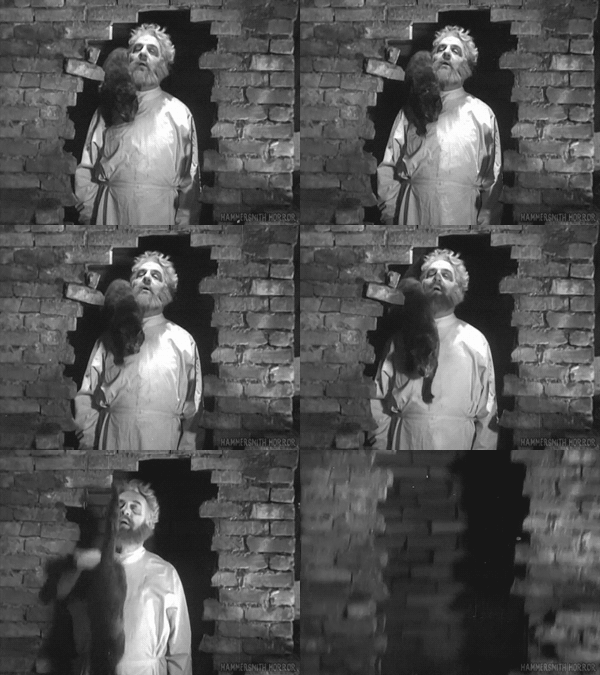
“A lot of these films, though, are so bad they’re good—or at least they’re funny.” (213) For example, Maniac by Dwain Esper is so bad it’s hilarious. It is supposed to be scary and warn people about mental illnesses, but the acting, script, and directing is so horribly done it turns itself into a whole comedy. Maniac is loosely based on none other than Edgar Allen Poe’s “The Black Cat.” This one, however, focused more on this psycho who kills the mad scientist that tries reanimation. It ties in other aspects from Poe’s short story, like the black cat and the focus on the eye and the progression of insanity.
Esper was not the only one who thought Poe’s story was worthy of a horror film. Edgar Ulmer directed The Black Cat in 1934, the same year that Esper’s Maniac came out. The plot of The Black Cat is simple yet done so well that it seems like a huge elaborate scheme. American honeymooners in Hungary get into an accident and end up trapped in the home of a Satan-worshiping priest. The bride is taken there for medical help because of the accident and things just spiral out of control when faced with a satanic cult leader.

Both directors based their films off of Poe’s story, which was really neat to learn, because both films are very different. Maniac focuses a lot more on the mad scientist aspect, with its dead body reanimation; however, the acting is just so bad that you can’t take it as a horror film. Disclaimer, it is only the 1930s, acting can’t be that good, film is relatively new and perfecting it is going to take decades of trial and error. The Black Cat is such a different horror film and easily a classic. Ulmer and Esper are clearly two very different directors, taking the same story and creating two completely different films. Ulmer’s style of directing made his film scarier. Personally, I was not afraid, but it seemed less like comedic relief and more of a drama. So, in choosing between the two The Black Cat would be my choice for a staple in the history of horror.
The agony portrayed in the film is intensely layered on to the point where it is not a real scare, but gives a more dramatic effect, leaving the audience on the edge of their seat, rather than cowered down. However, the film progresses like a nightmare. The audience is living through this nightmare that is bizarre and will ultimately be forever printed in their mind, leading to the audiences to never forget the experience.

Freaks, the 1932 film directed by Tod Browning is set in a circus. The leader of the side-show performers is planning to marry one of the trapeze artists. However, his friends discovered that she is only into him for the money. Hans still marries Cleopatra. After all, who cannot fall for Cleopatra, the most beautiful trapeze artist? Cleopatra is ultimately the monster of them all, an interesting twist being as she was surrounded by people society dictated as “freaks.” Freaks initially failed in the box office because of its “sympathetic” nature towards side-show characters rather than an exploitative one. This film is a metaphor for classism, and shows the clear lines drawn in society by class. The topic is hard to talk about and showing and criticizing it is rather taboo. Freaks was ahead of its time and by the late 20th century was reevaluated. Freaks has become more popular in the 21st century. The concept of the “freak show” has long since been repeated and reproduced, but its portrayal here is one of the first great and terrifying moments, some of which are still classified as the scariest in horror history. Browning chose to humanize the deformed in this film, rather than demonizing them like most would have, something the masses didn’t get behind until looking back on it. Freaks has led to several new uses of the trope of a freak show. American Horror Story had an entire season dedicated to “freak” in its season four titled “Freak Show.” The show was initially inspired by Browning’s Freaks and Herk Harvey’s Carnival of Souls. Both of these cult horror films came together and were able to form yet another staple in modern horror.
The retrospective effect is important when understanding cult. More often than not cult films become more popular after they have been released, the same can be said for a lot of cult horror films. However, ironically, in recent years films that once tanked in the box office are now mainstream. For example, Saw VI, a flop at the box office, ended up being the best film in the movie series. The Saw series was very mainstream, but the outlier, Saw VI, falls under cult classification. It flopped at the box office, it has a dedicated fan base albeit one for the franchise, it is transgressive, and its quotable. Saw VI is a modern day cult film. It tests our ability with gorish games of hell that make people question their humanity. This film ended up categorized as one of the best films of the franchise because of its intense “B story-line” and psychological warfare.

“The phrase cult horror film has come to mean ‘bad horror film,’ and that’s a bit unfair—but only a bit. The truth is that, yes, most movies that are called cult horror films are bad,” (212). However, the films are not entirely to blame, usually the stacks are set against them. They have: “minimal budgets,” “are poorly written and directed,” “production values are near zero,” and “the acting is appalling” (213). Despite all of that, the films are still loved and cherished by their fan bases. If no one liked the films then they would just be forgotten. These cult horror films attract a certain type of audience, but that audience is more dedicated and in love with these films than most of mainstream media is with the major production films. My favorite films are coming out of this mix of obscure taboo groups. Once you love them, you love them forever, the next best thing does not and cannot replace them. Cult horror films are totally insane and are such a massive variety that you can find just about anything to satisfy your need. These films like to break down society’s standards, and do not care about the backlash. They are original and underappreciated by mainstream media.
The last thing I want to say on the matter is take the leap. Instead of saying “horror isn’t for me I’ll never watch this,” watch the film. If you do not know where to start, take any of the films I’ve written about and watch it, then watch it again. You get so much more out of a second watch. The nuances you missed, the little shifts in the background, the outfit changes, and so much more. You appreciate and understand them better after a second screening. These films are not for everyone, but even if you do not become a horror fan after watching them, you understand and appreciate the learning curve of film. Every film cannot be your favorite film. But every film is an experience that you can learn from and take into your next experience. Even if you do not like Maniac, because of its really bad acting, you learn you like the mad scientist idea and then you go watch Dr. Jekyll and Mr. Hyde and fall in love with that story, or there is the classic that is Frankenstein. Your possibilities are endless. At the very least you might get a good scare.
“If I cannot inspire love, I will cause fear.”

Sources
Everman, Welch. “What is a cult horror film?” The Cult Film Reader, edited by Ernest Mathijs and Xavier Mendik, Open University Press, 2008, pp. 212-213.
Shelley, Mary Wollstonecraft. Frankenstein. Ed. Patrick Nobes. Oxford: Oxford UP, 2008. Print.
 Cult Movies