BY SARAH BATY
“Exploitation has never “gone away” so much as it’s experienced its own ebb and flow periods of mainstream cultural relevance,” writes film critic Dominick Suzanne-Mayer in his blog titled What Does a Modern Exploitation Movie Even Look Like Anymore? A look at how the subgenre can evolve (if it even can) in a more considerate film era. Exploitation films have evolved over the years and with the rise of directors and writers such as Quentin Tarantino and Robert Rodriguez, a new generation of Hollywood filmmakers has come to be. Filmmakers who looked at the films not as disposable entertainment fare, but as cultural touchstones. The films have all the same qualities as your average exploitation film; however, they are now considered art. Now these films can win awards or cross the nine-figure mark in the box office and we can hold college classes about the legacy of exploitation and its place in modern society.
wow, I wonder what that class would look like

The film industry is still very much so a male dominant field; however, women in the industry today are becoming more and more common, creating films that are a must see. A woman who became a major icon in exploitation films was Stephanie Rothman, an American film director, producer, and screenwriter, known for her low-budget independent exploitation films made in the 1960’s and 1970’s. Even though Rothman never made the transition to mainstream media as most of her male counterparts accomplished, she goes down in history as a game changer by creating exploitation films with women characters who challenged the way they were traditionally portrayed. With films such as, The Student Nurses, Rothman trailblazed a path for herself, and for other women, in the industry for years to come.

Rothman, born November 9, 1936 in Paterson, New Jersey and raised in Los Angeles, California, studied sociology at the University of Berkeley.

When she was 21 she watched The Seventh Seal (1957), a Swedish historical fantasy film telling the journey of a medieval knight and a game of chess he plays with the personification of death who has come to take his life. I have never in my life heard a film synopsis that sounded so intriguing. Rothman will refer to this movie as what kick started her desire to become a filmmaker, even though she hadn’t a clue how she would accomplish that.

She also went and studied filmmaking at the University of Southern California where she was mentored by the chairman of the cinema department. After graduating she received the Directors Guild of America fellowship, which is awarded annually to the director of a student film. This was the first time the fellowship had been awarded to a woman. This award combined with her academic qualifications, gained her a job offer from Roger Corman in 1964 as his assistant. Corman is an American director, producer, and actor. He has been called “The Pope of Pop Cinema” and is known as a trailblazer in the world of independent film. It was rare finding a job in the film industry without family connections and it was even rarer for a woman to find one. Corman believed in Rothman and her abilities; therefore, she always tried to do her best work for him. Corman eventually gave her her first full directing job, It’s a Bikini World, a musical comedy film released in 1967 featuring many famous musical groups such as, The Gentry’s, The Castaways, and The Toys. Following a pro-feminist plot line it is the only film in the beach party drama to be directed by a woman!!

After the film Rothman felt depressed and started having ambivalent feelings about her future as a director. She took a few years off until the urge to create films became too strong and she returned to filmmaking on Corman’s comedy Gas-s-s-s, as a production associate. In 1970, Corman established his new production and distribution company, New World Pictures. He hired Rothman to write and direct its second film, The Student Nurses.

The Student Nurses involved a friendship between four young nurses from different backgrounds whose sexual, professional, and political adventures made up the episodic narrative. Phred, Priscilla, Sharon, and Lynn all share a house together as they study to be nurses. Phred falls for a doctor after accidentally sleeping with his roommate and free-spirited Priscilla gets pregnant by a drug selling biker who leaves her, causing her to seek an abortion. Sharon forms a relationship with a terminally ill patient and Lynn sets up a free clinic with a Hispanic revolutionary. Priscilla’s request for an abortion is turned down by the hospital so Jim performs an illegal one in the girls’s house. Phred becomes furious with them both and ends up breaking it off with Jim. In the end she remains friends with Priscilla. Sharon’s lover/patient dies and she took it hard. This prompts her to join the Army Nurse Corps and serve in Vietnam. Lynn’s lover is involved in a shootout with the police and goes on the run, she decides to go with him. The four friends graduate together and viola, we have a cult classic on our hands.
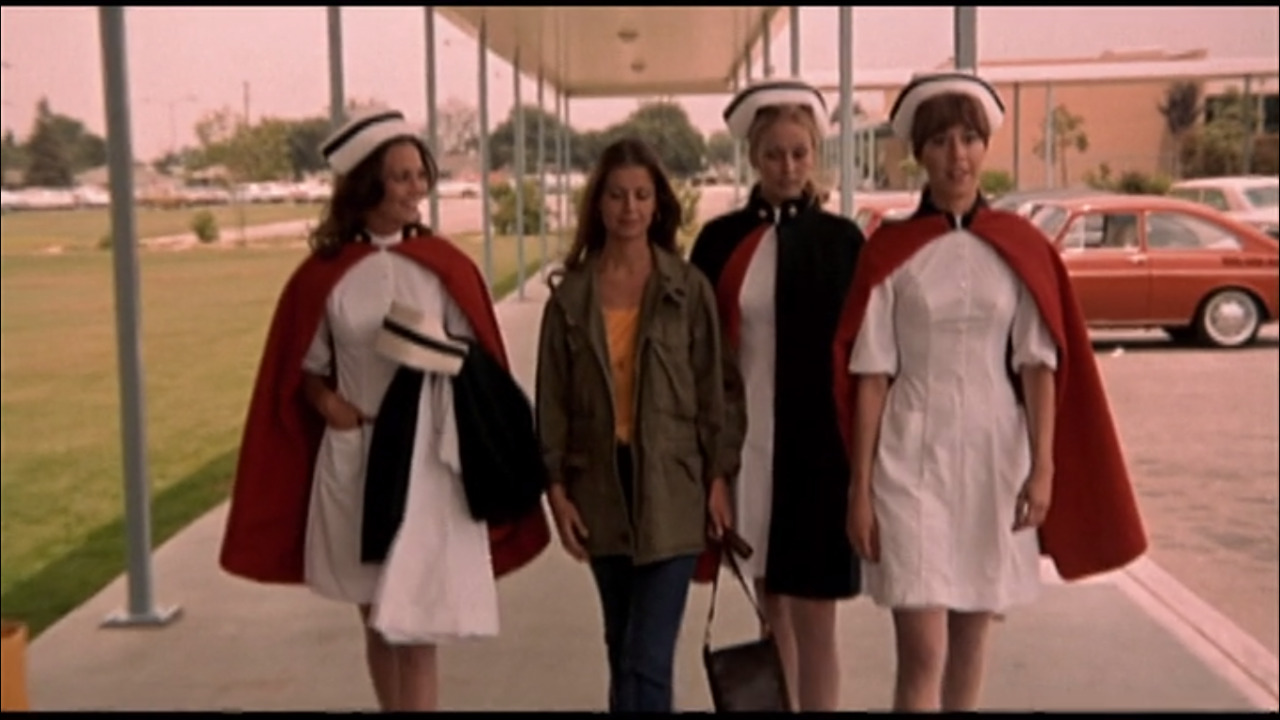
Rothman had creative freedom to do what she wanted with the film, as long as she still maintained the key points of an exploitation film: nudity, violence, graphic scenes, yada yada. Once she paid her debt to the requirement of the genre she was free to do as she pleased and was finally able to discuss issues that were being ignored in big-budget major studio films. For example, the topics discussed in this film included the economic problems of poor Mexican immigrants and a woman’s right to have a safe and legal abortion, in a time where abortion was still illegal in America. Always wondering why the mainstream media wasn’t discussing these controversial topics, she decided to tackle them herself. Never knowing when her time as a filmmaker would come to an end she never played it safe. She wanted to get what she had to say out there when she had the chance.

In our reading earlier this semester of Pam Cook’s Pleasures and Perils of Exploitation Films, Cook sings a high praise of Rothman and her films. Cook states how Rothman “took every opportunity to parody the basic principles of exploitation – in particular, the female body.” With casual sex scenes and a graphic abortion scene, Rothman doesn’t hold back when touching on the sophisticated discourse on 1970’s sexual politics, which is usually uncommon in exploitation films. Another unexpected scene was the drug-induced fantasy sequence with Priscilla, which I have learned was not fake! In Barbara Leigh’s (Priscilla) memoir, she discussed the scene stating how in the movie her lover gave her orange juice laced with acid. In real life her co-star put Sunshine Acid in her juice and she “was very stoned on camera.” Man oh man, what a time. Another instance involving Leigh was her audition. Rothman wanted her to expose her breasts to see if “they were actually worth photographing.” Rothman justified this by claiming that the reasons people want to see these films is because they delivered scenes that couldn’t be found in mainstream cinema. The struggle with these scenes was that Rothman wanted to justify the scenes by making them transgressive, but not repulsive. She tried to do this with the style in which she shot the scenes. I would say the way she shot the scene, and the other nudity scenes, was with main focus not really being about the nudity at all. Focusing on Priscilla’s scene specifically, she hallucinates a lot of different people watching her while she is having sex with weird biker man. The focus is on all the crazy hallucinations she’s experiencing. All- in-all, I believe Rothman completed her goal in making the nudity scenes transgressive, not repulsive.

Cook describes Rothman’s work as a prime example of feminist subversion from within. Rothman would use the generic “formulae of exploitation cinema in the interest of her own agenda as a woman director.” As stated earlier, Rothman wasn’t afraid to speak her mind. I would say her fear was that she wouldn’t get to express all she wanted to say. Exploitation films were problematic for women in a number of ways. A large one being the graphic depiction of rape and sexual assault, commonly viewed as pandering to sadistic male fantasies and encouraging the ongoing problem of sexual abuse. The Student Nurses came at a time when there was a growing demand for more interesting women roles. Showing Phred having casual sex and being so in control of her sex life, wasn’t something that was portrayed. Priscilla’s illegal abortion, obviously a topic not commonly discussed in films, received a certain amount of backlash; however, depicting a woman taking charge of her body is an idea that is still important today. I believe Lynn’s realization is less discussed, but is still important and deserves to be brought up. She was made aware of a situation she had previously been blind to. How the Hispanic immigrants never went to hospitals for their injuries because they didn’t want to be deported. She recognized that they’re people just like the rest of us and they deserve to be helped. Rothman tore apart women stereotypes and restructured them in a refreshing manner.

“Such emotional complexity in exploitation films of the era was unheard of, and the carefree attitudes towards sex and frankness about terminating a pregnancy are often hard to find in contemporary film of any sort today,” states Violet Lucca in her blog on The Film Comment, titled The Student Nurses and Exploitation. Rothman wrote the women in The Student Nurses with such detail and each of their storylines are portrayed with such growth it is hard not to adore it. Each woman, through their vastly different experiences, find their way and then come together in the end to share what could be their last experience together. Back to Cook, she recalls an interview in which Rothman remarked, “The Student Nurses, was a big success. The male buddy films were out. There was a correct hue and cry about the fact that there were no more roles by women for women.” The film has all four women going through their own problems, sometimes helping each other out along the way and then coming together in the end for one final hoorah. This portrayal was what women had been waiting for, and Rothman delivered. Through her efforts to push her feminist agenda in her films, she gave women a new place in film and showed how women do have a place in the film industry and they won’t be silenced.

WORKS CITED
Jenkins, Henry. “Exploiting Feminism: An Interview with Stephanie Rothman (Part Two).” Confessions of an ACA- Fan, Henry Jenkins, 17 Oct. 2007, henryjenkins.org/blog/2007/10/exploiting_feminism_an_intervi.html.
Leigh, Barbara, and Marshall Terrill. The King, McQueen, and the Love Machine: My Secret Hollywood Life with Elvis Presley, Steve McQueen, and James Aubrey. Xlibris Corp., 2001.
Lucca, Violet. “The Student Nurses + Exploitation.” Film Comment, 10 Mar. 2016, http://www.filmcomment.com/blog/the-student-nurses/.
Pam Cook Reading- Chapter 4, The Pleasures and Perils of Exploitation Films
Suzanne-Mayer, Dominick. “What Does a Modern Exploitation Movie Even Look Like Anymore?” Consequence of Sound, 2 Mar. 2018, consequenceofsound.net/2018/03/what-does-a-modern-exploitation-movie-even-look-like-anymore/.
 Cult Movies