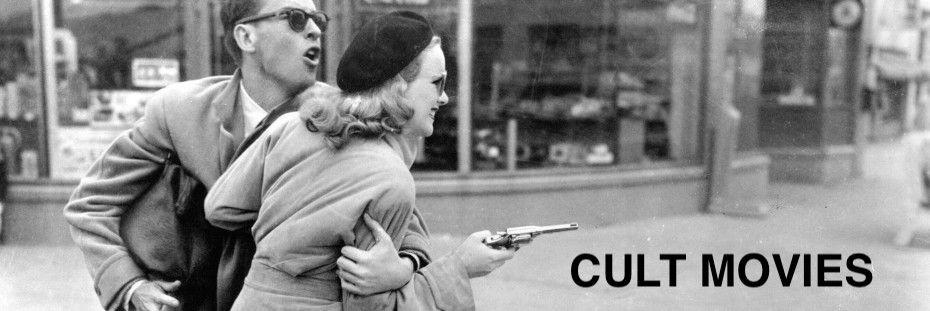
Cult films, like all films, are products of their environment and era. Given that a similarity shared with many cult films is the low budget creation or payoff, there is a quality of makeshift that’s ernesty has often attracted it’s following moreso than the marketing ploys of corporate film companies. These films achieve a status of cult authority because of their ability to communicate with, often culturally undermined, audiences. The intention of the film may not even be the reason for which it achieved it’s cult glory, as thus it is everything that happens after the film that determines its worth to the audience and contribution to film history. I took an interest in the presentation of films in the form of movie posters, and how this art form interacts with films that have been reappropriated. I found it fitting to contribute to, as John Fiske calls it, the economy of fandom by creating posters that capture the essence of the film’s true impact.
The graphics of film have always relied on the discoveries of what is appealing to the eyes as to make it sellable. This resulted in a visual timeline of the evolution of graphic imagery and typography in the form of title posters. Title posters serve a number of purposes. Besides being an introduction to the film and the main players that brought it to screen, they nurture audiences’ expectations, evoke the film’s overall mood and set up the story. Film adverts are, indeed, the initial impression an audience will have of a film. As the movie industry began to grow, studios realized the marketing value of creating colourful artwork that depicted scenes from their movies to promote the films and bring in more viewers. These posters were printed on inexpensive paper and not meant to be collected or preserved. From the mid 1920’s through the 1940’s, movie studios developed their own artwork styles for their movie posters and hired well-known artists and illustrators. The increasing public preference in the early days of Hollywood for colour photographic quality prompted Columbia Pictures to pioneer the “fake colour” process which colourized black and white still photos. It was not long before every studio adopted this process. As the industry began to grow, the processes developed and became more modern and experimental. The era in which I found particular interest was the graphic, vibrant hues and typographies of the 60s and how these stylistic posters came to characterize an era of film explosion and inspire artists to this day.

Works of Saul Bass
I was greatly inspired by an artist that emerged from this time period and created through one of the most productive periods of film history. Saul Bass, during his 40-year career, worked for some of Hollywood’s greatest filmmakers, including Alfred Hitchcock, Stanley Kubrick, Otto Preminger, Billy Wilder, and Martin Scorsese. Bass stepped up the sophistication of movie posters with his distinctive minimal style, stark colors, and distinctive iconic imagery; he then completely revolutionized the purpose of film title sequences. His work went beyond gimmick and advert ploys to intellectual works. Fiske stated, “Fans, like buffs, are often avid collectors, and the cultural collection is a point where cultural and economic capital come together.” While his posters were only an introduction to his role in animation and graphic design, they are an integral service to fan collections, thus furthering their interactions with films.
As an artist myself, I am constantly attentive to the interaction with the viewer. Cult films are unique in the fact that they are defined equally by the intention of the work and culture created around it. Movie posters are a visual introduction to the film, and in making them myself I can connect to the economy surrounding the films by giving to the culture and having it received by others. Also I value historical reference in my work, and giving homage to the luminary works that inspired and created the visual art world I’ve entered into. These posters are inspired by direct references of art created for popular films, reappropriated by a fan to celebrate formative cult films that have influenced me this semester. I feel as though it serviced my own exploration of art to make these, and I hope it benefits some other fan out there to see it.

This poster is in homage to the grainy, 1970s punk posters that pictured primarily scanned images that are bleached with contrast as they were continuously reprinted. It is in reference to the Otto Preminger film The Cardinal (1963) film poster designed by Saul Bass as well as The Wicker Man (1973) designed by Sid Ambrose. The layering of fake coloured images, bold typeface, and distinctive dark red is influenced by the modernist art styles that compliments and contrasts the styles and narrative of the film itself.

This poster is inspired by the fandom surrounding band posters, particularly KISS posters which is arguably a cult band. The orange-to-red color face is also reminiscent of The Wicker Man (1973) as well of the graphics of the band. It is directly inspired by Saul Bass’ poster for Rocky (1976) that has been utilized by many theatres, including the Alamo Drafthouse, as the film hadn’t many adverts due to it being an extremely low-budget film. The poster is meant to illustrate the minimalist, silhouette technique that became popular in the 60s, as well as giving distinguishable characters to the teens in the film.

This was simply one of the favorite posters to make, as it was abstract in nature as the film. It is inspired by the magical realism qualities of the Czech film, and the incorporation of iconography from recent female horror films such as Carrie (1976), the VVitch (2015), and Midsommar (2019). It’s layout is lightly inspired by Saul Bass’ Carmen Jones (1954) that was Bass’ breakthrough into the film poster world. I loved making something that embodied soft, feminine imagery that compliments the slightly disturbing; it’s one of the reasons I find female centric horror to be so refreshing.

Lastly, I made somewhat of a fan service to myself. I enjoyed presenting an argument on the defense of Jennifer’s Body as a cult film this semester, and for those who might recall I gave great emphasis to the initial failure of the film being primarily due to it being misrepresented in advertisement. I took the opportunity to create a poster directly inspired by the advert for Village of the Damned (1960), a film in which an entire town of women give birth to evil children, to illustrate a mod, kitsch representation of a 21st century modern film about a woman embodying evil. I found the gaudy style to fit with the dark-comedic genre of Diablo Cody’s movie. Personally I felt it gave more justice to the substance of the film than objectifying shots of Megan Fox, and immortalizes her image in a more classic, hollywood nature than for the service of male-fantasy.
Sources
https://www.artofthetitle.com/designer/saul-bass/
https://www.canva.com/learn/film-titles/
http://paas.org.pl/wp-content/uploads/2014/07/Fiske.pdf
 Cult Movies
Mary, this is so cool. Like, oozing coolness. Your discussion of how movie posters impact viewers rings true, I really like when studios release multiple poster designs for one movie. You can totally see the essence of the posters you used as references, but your designs are still uniquely yours. These are really awesome, I think Jennifer’s Body is my favorite.
LikeLike