Author Archives: jaylincard

Mega Misconceptions

Mega Misconceptions

The phrase “instant cult classic” was one I’d heard tossed around so often, flashing across the screen alongside a handful of new movie reviews, that the words never held any real value – it was to my uneducated mind the equivalent of seeing a “New York Times Bestseller” sticker on the cover of any (and every) book on the shelf. Before taking this class, I couldn’t even begin to understand the concept of cult or its value in cinematic history, let alone the impact that these films have left on the minds and in the hearts of their most dedicated followers. And, now having taken it, I’m saddened by the lack of recognition that there seems to be for cult as a genre in general among non-scholars and casual moviegoers.

A film doesn’t have to be loved or even known widely in order to be considered cult; but it is loved deeply, by a collection of loyal fans to whom it speaks on a personal level, through the use of a combination of transgression, controversy, badness (that really makes it good), and a certain countercultural ideology that captivates audiences outside of the mainstream.
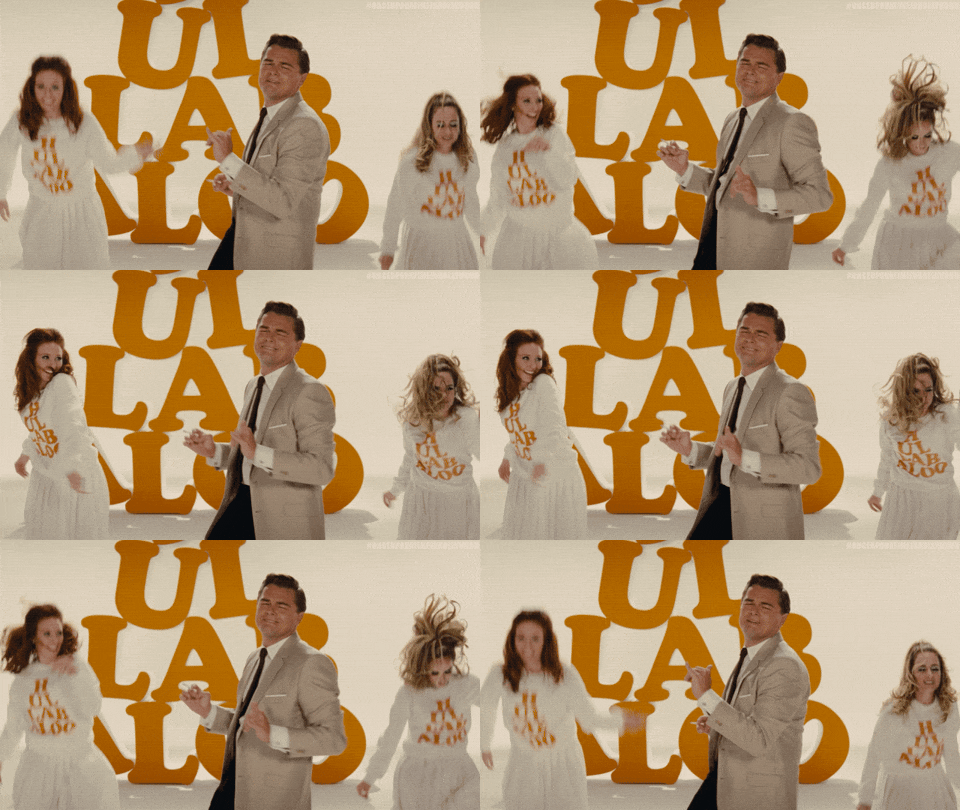

 "a film about the interplay between fantasy and reality, memory, mythology, masculinity, violence. It’s about fiction and film as redemptive, transformative, and just, and pop culture as a force that brings people together. It’s make-believe, and it’s memoir. Once Upon a Time…In Hollywood is Quentin Tarantino’s second draft of history." - Priscilla Page

Quentin Tarantino’s Once Upon A Time in Hollywood was an amazing film to end our semester with; not only because the movie itself is a masterpiece, but because it’s one of the rare examples of how a film today can successfully achieve true cult status. It embodies everything that Hollywood was during the time period, and its intense ending really leaves a lasting impression.

One thing that really struck me about the film was the depth to which Tarantino truly valued and put into the recreation of 1960s Hollywood nostalgia. This week’s round table reading discusses how much a viewer needs to already know before walking into see this film in order to get the most out of it, and I feel that even for those of us who don’t have an “emotional stake” in the film, having not lived during any part of this era, the atmosphere is so perfectly recreated through the use of clothing, billboards, music on the radio, etc, that we’re able to experience our own kind of nostalgia. There’s a certain shared cultural knowledge amongst those who were young during the time when this movie is set that definitely will enhance the viewing for them, but the story of Sharon Tate and the Manson family is one that most people are familiar with; I don’t think that not having the experience of being alive in the late 1960s leaves viewers missing out – it just allows for more than one type of nostalgia.

Tarantino has described his film as a “love letter to Los Angeles,” but Page describes it more specifically as “a love letter to those who make movies, the people on screen and the people behind the scenes, not only the stars, but the people who’ve been forgotten, fading in our collective memory, or the people we never knew or never saw at all.” I thought that this was a beautiful way to describe the film, and it really sums up the different journeys that we see our main characters embark upon. All in different levels of the Hollywood hierarchy, there’s a complexity in their stories with none ultimately being more valid than the other. It’s a reminder of mortality and the reality that there’s in the spotlight, out of it, and a million different levels in between.

My favorite quote from this reading was: “Cinema not only has the power to reframe myth, but to rewrite history: it brings back Sharon Tate. Manson longed for fame, and the film denies him this. The film doesn’t deliver its revenge exclusively via violence. It demythologizes Charles Manson, reduces him to a cameo, exposes the Manson Family as inept, and makes Sharon Tate the story’s beating heart. It gives Sharon a cinematic legacy that transcends her murder.” The ending of this movie was so powerful that it’s hard to put into words the sort of emotion it evokes. As brutal and unsettling as it may be to watch, the ending serves to bring a certain sort of justice to the Manson family murder case by taking its legacy and the horror that Manson so desperately wanted remembered and essentially writing him out of the story, while also preserving the memory of Sharon Tate and all of the lives lost. Tarantino rewrites history in a way that honor’s Sharon Tate’s legacy, honors this era of Hollywood and everything that it stood for, and ultimately reinforces this idea of the importance of redemption and preservation.


I honestly came into Cult Movies wondering whether or not I’d be able to hold up under the pressure of an upper-level film course. This semester has been an experience that I’m glad to have had because not only has it taught me about cult film, something I never would have understood otherwise, but it’s also challenged me as both a scholar and film novice.

There were so many good screenings this semester that it’s hard to choose just one to call my favorite. I connected the most with the later films and their nostalgic atmosphere, so I would probably have to say that Dazed and Confused was one that really stuck, and a film that I know I’ll be watching again; however, Matinee was a close second. And, surprising to even myself, Blacula was one of the earlier films that I enjoyed the most, simply because I admired the dignity and professionalism that William Marshall was able to bring to the role.

(Also, let it be noted that I also loved The Warriors but I felt that I was already pushing it with three favorite films, and four was just overkill - footnotes don't count.)

As far as least favorite screenings go, I wasn’t a huge fan of Pink Flamingos in the moment, when I was actually watching these things happen on the screen, but I now recognize just how crucial it is within the study of cult, and having been exposed to the film has given me an appreciation for John Waters that I never expected to have. Detroit Rock City was another film that I didn’t particularly connect with, but I felt was used to really strengthen the understanding of the links between music and cult films.

The syllabus this semester was incredible; the entire course was incredible. There were times I went into screenings wondering what the hell I was watching this film for, but there’s not a single film this semester that didn’t contribute towards my understanding of, well, why the hell I was watching it. The one disappointment I had with the syllabus was that it didn’t include Rocky Horror, which I was definitely expecting to see, but I don’t feel like there’s anything that needs to be changed. As someone with very limited knowledge when it comes to film, this course was designed in a way that really did make it possible for me to learn, not just go through the motions as I originally feared, and that’s what has made it such a positive and impactful experience.

Jaylin’s Final Project

The Death of Cult - The Beginning of Modern Cinema

Cult is a genre of film grounded in all things transgressive and taboo, most often marked by passionate, dedicated fanbases, box office failure, controversy, camp, and -perhaps most importantly- exclusion from mainstream cinema. Originally coined as sort of an umbrella term to describe the culture surrounding underground and midnight movies, cult soon evolved into a medium entirely its own, with the most successful of the genre’s films being labeled as “cult classics.” The foundation of cult film was built on the desire to rebel against the mainstream and to represent a counterculture that was rejected by societal standards. And yet, as American culture has evolved, most of the defining elements of cult film have been absorbed and integrated into mainstream cinema, making it nearly impossible for anything produced today to be recognized as true cult.

The earliest form of cult cinema, the exploitation film, is argued to have been around since nearly the beginning of cinematic history. While some of these films were produced as early as the 1920s, it wasn’t until the 1960s and 70s that the genre truly became popularized. With traditionally lower budgets and lesser-known actors, many of these productions were dubbed “B movies” and were generally intended for less distribution than the major studio productions; however, the terms “B movie” and “exploitation film” aren’t quite interchangeable. B movies were still meant to be consumed by the mainstream, and accepted with their counterparts, the A-film to their double feature. Exploitation films relied on success through the exploitation of controversial subject matter; sex, drugs, violence, gore, nudity, etc. Popularized during an era of sexual oppression and high moralistic values, exploitation films provided exactly the thrill and/or release that many people were searching for, by playing into natural, human curiosity and desire. The Hays Code, adopted in 1930, and more strictly enforced as time went on, presented regulations that prevented seedier exploitation films from being shown in most major theaters in an attempt to “keep Hollywood clean.” Although it was meant to end exploitation in film, the Hays Code, and the accompanying denial it presented the public with, fueled the need for exploitation in film. And while these films weren’t allowed to premier in major theaters, there were plenty of “grindhouse” theaters on the exploitation circuit which allowed for publicity. As exploitation continued to thrive, it became the building blocks for the cultist cinematic movements emerging in the latter half of the 20th century.

What’s the difference between B movies and Exploitation Films?: a video that I found helpful in explaining the difference between the easily-confusable terms.


One of the most influential of these cinematic movements, known as the “midnight movie” movement, has had a monumental impact on cinema as we know it today. It’s agreed amongst most scholars that the midnight movie movement began in the late 1960s, as underground and avant-garde theaters started programming risqué and exploitative materials. The term “midnight movie” is most traditionally associated with New York City; despite the fact that the movement was worldwide and thrived in certain areas of both North America and Europe, it’s the NYC midnight movie scene that has been studied most extensively. There’s debate about which film was truly the first “midnight movie”; generally, Alejandro Jodorowsky’s 1970 acid-Western, El Topo, is recognized as the spark behind the midnight movie phenomenon. Midnight movies were, in the simplest sense, movies that were screened at midnight. There was no advertisement for these films, save a minuscule line on the bottom of a theater ad, simply stating that the film would be screened at midnight; all other advertisement was strictly word of mouth, and yet the theaters were completely sold-out with many movie-goes returning for multiple showings. One of the biggest draws to midnight movies was the fact that the mainstream hated them; they were against everything that these films stood for. Mark Betz describes the shift to midnight movies as:

“[when] “kinky” foreign art films and American underground films came together, near the end of the 1960s, in an exploitation/art circuit that emphasized the countercultural potential of cinema.”

A counter culture is essentially a culture that rejects the ideas valued by another culture; in the case of the midnight movie, this was a rejection of mainstream societal values and standards. However, as the 1970s progressed, the countercultural movement began to lose momentum. Midnight movies became even more outrageous than ever before, but as their popularity increased the counterculture ideology that marked the movement was replaced by what Mathijs and Sexton deem, “generic and aesthetic radicalism.” Art house and B-movie distributors became more engaged in the midnight movie, and the original films were replaced by a string of new sub-genres that included lesbian vampire movies, porn chic, blaxploitation movies, and foreign philosophical allegories.

Easily the most notorious among this new batch of films was John Waters’ 1972 exploitation comedy, Pink Flamingos. Every aspect of the film oozes transgression, even by today’s standards, with Waters’ goal being to push against every boundary he could – something he did successfully; he didn’t just push boundaries, but rather obliterated them completely. Waters himself has described the film as, “a terrorist act against the tyranny of good taste,” and it’s this approach of directly challenging “good taste” through utter revulsion that made his film such a hit.

Fun fact: John Waters has been quoted with, "I made bad taste one percent more respectable, and that was what I was put on this earth to do." This is, in my opinion, an incredibly important quotation when considering the shift from midnight moves to mainstream cinema; not only did Waters make bad taste more respectable, but he made it more desirable, and in doing so has used this aversion to good taste in order to breach the gap between cult and mainstream cinema, ultimately helping to normalize certain taboo elements and desensitize today's audiences against it.

By the late 1970s, the midnight movie had become so popular that it was actually considered “a staple of alternative cinema exhibition.” As more people began to partake in these midnight screenings, they quickly became recognized as cult. Many of said screenings were accompanied by their own rituals and celebrations; especially the “campy rock musicals,” such as Rocky Horror Picture Show. These films became as much performances of cult, as they were cult themselves. Everything about these midnight movies revolved not only around the rejection of traditionalism, but the sense of community and the experience that came along with the almost exclusive screenings. However, just as the midnight movie phenomenon was incredibly influential, it was equally short-lived. After the 1970s, midnight movies began to quickly die out. The invention of the VCR had a huge impact on how movies were received. People no longer had to go to a theater to see these films; they could still do all of the same things that they’d do at a midnight screening ( such as smoking pot and having sex) but now they were able to do these things from the comfort of their own homes. Not only could they stay home, but they could pause, rewind, and watch the films as much as they wanted. By the end of the decade many of the original midnight theaters had gone out of business, and filmmakers either went underground once more, or they began to gravitate towards the independent film scene. It was incredibly rare for new midnight movie cults to appear.

Not only did midnight movie cult become rare, but cult itself became rare. Midnight movies loosened everything up, and then the shift happened; the sensibilities of the American public were altered by the integration of transgressive, taboo, and radical elements into our films, our sense of humor, and our very identity. When it became possible to make big budget, big cult films, the mainstream shifted completely to encompass everything that it had been missing. These directors had communicated so particularly and so effectively to the audience that they’d found, and they demonstrated to generations of producers that success through these types of films was not only possible, but it was unparalleled. Even filmmakers who were involved with midnight movies became more mainstream themselves; only thirty years after the premiere of Pink Flamingos, John Waters produced Hairspray, a Broadway musical. The filmmakers themselves didn’t change, nor did their values and their humors, but rather it was the American public that changed as a collective.


Unlike many of the older, midnight movie filmmakers, the authors of “Cult Cinema: An Introduction” would disagree with the idea that the midnight movies have died. They say:

“As befits cult receptions, the midnight movie did not really die. Since the 1990s the demise of the original phenomenon was balanced by three other trends. First,new films found their ways into festivals, which increasingly included midnight showings as part of their programs. Second, midnight premieres also became a feature of blockbuster releases vying for cult status.Third, the midnight movie phenomenon went into meta-mode […] audiences at the New York Pioneer Theater, aware of the legacy of the midnight movie phenomenon, were not only continuing a tradition that had existed for more than thirty years,they also consciously knew they were contributing to the heritage of the phenomenon by keeping it alive, or honoring the tradition by paying lip service to it.”

I personally agree with men like John Waters, George Romero, and David Lynch; Hollywood embraced the values and ideas put forth by these cult films, and by doing so it caused the death of the midnight movie and ensured that cult was rendered almost extinct. Cult is about so much more than liking a movie; it’s about the experience – it crosses boundaries of time, custom, form, and good taste, it violates our sense of the reasonable; and this is exactly what appeals to the film cultist. We’re allowed to vicariously delve into dangerous territory, but when it’s all said and done we can fall back on our reality – a world of reason. Transgression in a film challenges our ideas of morality, it puts us into a world of “what ifs,” and it sheds light onto an aspect of human nature that isn’t deemed pretty enough to be reflected in mainstream cinema. The counterculture of cult has somehow lost its ability to counter, and has simply become our culture. It has become impossible for anything to be transgressive, because we’ve become desensitized to amorality; it has become impossible for anything to be ironic, because everything is ironic; and it has become impossible for anything to elicit that forbidden thrill that moviegoers once sought, because we no longer need to venture out of our world and into the world of “what ifs” because we’ve already been there, we’ve seen that, and we’re exposed to it from the time we’re old enough to comprehend cinema. The need for these midnight, cult movies has disappeared because we’re now so readily exposed to everything they could have ever offered us; and the real reason it’s so difficult to find a film that is true cult lies in the fact that it’s so hard to produce anything that hasn’t already been done, that hasn’t already spoken, or that really has anything important left to say.


The awesome documentary Dr. S introduced me to, in case anyone else is interested in learning more about the shift from the margin to the mainstream.


Sources:

“Cult Cinema: An Introduction.” Ernest Mathijs and Jamie Sexton. Cult Reception Contexts

Midnight Movies: From the Margin to the Mainstream (2005)

Don’t They Know It’s the End of the World?

Don't They Know It's the End of the World?


"Why does the sun go on shining?
Why does the sea rush to shore?
Don't they know it's the end of the world?
'Cause you don't love me anymore"


☢ ☢ ☢ ☢ ☢ ☢ ☢ ☢ ☢ ☢ ☢ ☢ ☢ ☢ ☢ ☢ ☢ ☢☢ ☢ ☢ ☢ ☢ ☢☢ ☢ ☢ ☢ ☢ ☢☢ ☢ ☢ ☢ ☢ ☢☢ ☢ ☢ ☢ ☢ ☢

This week’s screening, Matinee, was surprisingly light-hearted and cute despite being about communism and the Cuban Missile Crisis, and atomic annihilation – easily one of the most enjoyable cult films we watched this semester. I found myself drawn in from the moment it opened, with that nostalgic carnival-esque music and the old-timey, 1960’s vibe. If that wasn’t enough, cut to the black and white educational-type video, giving me major Fallout vibes, complete with atomic bomb talk. And then, later on, que actual music from Diamond City Radio, and you’ve pretty much sold me on the movie. All in all, Matinee was an easy film that evoked nostalgia in a lot of ways as it tried to re-create the experience of being a pre-teen in post WW2 America. I found the similarities between the film’s crisis and the crisis our country is currently facing eerily similiar, so props for syllabus placement because Matinee kind of left more of an impact in some ways, due to that connection.

I also really enjoyed this week’s reading, “Collective Screams: William Castle and the Gimmick Film”, simply because I never really even knew what gimmicks were until I saw the way they were utilized in Matinee and then read about how they’ve actually been implemented in other films we’ve seen this semester.

"Gimmicks attempt to reach out to the audience and incorporate them directly into the cinematic experience, to restore the real or imagined experience of the early cinema spectator."

I find the whole concept of Castle’s gimmicks to be really interesting, the idea of immersing your audience so fully into the film that they’ve given this crazy experience. I loved that Matinee paid homage to Castle and his inventive ideas. When you think about electrical impulses and vibrating seats, the gimmicks that we see in modern cinema kind of pale in comparison, to the point where they’re unrecognizable as gimmicks – or at least a lot less “hands on.” To be fair, it’s hard to produce something that’s truly original and captivating in a world where it seems like everything’s already been done a hundred times over. Still, it’s a little disappointing to think about how impersonal cinema has become today. While Castle’s gimmicks were used to bring in money, he was also an active participant and you get the sense that he did these things because he loved it and because he wanted his audience to have this insane experience, not just because he was looking to make a quick buck.

Just for fun, after looking a little more into gimmicks I found an article talking about one of Castle’s earliest gimmick’s, for his 1958 thriller, Macabre:

One of William Castle's earliest movie gimmicks was for a thriller called Macabre, in which a father has only five hours to find his kidnapped daughter, who has been buried alive. The film was so scary, Castle claimed, that he was required to offer audiences a $1,000 life insurance policy just in case they died of fright. Movie theaters had people in nurse's uniforms on standby, "just in case." The gimmick worked, and Macabre was a smash hit.

Never Trust A Junkie

Never Trust A Junkie

This week’s screening, Sid and Nancy, was a little harder to swallow than the rest. Addiction is such a complex, touchy subject. As prevalent as it is in our society, it still somehow remains a taboo in the sense that it’s not something we necessarily want to see, discuss, or be associated with. Everyone has their own opinions on addiction, on right and wrong, and I feel that we all see it through a different lens. The subject is a little closer to my heart than I care for, so be warned that it may alter the way I interpret the film.

"Sid and Nancy's relationship forever illustrates the worst part of being in love with anyone, which is that people in love can't be reasoned with." — Chuck Klosterman

I’d known the story of Sid Vicious and Nancy Spungen, but knowing something and seeing it in action are totally different. The toxicity of their co-dependent relationship is prevalent throughout the film, but there’s always a certain degree of toxicity that comes along with addiction; it’s to be expected. You don’t form an addiction to something without that crutch becoming a toxic presence in your life, starting a domino effect that can be nearly impossible to stop. While I don’t by any means think that their relationship should be glorified, I don’t think that its toxicity should invalidate the emotion behind it. Maybe the emotion was genuine, maybe it was fueled by a mutual desire for personal gain, but either way I feel that this representation of dysfunctional love was human. It wasn’t a heartwarming story of someone turning their life around, but rather something raw and real, a depiction of the reality that is so many people’s lives. Regardless of how you view the pair, there’s a devastating sort of beauty in their love, a desperation that draws you in – even though you know nothing good can come of it – and tugs at your heartstrings.

"Cult film viewers have often differentiated themselves from mainstream film viewers and, by extension, mainstream society as a whole via attachment to films expressive of such difference. Bruce Kawin has written of the cult film“as a deviant or radically different picture, embraced by a deviant audience”(1991: 18), while Jancovichet al. have argued that the cult film is formed through a “subcultural ideology” that places films and/or film-makers and/or audiences in opposition to the main-stream (2003a: 1)."

This week’s reading, “Cult Cinema and Drugs” shone some light on the connection between drugs and (you guessed it) cult cinema. I never realized that there was much of a link between the two, but after reading this chapter I understand that drugs can really appeal to a lot of people for a lot of reasons. Much like how music is used to try and connect with certain audiences, drugs are exploited in the same way, hence the development of different categories of drug films. As the chapter says, “[an awareness off] the generation gap and anti-institutional attitudes fed into a burgeoning counter-culture, in which drugs became a symbol of pride and subversion.” I never realized how many films actually go for this approach until I stepped back and looked at it, but I feel like it’s not a surprise that that this topic ties so well into cult cinema. When you consider the appeal of drugs, whether it be to those who use them or those who are curious, there really is a wide variety of subcultures, drug and otherwise, that can be reached through film. I also never really knew that there were movies out there made with the intention of drugs enhancing the experience of watching it, but that sounds about as cult as you can get. Rejecting societal norms, transgression, taboo, celebration to the highest degree – what more could you want?

All in all, this week was pretty enlightening and yet a real downer at the same time. I don’t think that I’ll be watching Sid and Nancy again any time soon, but the impact that it had and the message behind the movie is pretty profound and not likely to be forgotten any time soon.

and, just for feels fun, a look at an interview with the real Sid and Nancy.

The Devil’s Music

The Devil's Music

This week’s screening, Adam Rifkin’s 1999 “Detroit Rock City”, really introduced us to the power of music in cult cinema. While “Dazed and Confused” had a killer soundtrack, I felt that it played more on nostalgia than anything; it wasn’t directly affiliated with any one artist or group, but rather used a variety of music from the 1970s and 80s in order to recreate a nostalgic atmosphere. Here, we’re able to see the full force of musical influence not only on a film and its characters, but on the way it’s received by its audience.

ϟϟ ϟϟ ϟϟ

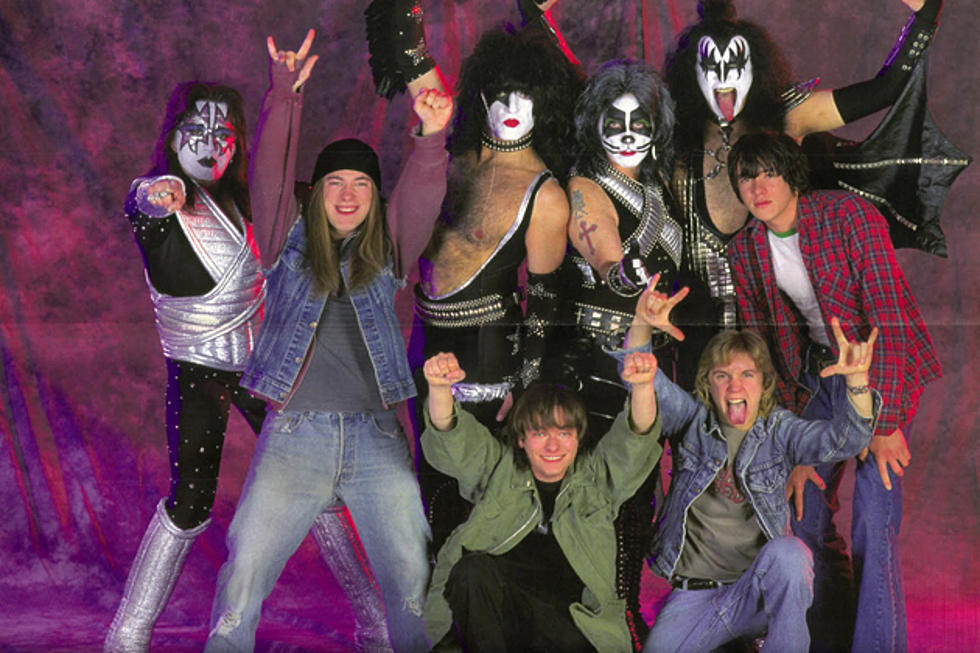
Detroit Rock City wasn’t my favorite screening, but it really helped me to understand the link between music and cult cinema. The whole film centers around the idea of these teenagers embarking on a journey to attend a Kiss concert, with the band’s music featured heavily throughout the film and the artists themselves making an eventual appearance at the end. It wasn’t a terrible movie, and I can understand why its developed such a cult following, but it didn’t evoke the same sort of nostalgia that last week’s screening did, and overall I found it harder to connect with. I feel like having been exposed to the film ultimately showed me both the power and the potential dangers of relying so heavily on music playing a key role in film.

This week’s reading, “Cult Cinema and Music” ties in really well with our screening. It discusses the fact that music and cinema often go hand in hand, but most don’t take into consideration the effect that music has on cult films. A lot of times it’s cross-media consumption that draws people into a film – artists might contribute to a soundtrack for a movie, or actually star in the film, and this both draws in and attempts to broaden their fan base. I feel like Detroit Rock City is undeniably a “rock movie” because music played a crucial role; it was the driving force behind the film, and because Kiss already enjoyed such a dedicated fan base this most likely attributed to the film’s eventual cult status.

a very dedicated fanbase

In addition, the podcast on “Detroit Rock City” from The Projection Booth gave us some insight on the film’s release and its reception. It discussed how a lot of Kiss fans were expecting to go into theaters to see a movie about Kiss, but in reality it was a movie that used the band and its music as a way to enhance the narrative; this ultimately might have contributed to the fact that the movie was a box-office flop. The podcast kind of expands upon the reading by showing us how cross-media consumption can be beneficial, but how it might also evoke certain expectations from fans that, when not met, can lead to failure.  (Which, in this film’s case, was only initial failure.)

Ultimately, “Detroit Rock City” did develop a strong fan base, which has led it to being recognized today as a cult film. Even though this movie does essentially revolve around Kiss, there’s so much more that goes into a cult film than just music; and I feel that it’s important to remember that while the exhibition of certain artists in film can be closely tied with cult cinema, ultimately cult cinema is most dependent on the concepts we’ve already learned it embodies. I feel that music really benefits cult film by reinforcing these concepts, not necessarily by creating them.

The Misfits of Nostalgia

The Misfits of Nostalgia

When 2020 has us like,
Matthew McConaughey comes through with words of wisdom.

"A sociology of nostalgia…is concerned with tracking down the sources of nostalgic experience in group life [...] commodified nostalgia involves the revival by the culture industry of certain fashions and styles of a particular
past era"

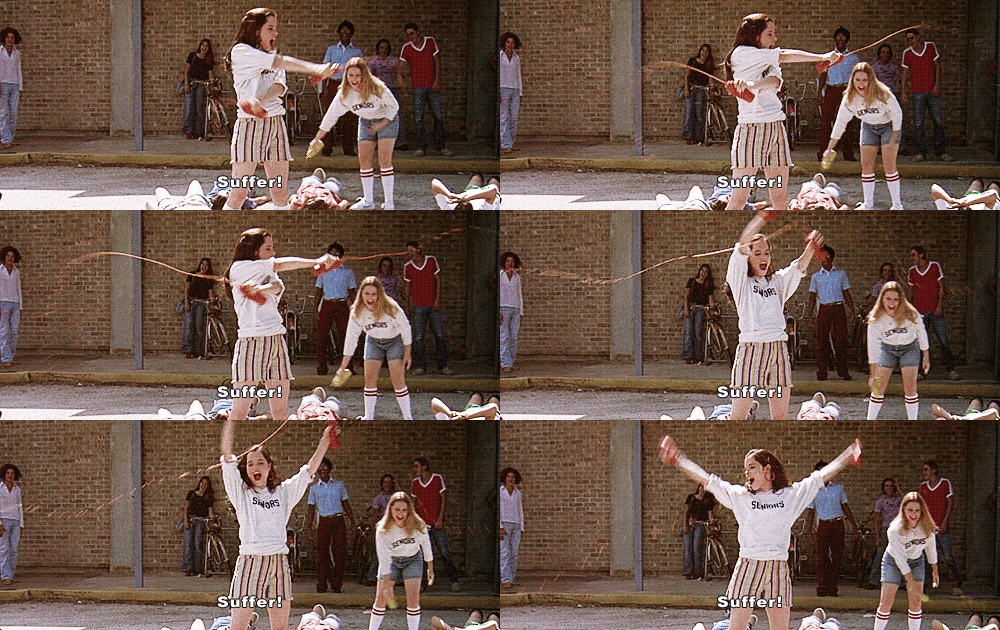
This week’s nostalgic screening, Dazed and Confused, was by far my favorite of the films we’ve watched in class and is probably now one of my favorite movies of all time. Everything about this movie is iconic – the clothing, the hairstyles, the language, the whole youthful and carefree atmosphere that surrounds these teenagers as they navigate life in the late 1970s. Davis defines nostalgia as an experience of group life which involves a revival of culture, and I think that Dazed and Confused is the embodiment of this concept. For me, the beauty of this film lies in its ability to somehow make me nostalgic for a time that I’ve never even know, by recreating this not-so-distant culture and presenting it in a way that allows me to fully engage with its ideas and values – by presenting it as a shared experience.

"… a new kind of engagement with the past, a relationship based fundamentally on its cultural mediation and textual reconfiguration in the present."

The funniest thing about the nostalgic feelings you get from this film is the fact that they’re evoked by watching a group of teenagers do a whole lot of nothing. Most of the film shows these different groups driving around, talking, getting into trouble in a way that is almost mundane and expected from the time period. It reminds you of what it’s like to be a highschooler, with no cares and nothing better to do than wasting your time goofing off with your friends. It feels like almost every scene in the film evokes some sort of connection, from driving around aimlessly with friends to the hell you have to go through in order to find your place in the social hierarchy. No one likes hazing, but we like the idea of it – we all feel that universal need to fit in, and I think that this movie really plays on that desire as we watch Mitch navigating the transition between junior high and high school. We’re presented with characters that are easy to connect with because of the fact that we can see ourselves reflected in them, and its through these connections we make that we’re able to get a sense of this time and its culture, and to really feel those feelings of nostalgia that these films are designed to create.

One final thing that I feel I have to address: the soundtrack. Holy shit. It’s the first thing to draw you in and it honestly never disappoints, continually driving the plot forward and supporting it in ways you didn’t even know it needed. In some ways, the music is one of the strongest aspects of this film – it’s sort of the background music that sets the tone for the whole film, and is really vital in conveying those nostalgic undertones that are meant to evoke a positive response from viewers.

Overall, I’d say that this film is alright alright alright. 😏

ps, one of the most relatable moments in all of cinematic history:

Suspiria and the Power of Setting

"If one adopts this definition of the term “expressionist” for Suspiria, it proves useful to analyse the peculiarities of cinematography and set design in German Expressionism and to demonstrate whether and to what extent these peculiarities are applicable to Argento’s film. By doing this, the present article seeks to discuss how colour and set design in Suspiria also function as projections of the characters’ bodily and mental states to such an extent as to determine both the development and the several nuances of the story itself."

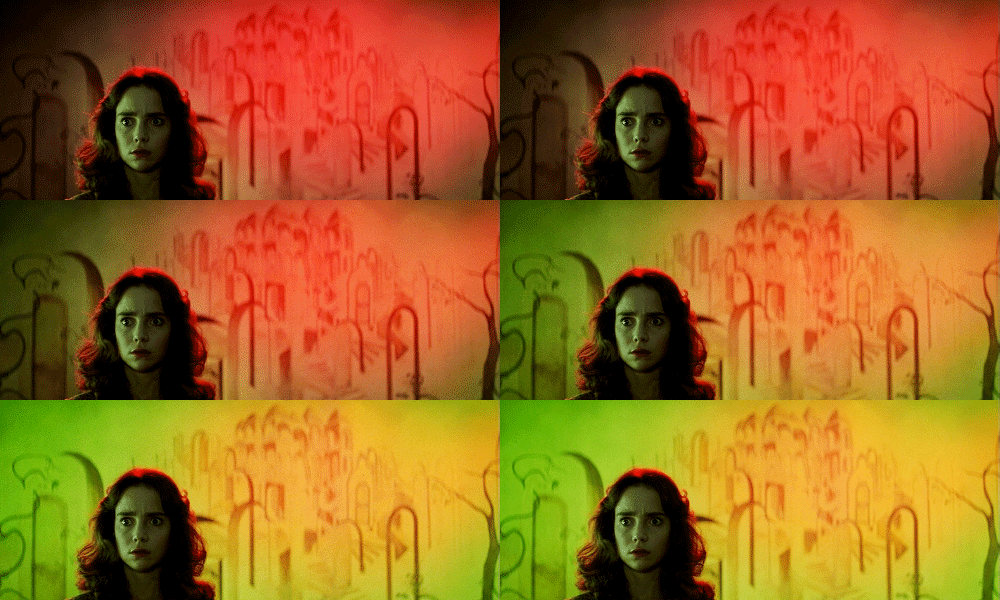
Without a doubt, the first thing that draws you into “Suspiria” is the color palette. The vibrancy of the colors that surround this movie is astounding. When you think of the horror genre, you don’t generally tend to picture bright any sort of brightness. You expect muted tones, dark and dreary hues that add to the suspenseful and unsettling ambiance of the film. Somehow Argento is able to take the use of primary color and turn death and horror into something beautiful to watch – this is the magic of Suspiria, and this technique makes it impossible to look away from the screen because no matter how gruesome the death, it’s always somehow shrouded by a veil of beauty. The concept of artistic horror is something that heightens the experience of this film, truly taking it beyond just another thriller and transforming it into a work of art.

Giusti divides the spaces in Suspiria by diving the color palette into three main categories: the magical, the daylight, and the monochrome.

"The first two categories are highlighted by the presence of a blue-red-yellow scale, sometimes alternated and sometimes all present in a single shot. While the magical spaces are the ones taking place at night, in which the supernatural is perceived by the medium of the IB stock, the daylight are the ones taking place during the day, although the presence of the supernatural is still evident. In this case, the co-existence of blue, red, and yellow is not identified by the IB stock, but by a diegetic use of colour palette through the architecture and the décor."

I found this article so interesting because it talks about how the setting and color palette aren’t simply there for aesthetics- they’re working on a whole other level, to reflect both bodily and mental states of being in the film. Argento himself has stated that the house where the story takes place is a living organism. The concept of both architecture and decor as being alive presents us with the idea of the building as a body of some kind, embodying the states of both body and mind that are based on bodily sensation. Thus, the environment as a whole is “endowed with bodily or organic characteristics.” I feel like this article is the one that spoke to me the most simply because I’m fascinated by the director’s approach and his desire to make the film work on so many levels. Nothing that is placed into this film is done so by accident. Everything works together to ensure that ultimately, the film is so much more than the sum of its parts. Having read this article, I look at “Suspiria” in an entirely new light and appreciate the complexity behind both the design and the vision.

"[The setting is] rendered through unrealistically distorted and exaggerated architectural shapes and through a series of curving, oblique, and rectilinear lines converging across an undefi ned expanse toward the background, for the expressionist purposes of reproducing the dreamlike atmosphere seen through the eyes of a madman20. As a result, these spaces achieve a dramatic status as they “do indeed seem to vibrate with an extraordinary spirituality”, creating the animation of the inorganic through bodily and mental projections."

Overall, I feel like “Suspiria” is worth the watch. I found it a little hard to follow, but I feel like it has to be approached the same way we found ourselves approaching Valerie – not for its cohesiveness, but for the experience we get by watching it. So unlike any other “horror” movie I’ve ever known, it’s an artistic medium all its own.

Valerie and Her Week of What the Hell Did I Just Watch

Valerie and Her Week of What the Hell Did I Just Watch

A polecat-faced vampire, named simply Polecat—campily aware of his own hideousness—arrives and does his best to reclaim the family seat. Valerie’s grandmother becomes a vampire herself,hoping to win back her former lover (a sinister Catholic priest). Thanks to her magic earrings, Valerie manages to slip from the priest's clutches when he tries to molest her, eludes her grandmother’s fangs, cures (by means of a tender lesbian tryst) another young woman who has been bitten, and survives a burning at the stake. There’s also a handsome young man named Eaglet who gets her out of several sticky situations, and whether he’s her brother or her boyfriend remains ambiguous.

“Valerie and Her Week of Wonders” is a film of heightened surrealism, with a dreamlike quality that captivates its audience through the use of vivid imagery and an absolutely haunting score. The film is as mesmerizing as it is disturbing, leaving its audience feeling a confused sort of enlightenment – glad for having experienced its one-of-a-kind charm, and yet unable to fully process (or even follow) the plot line. This unshakable feeling of incompleteness isn’t the result of a poorly made movie; rather, it’s a stylist choice employed by Jireš in order to leave the audience questioning the reality of what they’ve just witnessed.

"in Valerie, a fable whose general outline is familiar, the quick and often disorienting shifts are intended to shatter any reliable sense of what is real and to lend the folkloric proceedings a mad, impish tone."

The movie is said to be reminiscent of “Alice In Wonderland,” with Valerie’s descent into womanhood the equivalent of Alice’s descent down the rabbit hole. The vibrancy of the world around her, the loss of childhood innocence, the series of unbelievable events and narrow escapes – these all contribute to this idea of disorientation. The disorientation that we feel in “Valerie” is meant to mimic that of a hallucination, and the absurdity of the journey she embarks on plays into this idea at every turn. (See: every scene with vampire granny) This feeling intensifies throughout the story, creating a sense of urgency that underlies the young girl’s abrupt emergence into adulthood.

Overall: the plotline, questionable. We never really get any answers to our many questions. By the end of the movie we’re somehow even more confused than we were at the beginning, only now we’re questioning everything we thought we knew. Valerie’s familial ties drive the movie, and yet they’re ambiguous to the point of discomfort. (Seriously, is he her brother or her boyfriend? Or both?) The womanly awakening Valerie experiences is disturbing at best -cue half a dozen child molestation attempts- but overall, the word taboo pretty much sums up this movie perfectly. Everything in it goes against societal standards, pushing the boundaries not only between good and bad but between fantasy and reality.

The imagery, however, is beautiful. The contrast between sharp, vivid colors that jump out at you and the muted whites that make you feel as if you’re watching through a haze plays perfectly into the movie’s dreamlike state. The score is beautiful and haunting, strange and yet somehow innocent. “Valerie” is a movie about experience, not comprehension, and in that aspect it excels at every turn.

The Armies of the Night

The Armies of the Night

These are the Armies of the Night. They are 100,000 strong. They outnumber the cops five to one. They could run New York City.

The outrage and fear upon the film’s release described in this week’s reading on The Warrior‘s really helped me to understand the need for theaters that were willing to screen what others deemed controversial. Walter Hill’s 1979 cult classic, The Warriors, was initially met with negative reactions and branded an “inciteful film.” When you stop to think about the fact that today it has attained a massive cult following, you realize that that wouldn’t have been possible if not for theaters, like the Rialto, that were home to a sort of hodgepodge of people all searching for exactly what the mainstream cinemas tried to conceal.

I found this week’s reading about the Rialto interesting, particularly the descriptions of the types of people in attendance. The negative connotations that come to mind when we think of exploitation films make it easy to assume that that the audiences would somehow reflect the gritty themes that are typically explored in this genre. This week’s reading, “Horror at the Crossroads: Class, Gender, and Taste at the Rialto” reminds us that the people who sought out these movies were perfectly average. In fact, it paints 42nd street as a sort of safe-haven not just for an emerging gay subculture, but for anyone who was looking to explore life beyond societal norms.

"While some accounts present the Rialto as a “lurid place” and its audience as largely
working class, it clearly attracted many members of the middle classes, although the cinema was not simply composed of Harvard-educated entrepreneurs or avant-garde critics either. Indeed, the character of the cinema and its audience owed much to its location in Times Square, which during the 1930s and 1940s was the cultural equivalent of a “primordial soup,” an environment in which radically different social groups converged and collided, and out of which a variety of cultural forms and practices would emerge—the postwar gay subculture, the Beats, the cult movie audience, and the postwar art-cinema scene—cultural forms and practices that were often intimately connected with one another."

I found this video interesting because it has actual footage with commentary on the theaters of 42nd street. I feel that this video really reaffirms the idea that these theaters served more of a purpose than to exploit censored topics – it was a hub for social activity. The hook was the idea of “adult theaters” but people went there for the experience just as much as they went for the subject matter.

This second video is in here because I really enjoyed seeing the contrast between 42nd street then, and 42nd street now.


As for The Warriors itself, it was by far my favorite screening this semester. I went into class unsure of how I’d feel at the end of the night, but the film surpassed any and all expectations I had. The plot wasn’t quite like anything I’d seen before, and I found myself drawn into the story of this ragtag group from the very beginning. As tensions grew in the movie, I found myself actually engaging and trying to figure out what would happen next. The film was full of action, suspense, humor, and badassery – and one of the best parts about it is the fact that you don’t have to be a cult enthusiast in order to appreciate it. I would definitely recommend the film to anyone who hasn’t seen it (and I already have).

Blaxploitation Meets Dignity

Blaxploitation Meets Dignity

"It may not actually be a trend as yet—it may simply be a superficial impression, based on several weeks of rather ordinary movie‐going—but it does seem as if the bottom has dropped out of the market for black exploitation films. I'm referring to those supercharged, bad‐talking, highly romanticized melodramas about Harlem superstuds, the pimps, the private eyes and the pushers who more or less singlehandedly make whitey's corrupt world safe for black pimping, black private‐eyeing and black pushing." - FILM VIEW; Are Black Films Losing Their Blackness?; VINCENT CANBY. April 25, 1976,

Blaxploitation emerged during the 1970s as a subgenre of the exploitation film. For the first time, black characters were painted as heroes and given the opportunity to become the focal subject of film, rather than sidekicks or villains. The subgenre was originally aimed towards urban African American audiences, but its popularity quickly crossed racial lines. There were many members of the targeted audience who appreciated seeing these new heroes, but many who felt that black communities were being displayed in a negative and stereotypical light. Protests against these films eventually led to the death of the blaxploitation movement in the late 1970’s. Today, there is still an ongoing debate addressing how blaxploitation affected the black community and its portrayal.

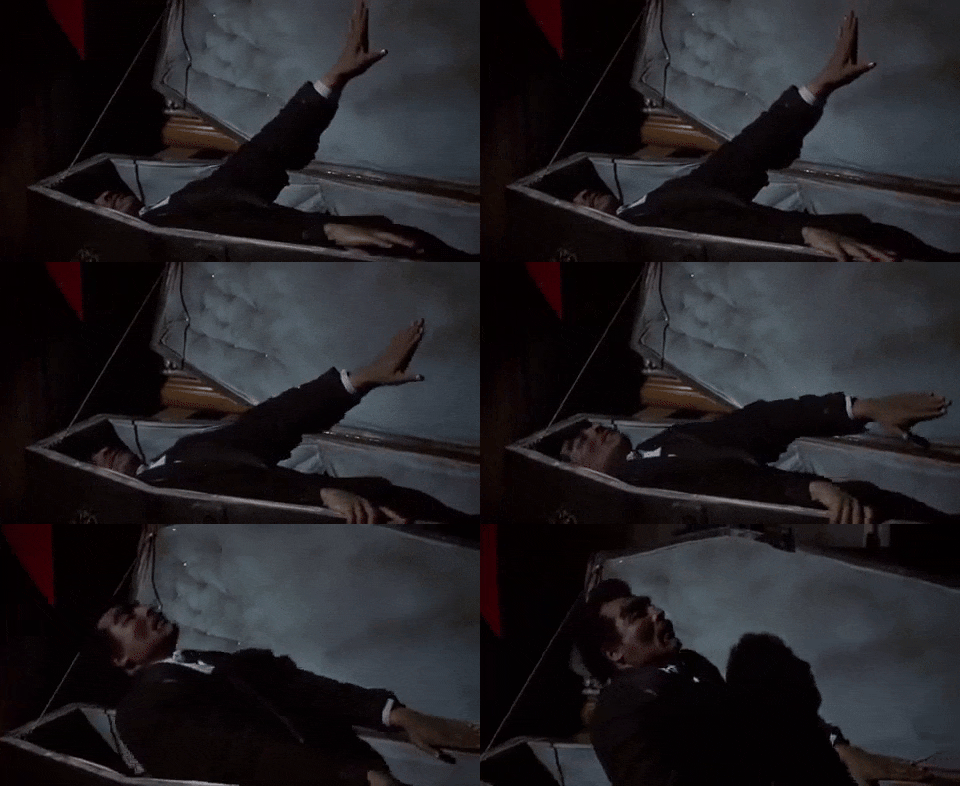
William Crain’s 1972 blaxploitation film, Blacula, brought blaxploitation into the horror genre. It tells the story of Mamuwalde, an African prince turned vampire after his failed attempt to gain Dracula’s aid in ending the slave trade. Although a blaxploitation film, there’s a solemnity about the story that makes it resonate deeper with the audience than one may expect. By the end of this week’s screening of Blacula, I found myself pleasantly surprised with the portrayal of characters and the acknowledgement that it had evoked genuine emotion.

I feel like what I enjoyed most about Blacula is the dignity that William Marshall brought to the character – his Shakespearean training shines through in the way he approaches the story of Mamuwalde. I’m not familiar with many blaxploitation films, but from what I understand they more often than not fall victim to portraying stereotypes; something that the early drafts of Blacula would have reiterated had the producers not been willing to experiment with form at Marshall’s request. In “Deadlier than Dracula!” Blacula and the Horror Genre, it’s said that he wanted to ensure that “the image of the first black horror monster contained a level of dignity.”


“I wanted the picture to have a new framing story. A frame that would remove it completely from the stereotype of ignorant, conniving stupidity that evolved in the United States to justify slavery” - Marshall, on Blacula (Martinez et al. 42)

Originally, producers wanted the main character to have a name that echoed that of a blackface white comedy team, which led to Marshall suggesting that the character’s previous life be one of nobility. He insisted that Blacula’s name should be Mamuwalde, and that he had been an African prince before falling victim to vampirism. It was his desire to see a character that didn’t embody every stereotype that blaxploitation films were known for utilizing. Although producers were initially hesitant with straying from what they knew would create revenue, they eventually embraced Marshall’s suggestions and thus the first black vampire emerged as a truly regal character.

William Marshall, further explaining his stance and vision behind his character, Mamuwalde

I feel that Marshall is the driving force behind Blacula as a cult film. Without his presence, we’d most likely be watching a film centered around stereotype. Not all blaxploitation films feature actors who take their roles as seriously as Marshall took his, and it’s in the way that he approaches the character of Mamuwalde that sets the whole tone of the film. He brought an air of dignity to the character of Mamuwalde, which gives his story a seriousness and sympathetic edge that would have been impossible to convey without both the changes Marshall proposed and the talent he demonstrates.