Author Archives: jaylincard

Get More Out of Life: See A Fucked Up Movie

Debates surrounding cult cinema most often address how a cult film breaks boundaries of morality, challenges prohibitions in culture, disputes commonsense conceptions of what is normal and acceptable, and how as a result they confront taboos. - Mathijs and Sexton

Life advice from John Waters

“Transgression and Freakery,” an excerpt from Cult Cinema: An Introduction by Ernest Mathijs and Jamie Sexton, highlights two common ways that cult cinema confronts taboos. A taboo is “a cultural prohibition, an act seen as morally wrong.” Often seen as reflections on the contamination of perceptions of purity, taboos generally tend to be bodily fluids. As Douglas says, “the traffic between the inside and outside of the body correlates strongly with what cultures see as taboos. A crucial element here is that of any substance that allows for the crossing of borders between the inside and outside of the body.” Such substances include tears, sweat, blood, pus, urine, semen, spit, menstruation, lactation, or feces.

For a film to be considered transgressive, it has to violate law or morality – it must pass beyond the limits imposed by society. Water’s 1972 exploitation comedy, Pink Flamingos, is a movie that has no sense of boundaries. Although exploitation has become harder to execute as it forges with mainstream cinema culture, Waters film is still as transgressive today as it was then. Even if you rule out certain elements that our society may have become desensitized to, such as nudity, masturbation, and incest, Pink Flamingos still touches on a variety of taboo topics: rape, cannibalism, the consumption of feces, etc. Transgression can take place in terms of content, attitude, or style; however, regardless of how it achieves transgression, this idea lays at the center of the construction of cult films.

“It still works, I know that. It didn’t get nicer; it might have even gotten more hideous. Even people who think they’ve seen everything are sort of stunned by it. They may hate it, but they can’t not talk about it. That was the point. It was a terrorist act against the tyranny of good taste.”

– John Waters in an interview with Vanity Fair, discussing Pink Flamingos forty-five years after its initial release (2017).

Waters chose to approach transgression by directly challenging good taste, which I feel makes this film transgressive in every aspect of the word. The content, which centers around characters who are literally fighting for the title of “the filthiest person alive”; the attitude, with Waters purposefully trying to outrage the masses; and the style, which is nothing if not competently excessive in every regard – each of these mediums on their own would have laid the groundwork for a cult film, but when paired together, they create a film that is almost timeless in its reception.
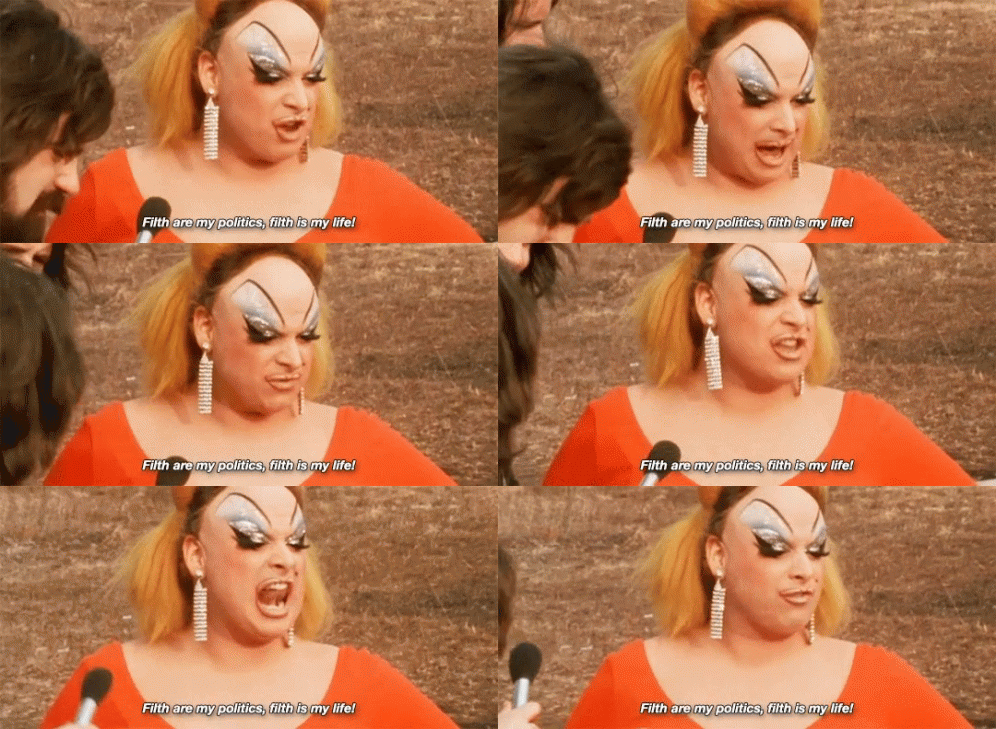
The transgression of reason -which J.P. Telotte describes as “the love for unreason” – is an incredibly important aspect of how a cult film is received. When a film confronts and embraces taboos, when it crosses boundaries of time, custom, form, and good taste, it violates our sense of the reasonable; and this is exactly what appeals to the film cultist. We’re allowed to vicariously delve into dangerous territory, but when it’s all said and done we can fall back on our reality – a world of reason. Transgression in a film challenges our ideas of morality, it puts us into a world of “what ifs,” and it sheds light onto an aspect of human nature that isn’t deemed pretty enough to be reflected in mainstream cinema. I feel that this explains why Pink Flamingos was such a cult hit then, and why it still packs a punch today. None of us want to be Divine, but we’re enthralled by her and by the world in which she lives, because both directly challenge everything we know not only about our own world, but about ourselves and the societal standards that have always been imposed on us.

In the words of John Waters, "Get more out of life. See a fucked up movie."

Carnival of Souls vs Conservative Horror

Carnival of Souls vs. Conservative Horror

“In the beginning, things are okay. Then something unusual turns up – a vampire,  werewolf, an alien, a monster of some sort, a guy in a hockey mask- and everything is a mess. But someone figure out how to solve the problem, and in the end, things are pretty much where they were in the beginning.” - Welch Everman, on conservative horror films.

In order to ensure success and revenue when producing horror films, most filmmakers resort to copying films that have already made money. And by copying these films, they also wind up conveying certain conservative world views. Horror films may be conservative in very specific ways, such as “in their treatment of women as helpless, powerless victims or in their view of anyone who is different as dangerous and deserving death.” Or they may be conservative simply in ideology; generally speaking, most horror filmmakers follow a basic formula which “assumes that the way things are is the way things ought to be, and so the goal of the movie is to get everything back to the way it was, back to normal.”

What I enjoyed most about Harvey’s Carnival of Souls was the fact that it doesn’t follow your basic horror-film formula. In fact, it pretty much completely goes against the grain of what Everman would consider to be ‘conservative horror,’ i.e. horror created with the intention of making a quick buck. For starters, nothing in Carnival of Souls was never okay – the movie started out with a car full of young women going over the edge of a bridge and plummeting to their deaths. It can be argued that “The Man” is the formula’s “something unusual” that turns up, but considering the fact that he is never truly a threat to the protagonist nor is his arrival what turns her life into a mess, I wouldn’t consider it so. And in the end, nothing ever gets back to normal. The goal of the movie is never to return the character to normal, although that may be her goal, but rather to convey the struggles she goes through as she tries to navigate life in the purgatory state she’s unaware of entering.

Ultimately, I feel that the originality of Harvey’s plot is what separates it from other horror movies of its time, which has thus earned its cult following. The ‘aura’ that Walter Benjamin mentions in his essay, that indefinable something that sets it apart from everything else, has a lot to do with the structure of the movie and the world that Harvey creates around his main character. Although the threat posed seems to be “The Man” whom Mary constantly sees, the world around her is much more dangerous than he ever proves to be. From the men who seem to be essentially in control of her life – the priest with her profession, the neighbor with her comfort, and the doctor with her credibility – to the bouts of time spent in confused detachment from the rest of the world, we see Mary in direct conflict more with her surroundings than with “The Man.” It’s the journey between worlds in this movie that truly defines everything, giving it this sort of hazy aura that can only be achieved by the fact that the ending doesn’t offer resolution in the way we expect, but rather with the revelation of this purgatory state and the protagonist finally bridging the gap between the two worlds.

The Excellent Foppery of the World

The Excellent Foppery of the World

One aspect of Ulmer’s Detour (1945) that really made an impression on me is the idea of fate vs the unreliable narrator. An unreliable narrator is defined as a narrator whose credibility has been seriously compromised, which leads the audience to judge the accuracy of their story. Our narrator, Al Roberts, begins the film as a lovable idiot who seems to find himself in the wrong place at the wrong time. And for a good portion of the film, he actually had me believing that his interpretation of the unfolding events was truthful; the trademark of a really good unreliable narrator, who has done his duty well. But what Al chalks up to fate, we the audience must brand as a very biased take on the film’s plot.

Andrew Britton’s essay “Detour” really narrows in on Al as an unreliable narrator, and highlights the emphasis put on fate in the film. Let me start by saying that I found it interesting that Andrew Briton chooses to begin his section “the unreliable narrator” with a quote about fate from King Lear, as opposed to one of many fitting quotes from Hamlet, arguably Shakespeare’s most unreliable narrator. I soon realized, however, that Britton’s use of the quote perfectly serves his desire to paint Al Roberts not simply as an unreliable narrator, but as “self-deceived.” By pushing the blame onto fate and telling himself that there was never an alternative ending, Al escapes the guilt of his actions and paints a story of a well-meaning man who never really had much of a choice. The narrator’s unreliability comes not from intent to deceive or a compromised mental state, but rather from his inability to accept the full responsibility of his actions.

An aspect of Al’s unreliability that I didn’t quite catch in the film was his description of his relationship with Sue as compared to the evening that we see the two of them walking home. Our narrator describes their pairing as “an ordinary, healthy romance,” but it soon becomes apparent that this is only his interpretation. As Britton points out, “it is certainly difficult to reconcile this rhetoric with the couple’s actual behavior, the most striking feature of which is the suppressed mutual frustration of partners who want completely different things, both for themselves and for each other.” We’re supposed to accept their love as true because we perceive the world through Al’s eyes, but closer inspection makes it apparent that his desire to marry Sue and her acceptance stems not from a place of compatibility, but rather compliance.

The unreliability continues when Al meets Haskell and the latter meets an untimely death. Despite having on several occasions provided his companion with a small tin of pills, it never occurs to Al to inquire about the either the necessity or recreational use of the medication. When Haskell won’t wake, Al doesn’t continue driving to a hospital or try to seek help. Instead, he leaves the man’s body on the ground and begins contemplating how he’s going to get out of the situation. The cause of death isn’t crucial to the reliability of Al’s story, but the action he takes afterwards is. He convinces himself that no matter what he does, he’s going to be seen as guilty and goes to great lengths to cover up a crime that he doesn’t see himself as having committed. All too easily, Al takes everything Haskell owns, including his very identity. This leaves the audience feeling uneasy as the coincidence of Haskell’s death and Al’s insistence of total innocence even as he steps into a life of luxury seem too unlikely to be believable.

Enter, Vera.

"It had already been intimated to us that Sue swims in and out of A's consciousness with the ebb and flow of his financial prospects, and Ulmer now implies that he comes to Vera's rescue because his new-found wealth has given him the sense that he is again a free agent, economically and sexually. He no longer feels the need to bank on the hypothesis that sue will 'click' in California, and, since Vera seems to be available, he offers her a ride for much the same reasons that Haskell did."

Britton’s analysis of Al post-Haskell’s death makes complete sense in hindsight. The last thing that he, a man supposedly on the run, should do is offer a ride to a stranger hitchhiking on the side of the road. And yet, he does. When he has everything to lose and nothing to gain, Al finds himself so absorbed in the “truth” of his supposed innocence that he takes it upon himself to reap the rewards of Haskell’s death. What could appear to be a good deed quickly turns dark when the audience realizes that at this point in his story, Al is acting purely out of his own desire to test the limits and see exactly what life as Haskell can entail. He doesn’t stop to mourn the lost life or even think about let alone regret his actions, but instead revels in his newfound freedom with abandon. Throughout the whole scene, his shaky claim to innocence is the only moral backing he needs.

The underlying theme in all of these scenarios and what makes Al so unreliable as a narrator is the fact that he acts in accord with his own ulterior motives and then portrays each scene as a happening of circumstance. He doesn’t love Sue, but rather his desire to marry her stems from his own feelings of inadequacy and because of this he portrays their relationship as what he’s deluded himself into believing it is. Although Haskell’s death could be a result either of the medication he was taking or a genuine accident, Al knows that the man is wealthy and rather than do what he can to make the situation right, he flees with both the car and the money, which offers him the chance at a life he would never otherwise be able to afford. And when he picks Vera up on the side of the road it isn’t out of the goodness of his heart, but instead an effort on his part to start his life as a new man, equipped with the identity and the financial backing which has the world at his fingertips.

So thus begs the question: by grand design or through great attempts?

Throughout the film Al narrates his story as if it’s been written in the stars, but he never takes into consideration the consequences of his own actions. If he hadn’t chosen complacency, if he hadn’t buried the body, if he hadn’t picked up Vera, if he hadn’t run away from it all instead of owning up to his mistakes. These choices, they’re what make the story. No matter how we choose to perceive, reliability depends on the narrator’s ability to accept the part they play and portray it without deluding themselves or the audience.

The Art of Exploitation

The Art of Exploitation

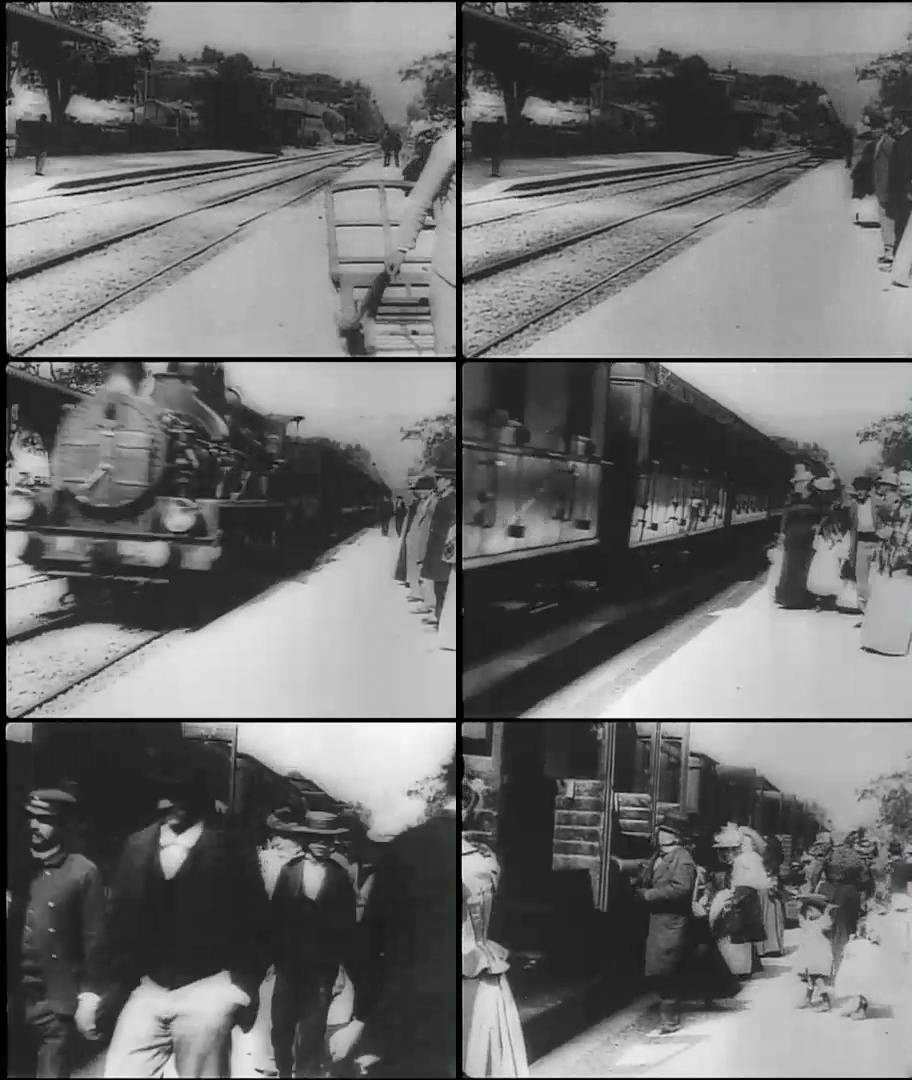
L’Arrivée d’un train en gare de La Ciotat, 1896.

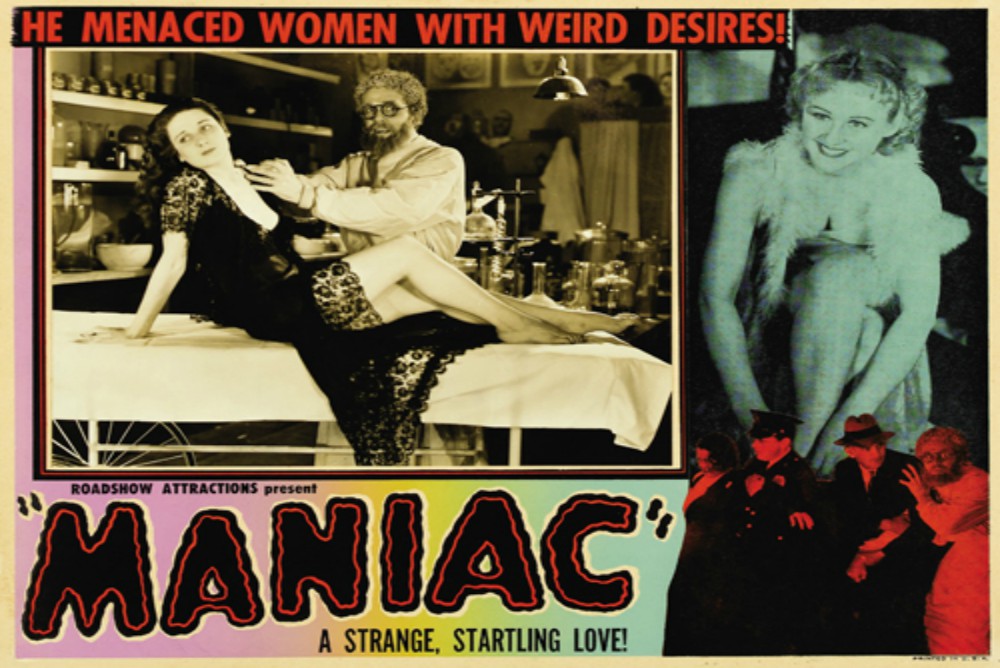
This week’s screening of Dwain Esper’s 1934 film, Maniac, introduces us to cult movies through a glimpse into the world of exploitation. An exploitation film is simply a film which has an element that you can exploit for profit, most often a taboo subject matter. As we learned with the documentary American Grindhouse, exploitation films have essentially been around since the beginning of cinematic history, with Edison essentially paving the way by accounting for his audiences’ taste and giving the people exactly what they wanted. Esper followed suit with his films, but the Hays Code -adopted in 1930, and more strictly enforced as time went on- offered regulations that prevented seedier exploitation films from being shown in most major theaters. Although it was meant to end exploitation in film, the Hays Code, and the accompanying denial it presented the public with, fueled the need for exploitation in film.

Esper’s Maniac loosely follows the story of Maxwell, assistant to a scientist obsessed with reanimating the dead. When Maxwell is forced to kill the doctor, he assumes the man’s identity and goes on to treat his patients. Clearly nothing good can come from this, and soon the audience is subjected to a disturbing rape scene, an awkwardly placed glimpse into a room full of showgirls, and Maxwell’s victorious pursuit of the cat’s eyeball. (Or was it an Oyster? Grape? I hear they’re quite alike.) Although presented in the guise of an educational film, Maniac clearly centers around the things that Esper knew would sell: nudity, violence, rape, etc. In fact, despite being a novice director, seemingly with no ambition to be anything more more, Robert G. Weiner crowns Esper “the prince of exploitation” in an article by the same name. According to Weiner, the one thing Esper did know how to do, and do well, was turn a profit:

“Esper was the king of turning a profit. Even though he directed very few films (and was involved in making only a handful more), his films exemplify the sensationalist end of cinema at its most profitable; with their sideshow techniques, the Espers could milk profits from a very cheaply made film for years.”

Maniac-poster-R

The real draw of Esper’s movies was the carnival-like sideshow attractions that accompanied him on the exploitation circuit. The goal of these attractions was to generate as much money as possible; and it worked. There’s nothing proving that Esper ever had any interest in film as “art,” but through these screenings and our readings I’ve come to believe that he saw a different value in film-making, not only for monetary purposes but because he was able to provide the public (and himself) with entertainment and, to some extent, education during a time where people were painfully uninformed and desperate to understand the truths being withheld from them. 

Our screening of American Grindhouse helped to put the concept of exploitation into context by providing background and additional information on its history. The documentary covered a wider variety of films and sub-genres, showing the emergence of taboo themes into more mainstream cinema. One of the best aspects of American Grindhouse is its ability to blend education and humor, showing us some of the absurdities of exploitation film while also demonstrating its importance to the development of cinema. The world of exploitation and mainstream cinema have become one, and as a result our sense of ‘normal’ now echoes traces of a pivotal time in cinematic and cult movie history that, without this class, we wouldn’t be able to fully appreciate or understand.