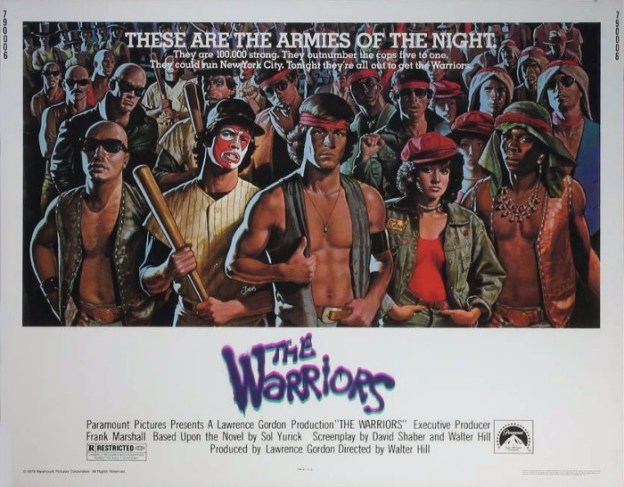
 This week in our film class, we learned about and discussed fandoms in our reading of “The Cultural Economy” by John Fiske. We learned about the importance of the support of fans and how fans make up necessary communities in the world of cult films. Our Screening of the week, The warriors, is a 1979 American action film directed by Walter Hill, based on Sol Yurick’s 1965 novel of the same name. This movie is one that flourished through its fandom, from the late night showings to the success of video games and things of the like, the fans of this film allowed it to gain its cult movie title.
The Warriors is a unique film with an intriguing aesthetic and dialogue throughout the entire movie. The film stars Michael Beck, James Remar, Deborah Van Valkenburgh, Marcelino Sanchez, David Harris, Tom McKitterick,rian Tyler, Dorsey Wright, Terry Michos, David Patrick Kelly, Roger Hill, Edward Sewer, and Lynn Thigpen. The plot of the film: Cyrus,played by Roger Hill, leader of the Gramercy Riffs, the most powerful gang in New York City, calls a midnight summit of all the city’s gangs, requesting them to send nine unarmed delegates to Van Cortlandt Park. The Warriors, from Coney Island, attend the summit. Cyrus proposes to the assembled crowd a permanent citywide truce and alliance that would allow the gangs to control the city since they outnumber the police by three to one. Most of the gangs applaud his idea, but hidden in the crowd, 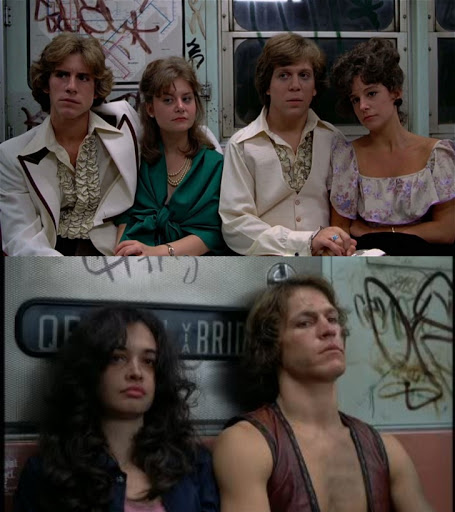 Luther, played by David Patrick Kelly, leader of the Rogues, shoots Cyrus dead just as the police arrive and raid the summit. In the chaos, Luther frames the Warriors’ leader Cleon, played by Dorsey Wright, for the murder, and Cleon is beaten down and apparently killed by the Riffs. Meanwhile, the other Warriors escape, unaware that they have been implicated in Cyrus’ murder. The Riffs put out a hit on the Warriors through a radio DJ. Swan, the Warriors’ “war chief”, takes charge of the group as they try to make it back home. The rest of the film watches the gang and their encounters on their journey home. They come in contact with several gangs who are targeting them as they think the Warriors are responsible for the death of Cyrus. They fight off gangs and policemen throughout the film making it action packed and exciting. They meet a girl along the way, (because-of course there has to be a girl dressed in skimpy pink clothes following around a gang of muscly men through New York City in the middle of the night, begging for one of them to pursue her) Mercy, Played by Deborah Van Valkenburgh, who becomes a sort of sidekick in for the rush. She often just puts herself in dangerous situations getting involved in the violent gang fights. A part that I found insanely intriguing was the scenes with the radio broadcaster. Played by Lynne Thigpen, this character broadcasts reports to the gangs of the city. The only part that can be seen of her is her mouth talking into the microphone which highly reminded me of the opening of the Rocky Horror Picture Show where there is just a mouth pasted onto a black screen singing a song.
The release of the film in 1979 caused a bit of a violent breakout among the fans of The Warriors. The film had linked to vandalism and three separate killings following the weekend of its release. This prompted Paramount to remove advertisements from radio and television completely and display ads in the press were reduced to the film’s title,  rating and participating theaters. In reaction, 200 theaters across the country added security personnel. Due to safety concerns, theater owners were relieved of their contractual obligations if they did not want to show the film, and Paramount offered to pay costs for additional security and damages due to vandalism. In the case of this film, the fandom got out of hand, attempting to role play what had happened in the film. This makes sense as it was the first film of its kind and has a violent rhetoric towards police officers. However, this is just a film, but this kind of reaction shows how influential a film can become to its fans, and how fandoms are a huge part of the film industry, both positively and negatively.
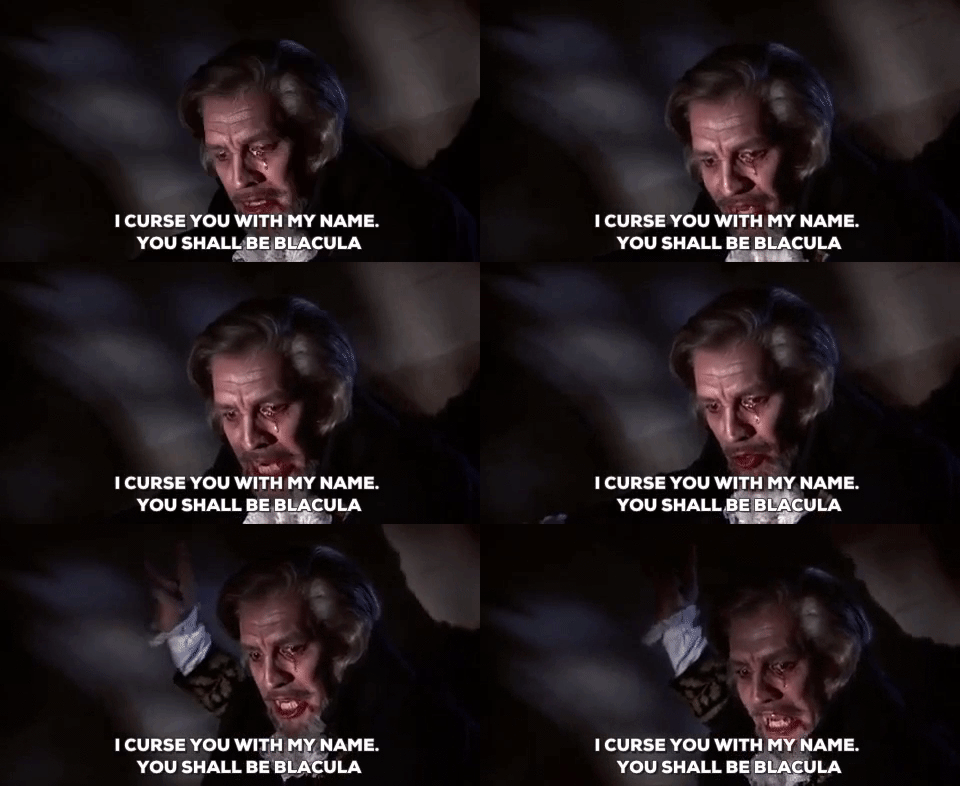
 Blacula is a 1972 American blaxploitation horror film which was directed by William Crain, who is named as one of the first black filmmakers from a major film school to achieve commercial success. Blacula stars William Marshall who plays the main role in the film as an 18th century African Prince named Mamuwalde. It also stars Denise Nicholas, Vonetta McGee, Gordon Pinsent, and Thalmus Rasulala. In the film, Mamuwalde is turned into a vampire after he is bitten by the one and only Dracula himself, and is locked in a coffin in Dracula’s castle in Transylvania in 1970 after Mamuwalde asked for help with supression of the slave trade, and Dracula refused. Luva, Mamuwalde’s wife (played by Vonetta McGee) is also imprisoned and left to die in the room with her husband. The film then fast forwards to the present day world where Mamuwalde is released from his coffin into the world as a vampire. He meets a woman who is identical to his past wife and falls in love with her. The film follows his experience as a crazed bloodsucking killer who attempts to keep the woman he is in love with while also fixing his cravings by turning the people around them into vampires. Blacula received mixed reviews after its release, however, it turned out to be one of the top grossing films of the year. It was followed by its sequel, Scream Blacula, Scream in 1973, and inspired a wave of blaxploitation themed horror films.
 and from our class discussions, we learned about what these films consist of. The films from the cult genre are transgressive and they often consist of themes of sex and violence, and many include sci-fi themes. Two films that we watched in class this week were great introductions to diving into the movie genre.
 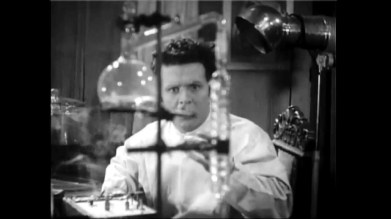 in focus and the characters themselves are blurry and out of focus, which carries on throughout the movie. The plot of the film: Don Maxwell is working as a lab assistant to Dr. Meirschultz. This doctor is a “mad scientist”; he is attempting to bring the dead back to life. Maxwell ends up killing the Doctor, and in his attempst to hide the murder, he dresses himself up, facial hair and all, and impersonates the Doctor. He buries him in a brick wall (but does not see the cat that had happened to slip behind the wall before he had sealed it up) This impersonating doctor treats a patient but injects him with adrenaline on accident, causing the man to go crazy and assault a woman. Lots of things that happen very frantically and unorganized and don’t seem to make any sense are played out leading up to the neighbor calling the police, who began to search the premises. They hear the cat behind the brick wall and begin to tear it down, discovering the deceased doctor. This film, while incredibly poorly made with a ridiculous plot, lead the way for many films of its kind to be made, leading to the advancements and the impact of what is the cult film.
  Herschell Gordon Lewis, and many more. This film, while being insanely informative, was also very interesting with how they explained what happened during the history of film and in film politics with trends and regulations alongside which films were made at the time and why. The politics of cinema is very interesting when you consider how producers and filmmakers worked with the politics to put out films that they knew would appeal to the public and to their crowds. These films that we watched were two that I found held my interest and made me want to learn and discover more about the Cult Film genre and exploitation in films.
  Cult Movies