Author Archives: ChelseaRae

And That’s the End

Where do you even begin with Once Upon a Time in Hollywood? This film was a lot. Quentin Tarantino only produces masterpieces and this film was no different. The cast was full of A-listers. Leonardo DiCaprio, Brad Pitt, and Margot Robbie star in this film about a washed out television star trying to achieve fame with his stunt double during the late 60s in Los Angeles. This film was the perfect close to the semester because it shows the change in the film industry, which is a lot of what we have learned throughout the course. As the semester progressed we got to see the changes of film story-lines, quality, production, directors, and so much more. And then Tarantino shows it so well in this film, giving it his own perspective. The film really speaks for itself, especially with its top 10 films of 2019 ranking by the American Film Institute.

One of the many readings this week was “Once Upon A Time in Hollywood” by Priscilla Page. Page wrote that Once Upon a Time in Hollywood is “a film about the interplay between fantasy and reality, memory, mythology, masculinity, violence. It’s about fiction and film as redemptive, transformative, and just, and pop culture as a force that brings people together. It’s make-believe, and it’s memoir. Once Upon a Time…In Hollywood is Quentin Tarantino’s second draft of history.” Page’s description corresponds well with what this film is. She uses the right words to show the magnificence that is Tarantino’s film. DiCaprio’s vocal range is impressive, and the drastic difference between his voice in this film and any other was an interesting artistic choice. His back and forth with Brad Pitt is amusing and almost comical that Pitt is his stunt double when they don’t look that much alike, other than maybe their hair color. And lastly, Robbie. Margot Robbie plays the role of Sharon Tate, a wonderful actress, whose life was cute too short because of Charles Manson. Robbie’s role is controversial, but Tarantino didn’t want her role as a murder victim only commemorating the murder, but rather the amazing actress she was. There’s a scene where Robbie watches a film with the real Sharon Tate and the emotions she displays strikes home over the up and coming actress. Robbie commemorates Tate and represents everything she had to go through before she was suddenly taken from the cinematic world. Tarantino took great care for all three of these actors and actress to represent the reality of what it was like in the film industry, while making the story his own. Rather than conforming to modern day ideals he showed the truth of what it was like, even though it earned harsh words like misogyny and disrespectful. It was the truth and that in itself shows how far everything has come since the 60s.

Post modernism is very important. This week we had two videos on it. Nostalgia is the biggest part of post modernism. Throughout the decades nostalgia has been used to evoke emotional responses to the mass audiences, whether it be a Coca-Cola commercial or the newest cinematic reboot. Nostalgia is the most used and effective method in post modern media.

While watching the Frederic Jameson video, they referenced Andrew Butler in their discussion about post modernism. Andrew Butler states: “There is a breakdown in any meaningful connection between words and images” post modern art has “an eclectic range of allusions or a bewildering collection of fragments of different voices.” Post modernism is related to late capitalism. Late capitalism focuses on style over substance, surface over depth. This creates this unstable, fragmented reality that is artificial. All of which is very true. Society now is so focused on appearance and what the eyes can see, that it fails to recognize the beauty and meaning in the things it can’t see, or is considered outside the norm. There is little to no substance in this mindset.
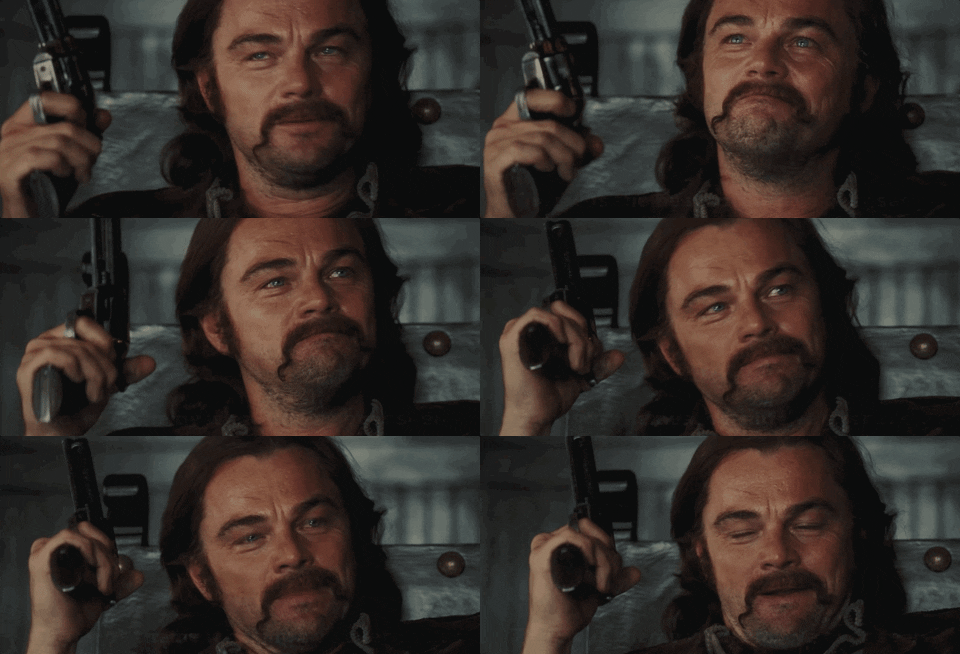
At the start of the semester I took my very first film course. I was introduced to the class with one very specific objective and description. “Cult Movies is a broad but vivid special topics seminar designed to produce rigorous analysis and critique of the cult film phenomenon. Together, we’ll investigate their modes of production, distribution, and exhibition. We’ll also focus on their reception, their fans and various reading strategies. This course also examines the question of “taste” as it relates to culture.” Even with this I had absolutely no idea what to expect from this class. My idea of cult didn’t even come close to what it really meant. I knew I was in for a whirlwind of discoveries and experiences the moment Maniac came on the screen.

Audio plays a massive role in cinema, whether its the overlay of dialogue from a separate recording or the soundtrack of the film. A really good soundtrack can salvage some relatively bad acting or bad writing. Exploring and examining soundtracks and other audio effect methods were my favorite aspect to learn about when we learned about what goes into a film. The hardest thing to learn was by far camp. It is complex and covers several different aspects of cult. Camp is both when something is trying to be camp and when it isn’t.
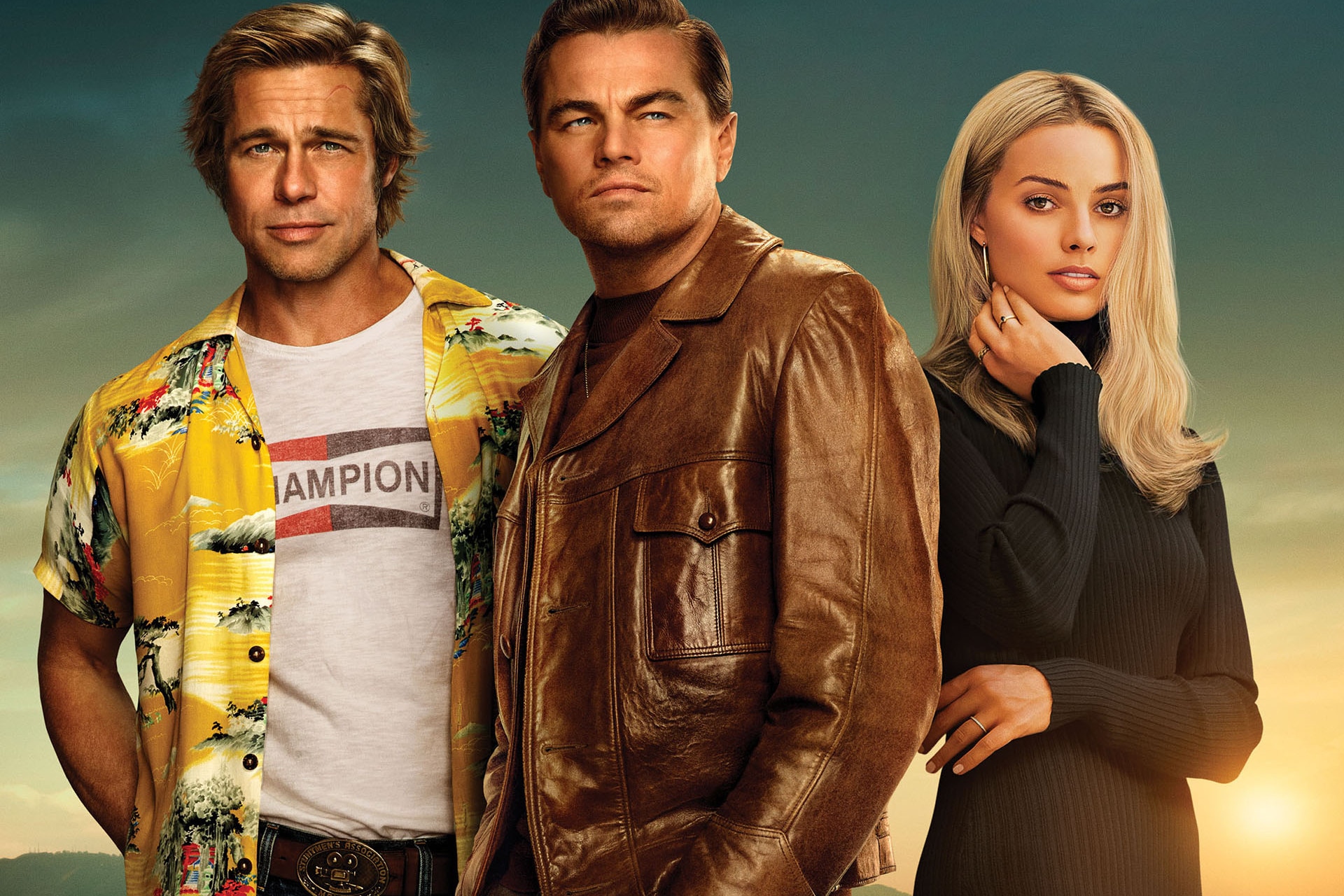
My favorite film this semester was by far Matinee directed by Joe Dante. A close second would have to be The Warriors directed by Walter Hill. Both of these films started off as something I didn’t think I was going to like and I ended up loving them. They’re both really entertaining and keep you engaged, so I would highly recommend them.
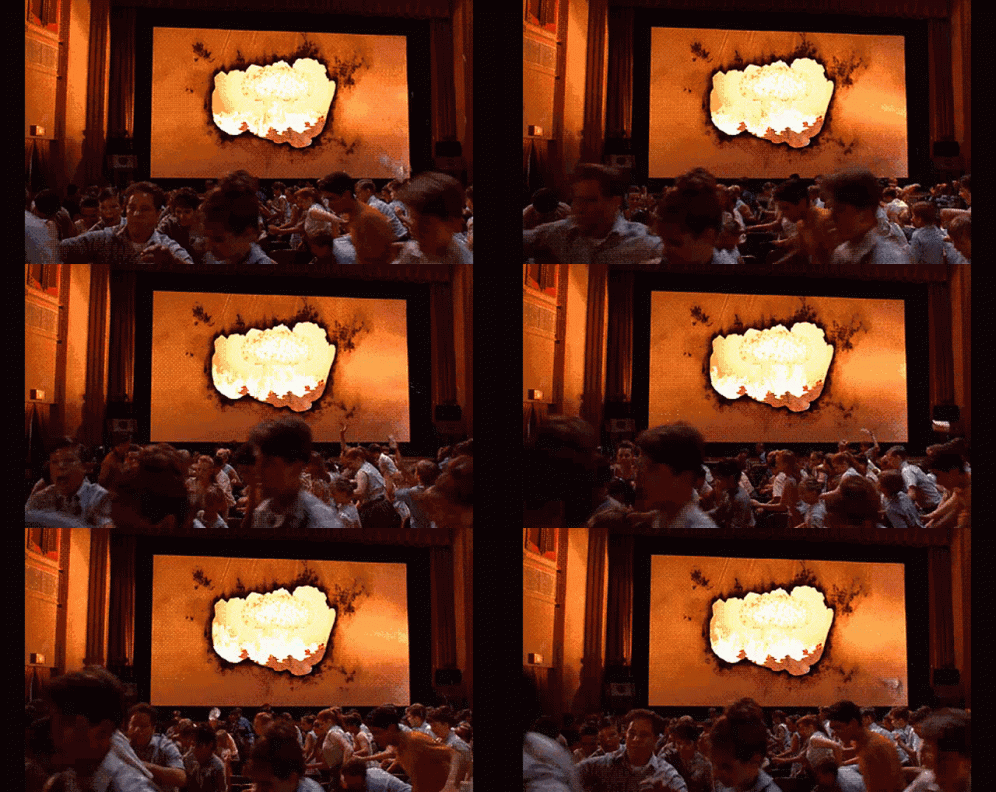
My least favorite film this semester has to be John Waters’s Pink Flamingos. It wasn’t a bad film, it just was not for me. The amount of disgusting scenes in it were just too much for me. I can sit here and watch gore all day long and still have an appetite, but could not eat my dinner after this film, it was, insane.

The semester introduced me to not only new films, but so much I didn’t know about film making. It’s hard to focus on just one thing, because everything was new for me. I honestly had no idea what to expect or what a cult movie even was and it was an amazing experience that I would recommend to everyone.
Final Project: Cult Horror Films

We should begin with the basics. What is cult? Why does it matter? The best definition I have read comes from Welch Everman’s essay “What is a cult horror film?”: “cult suggests a small group of loyal fans, so a cult horror film would seem to be one made strictly for the horror audience, the audience that will literally watch anything as long as it’s a horror flick” (213).  This definition suggests the extreme and is completely exclusive.  The dedication and work that goes into being a cult is extensive.  This work further separates the cult from the mainstream.  However, this is not all bad. Being part of a cult fan base brings about a whole community, giving someone an immediate friend. Someone walks into a room with an Insidious shirt and it is an immediate conversation topic, giving a connection to a complete stranger, forming a bond one never would’ve formed otherwise. It is one of the many reasons people love horror.

Classic films are unique works of cinema that have transcended time and trends, with indefinable quality. Classic films are often universal favorites that constitute rescreening. Cult classics are a bit different. Cult films are known for their dedicated, passionate fan base, quoting dialogue, and audience participation. But the term cult allows for major studio productions, especially box office bombs, or films that are more on the obscure side and are usually transgressive in nature, causing the films to be shunned by the mainstream. Cult films in themselves are a wide band idea that covers just about every aspect of cinema, by narrowing in different sections and distinguishing them from what constitutes as mainstream.

“Cult horror films, then, are not classics and never will be. Classic horror films are those that have influenced the entire history of horror movies—James Whale’s Frankenstein, Tod Browning’s Dracula, George Wagner’s The Wolf Man, and so on. It isn’t very likely, however, that movies like Dracula vs, Frankenstein, Mansion of the Doomed, or The Vampire’s Lovers will have any lasting effects on the genre.”(213)

First and foremost, this statement is disproved. Horror is not only a classic but is a major part of forming cult history and film history. Everman tries to create a distinction between classic films and horror cult films, as if they cannot be under the same classifications; however, horror cult films can be considered classics, even under his definition of classic. He claims they have to influence the “history of horror movies” and a lot of cult films do. Scene, tropes, ideas, and skills are passed on throughout the horror genre, no matter the film or the story line. Directors from Joe Dante, Tod Browning, Alfred Hitchcock, to John Carpenter we have the widespread of horror masterminds. Horror is a fine art and that is where the problem comes in with people not classifying it as cult. Not all horror is cult, but many of the best horror films are cult films, or are based on cult horror films.

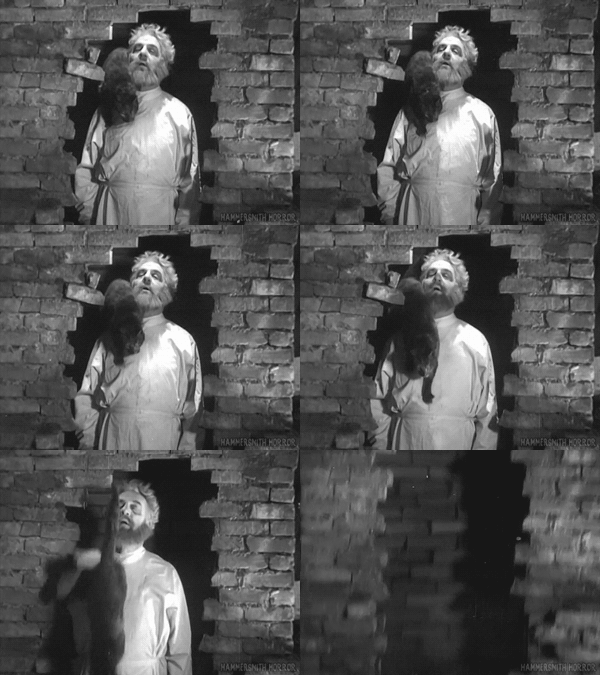
“A lot of these films, though, are so bad they’re good—or at least they’re funny.” (213) For example, Maniac by Dwain Esper is so bad it’s hilarious. It is supposed to be scary and warn people about mental illnesses, but the acting, script, and directing is so horribly done it turns itself into a whole comedy.  Maniac is loosely based on none other than Edgar Allen Poe’s “The Black Cat.” This one, however, focused more on this psycho who kills the mad scientist that tries reanimation. It ties in other aspects from Poe’s short story, like the black cat and the focus on the eye and the progression of insanity.

Esper was not the only one who thought Poe’s story was worthy of a horror film. Edgar Ulmer directed The Black Cat in 1934, the same year that Esper’s Maniac came out. The plot of The Black Cat is simple yet done so well that it seems like a huge elaborate scheme. American honeymooners in Hungary get into an accident and end up trapped in the home of a Satan-worshiping priest. The bride is taken there for medical help because of the accident and things just spiral out of control when faced with a satanic cult leader.

Both directors based their films off of Poe’s story, which was really neat to learn, because both films are very different. Maniac focuses a lot more on the mad scientist aspect, with its dead body reanimation; however, the acting is just so bad that you can’t take it as a horror film. Disclaimer, it is only the 1930s, acting can’t be that good, film is relatively new and perfecting it is going to take decades of trial and error. The Black Cat is such a different horror film and easily a classic. Ulmer and Esper are clearly two very different directors, taking the same story and creating two completely different films. Ulmer’s style of directing made his film scarier. Personally, I was not afraid, but it seemed less like comedic relief and more of a drama. So, in choosing between the two The Black Cat would be my choice for a staple in the history of horror.

The agony portrayed in the film is intensely layered on to the point where it is not a real scare, but gives a more dramatic effect, leaving the audience on the edge of their seat, rather than cowered down. However, the film progresses like a nightmare. The audience is living through this nightmare that is bizarre and will ultimately be forever printed in their mind, leading to the audiences to never forget the experience.

Freaks, the 1932 film directed by Tod Browning is set in a circus. The leader of the side-show performers is planning to marry one of the trapeze artists. However, his friends discovered that she is only into him for the money. Hans still marries Cleopatra. After all, who cannot fall for Cleopatra, the most beautiful trapeze artist? Cleopatra is ultimately the monster of them all, an interesting twist being as she was surrounded by people society dictated as “freaks.” Freaks initially failed in the box office because of its “sympathetic” nature towards side-show characters rather than an exploitative one. This film is a metaphor for classism, and shows the clear lines drawn in society by class. The topic is hard to talk about and showing and criticizing it is rather taboo. Freaks was ahead of its time and by the late 20th century was reevaluated. Freaks has become more popular in the 21st century. The concept of the “freak show” has long since been repeated and reproduced, but its portrayal here is one of the first great and terrifying moments, some of which are still classified as the scariest in horror history.  Browning chose to humanize the deformed in this film, rather than demonizing them like most would have, something the masses didn’t get behind until looking back on it. Freaks has led to several new uses of the trope of a freak show. American Horror Story had an entire season dedicated to “freak” in its season four titled “Freak Show.” The show was initially inspired by Browning’s Freaks and Herk Harvey’s Carnival of Souls. Both of these cult horror films came together and were able to form yet another staple in modern horror. 

The retrospective effect is important when understanding cult. More often than not cult films become more popular after they have been released, the same can be said for a lot of cult horror films. However, ironically, in recent years films that once tanked in the box office are now mainstream. For example, Saw VI, a flop at the box office, ended up being the best film in the movie series. The Saw series was very mainstream, but the outlier, Saw VI, falls under cult classification. It flopped at the box office, it has a dedicated fan base albeit one for the franchise, it is transgressive, and its quotable. Saw VI is a modern day cult film. It tests our ability with gorish games of hell that make people question their humanity. This film ended up categorized as one of the best films of the franchise because of its intense “B story-line” and psychological warfare.

“The phrase cult horror film has come to mean ‘bad horror film,’ and that’s a bit unfair—but only a bit. The truth is that, yes, most movies that are called cult horror films are bad,” (212). However, the films are not entirely to blame, usually the stacks are set against them. They have: “minimal budgets,” “are poorly written and directed,” “production values are near zero,” and “the acting is appalling” (213). Despite all of that, the films are still loved and cherished by their fan bases. If no one liked the films then they would just be forgotten. These cult horror films attract a certain type of audience, but that audience is more dedicated and in love with these films than most of mainstream media is with the major production films. My favorite films are coming out of this mix of obscure taboo groups. Once you love them, you love them forever, the next best thing does not and cannot replace them. Cult horror films are totally insane and are such a massive variety that you can find just about anything to satisfy your need. These films like to break down society’s standards, and do not care about the backlash. They are original and underappreciated by mainstream media.

The last thing I want to say on the matter is take the leap. Instead of saying “horror isn’t for me I’ll never watch this,” watch the film. If you do not know where to start, take any of the films I’ve written about and watch it, then watch it again. You get so much more out of a second watch. The nuances you missed, the little shifts in the background, the outfit changes, and so much more. You appreciate and understand them better after a second screening. These films are not for everyone, but even if you do not become a horror fan after watching them, you understand and appreciate the learning curve of film. Every film cannot be your favorite film. But every film is an experience that you can learn from and take into your next experience. Even if you do not like Maniac, because of its really bad acting, you learn you like the mad scientist idea and then you go watch Dr. Jekyll and Mr. Hyde and fall in love with that story, or there is the classic that is Frankenstein. Your possibilities are endless. At the very least you might get a good scare.

“If I cannot inspire love, I will cause fear.”

Sources

Everman, Welch. “What is a cult horror film?” The Cult Film Reader, edited by Ernest Mathijs and Xavier Mendik, Open University Press, 2008, pp. 212-213.

Shelley, Mary Wollstonecraft. Frankenstein. Ed. Patrick Nobes. Oxford: Oxford UP, 2008. Print.

https://en.wikipedia.org/wiki/Freaks_(1932_film)#Release

John Goodman, Joe Dante, a Mant, What Could Go Wrong?

A small-time film promoter releases a kitschy horror film during the Cuban Missile Crisis.

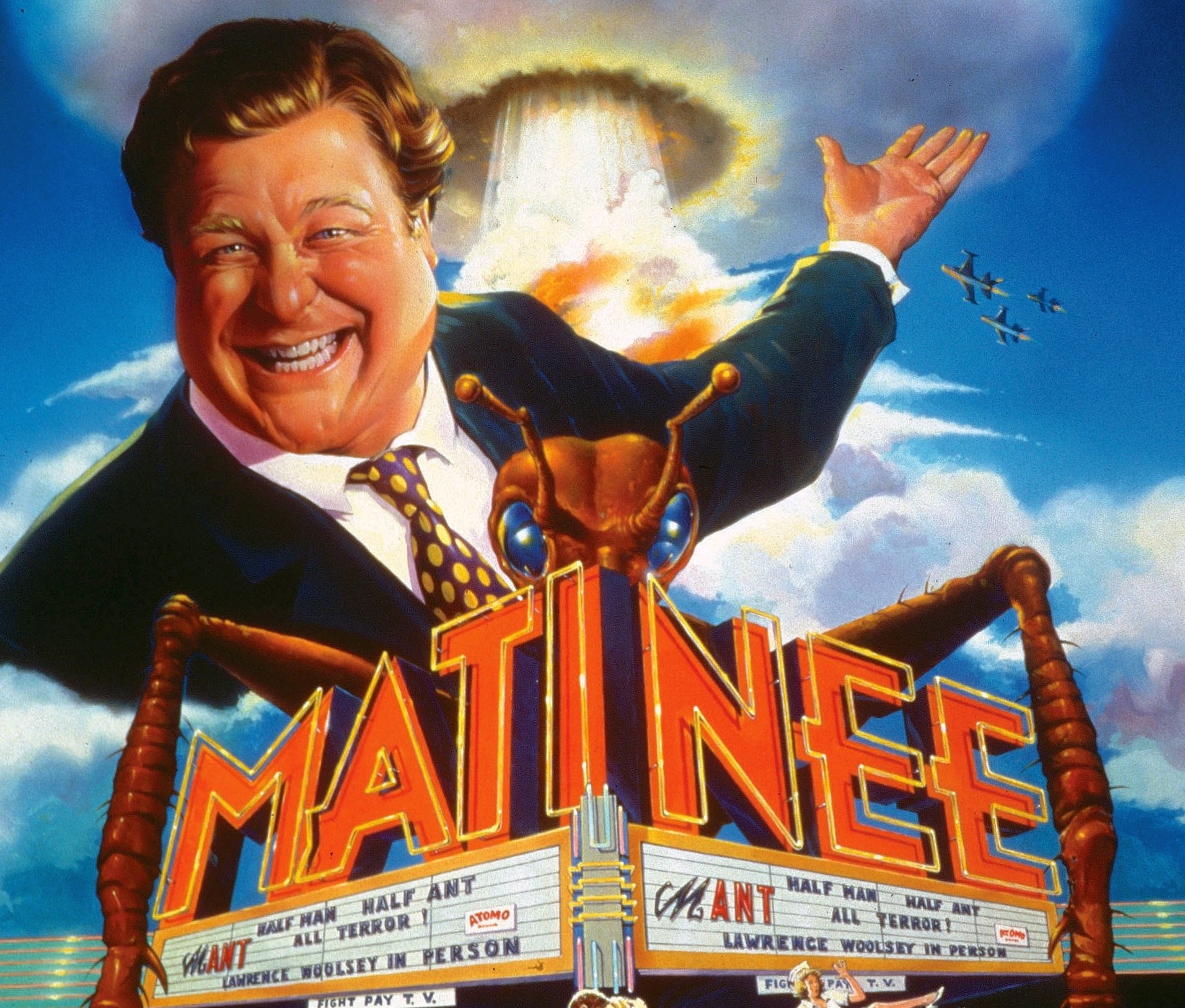
We’re almost to the end folks. Even after 12 weeks I found myself surprised by yet another cult film. This week we watched the 1993 film Matinee directed by none other than Joe Dante. We have already seen Dante before in this class, way back with his appearance in American Grindhouse. Personally, I know him from Gremlins and Piranha, though I was excited to learn that he took part in the Looney Tunes: Back in Action, one of my favorite movies growing up.

The Hustle of Horror Film-Making

I have to stop and talk about John Goodman. He can make anything funny. Goodman is one of my all time favorite actors/comedians. I fell in love with him while watching the television series Roseanne as a little girl and only grew more in love with him as he took part as Sully in the Monsters Inc franchise, his role as the voice of Hound in the Transformers series and finally, my favorite, his voicing of Pacha in the Emperor’s New Groove and Kronk’s New Groove. John Goodman is a major part of my life growing up, as a lot of my life revolved around the types of younger viewer friendly movies he was in. His voice, face, and name are recognizable in my house, and I can honestly say a lot of actors can say the same. The moment I saw John Goodman’s name on the cast list I knew this film would be a can’t miss. Lawrence Woolsey makes my list of all time favorite John Goodman roles. I was hooked the moment he introduced himself in the introduction of the film.

My Favorite Trailer

There is so much one can say about this film about a horror movie. Firstly, I would totally watch Mant and laugh. Secondly, I was laughing through this entire film, which was a little hard to do, because the film is placed during the Cuban Missile Crisis. Their world is in chaos and the every day person cannot do anything about it. It hit a little close to home right now with our quarantine right now because of the COVID-19 pandemic. Although, we are not in all out war, facing nuclear bombs we are sitting and watch the world crumble around us because we can do nothing about it other than stay in doors and far too many people can’t even do that. The scene in the grocery store showed me the most that history repeats itself. On a more positive note. The soundtrack in the background is superb. In the last few films we’ve watched I notice the soundtracks are getting better and better with song choice.

One of our readings this week was “Film As a Subversive Mass Art: Joe Dante at BAM” by Giovanni Vimercati. It discussed the mastermind that is Joe Dante. The part I want to focus on is the section about this week’s film Matinee.

“An exemplary film in this respect is one of Dante’s masterpieces, Matinee (1993), a heartfelt homage to the B-movie impresarios and visionary mavericks, from William Castle to Roger Corman. Our hero, a small-time film distributor with a knack for promotional tricks, releases his latest flick during the Cuban Missiles Crisis. The two seemingly unrelated events will come to closely depend on each other…”

Tomorrow is like a big knife.

Calling this film a masterpiece is an understatement. I absolutely loved this film. Some parts can be classified as “bad” because of budgets and poor acting, but I think it makes it even better. The film itself is riddled with comedy and is paired with an end of the world scenario. That pairing is what makes Dante a mastermind. He creates the ultimate stories for audiences to experience. And this has to be my favorite work done by him by far.

This week we had two wonderful presentations on The Breakfast Club and Doctor Sleep. I’ve seen The Breakfast Club film before, and I was very excited to hear another’s take on it and how it portrays into the culture and the history cult films in cinema. The Breakfast Club has become very mainstream, at the very least in reference. I really enjoyed the part where we talked about how it was used in the show Victorious. That is one of my favorite episodes from the show. As for Doctor Sleep, my mother said it was amazing. I didn’t watch it when we rented it because I’ve never seen The Shining. After the stellar presentation on it I think I’m going to have to finally take the time to see both. Amazing presentations this week!

Nancy and Sirius Black??

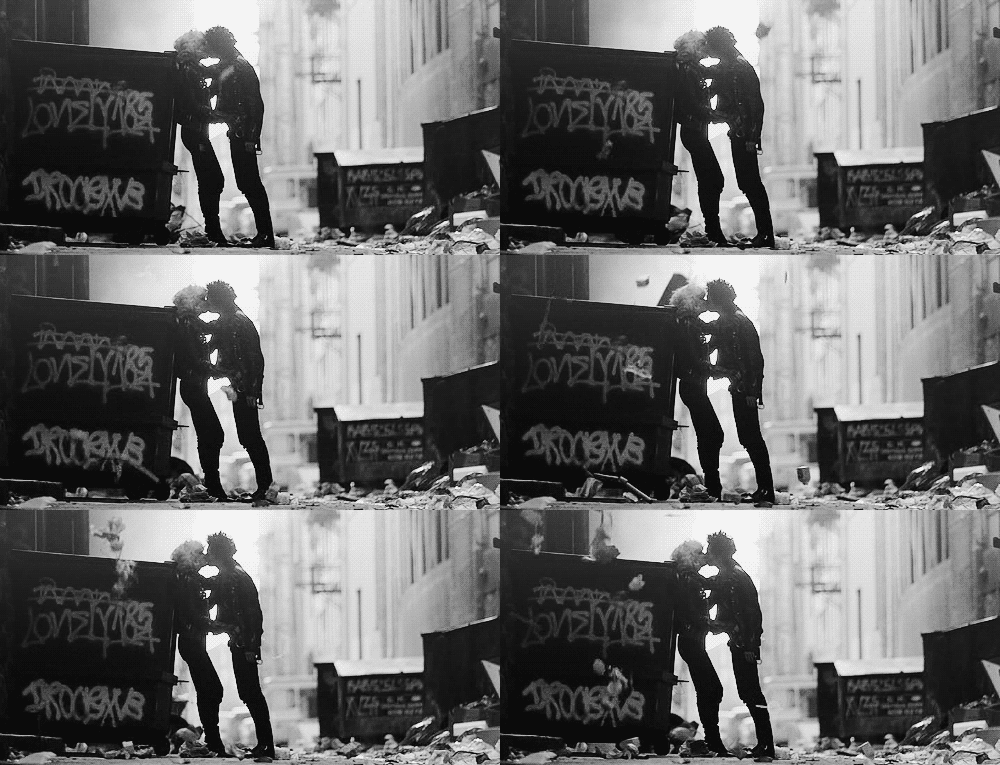
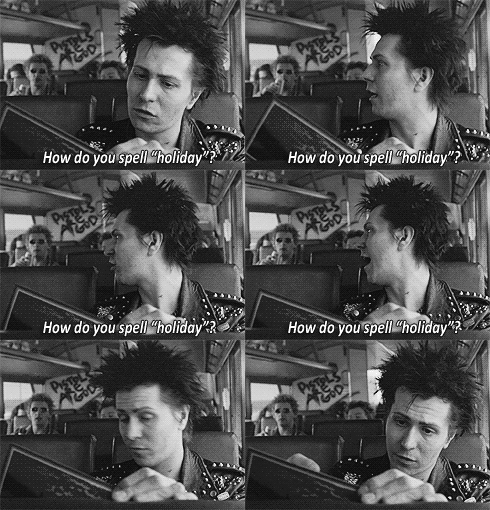
And we’re back for another blog post, with a new film, and a new set of readings. This week we watched Sid and Nancy, the 1986 drama directed by Alex Cox. Before I even go on about the film I want to introduce the most important fact I actually missed until it was pointed out. Sid Vicious is played by Gary Oldman, or rather as I know him, Sirius Black. I grew up living and breathing the Harry Potter franchise: novels, movies, fan-based content. There were no limits. I was severely disappointed in myself when I didn’t even recognize him. There is an 18 year gap between his portrayal of Sid Vicious and Sirius Black, so there is a lot of growth and age, but to learn that fact shocked me to my core, more so than the drug film readings.

This weeks film was a lot darker than I was expecting. I really didn’t know what to expect. Before this cult films course I had never even heard of this film, perhaps because of its heavy drug use and drug influence. Growing up in a sheltered world the entire concept of this film would have been a no-go in my household. A lot of these films we watch are very different to me, but I am very grateful for this new experience and all of the films are so drastically different it’s like I am being driven at high speed through all of the culture I have been missing out on.

This week we read the chapter on”Cult Cinema and Drugs.” I was actually very surprised at how deeply effected cinema was by drug consumption and portrayal. I knew it held a role in the history of just about everything, but I had no idea how much or why until this week. “Drugs have also played a crucial role in many sociological accounts of deviance and subcultures. In various, often youthful, sub-cultural groupings, different drugs have often played important roles as agents of altered conscious-ness that can erect barriers between “us” and “them” (i.e.“straight,” conventional society)” (165). Drugs are the newest way we have learned to differentiate between the “mainstream” society and the “outskirt” society. Most of this film follows the destruction of heroin addicts and ultimately ends in the deaths of both characters, something tragic albeit predictable. Based on how I was raised I took this film as a warning of “don’t do drugs kids,” a very common phrase now. In a completely different society this is a tragic love story that doesn’t actually end horribly, because they’re together in this “after” world. With how significant the role of drugs play in the plot and in society it really made me question the ending. I was happy they ended up “together again” rather than it just being a harsh ending, but does this “happily ever after” take away from an important message on heroine addiction? It was hard to tell. The type of drug they chose for the film is also super important. The fact it was heroine instead of marijuana changes so much. The severe drug choice made me sit back and think, even if that wasn’t the ultimate goal of the film.

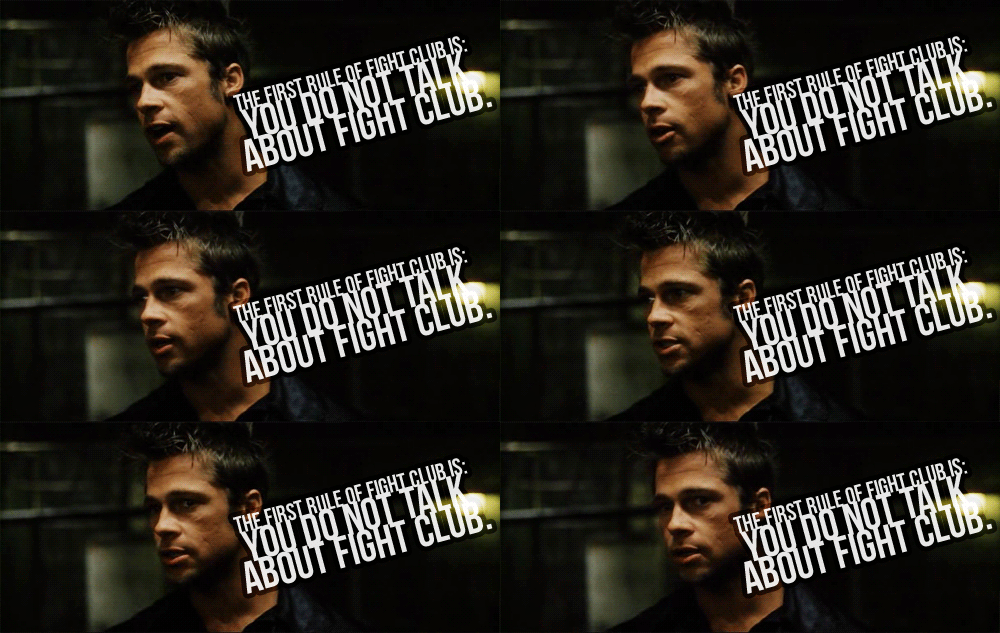
And finally, this week we had two amazing film presentations. This week we got to enjoy La Haine and Fight Club. I have not seen the first film, something I plan to change, but the second is one of my all time favorites. I won’t go on, as we both know the most important rule of Fight Club, is we don’t talk about Fight Club.

Nostalgia, Classical Hollywood Cults, and KISS

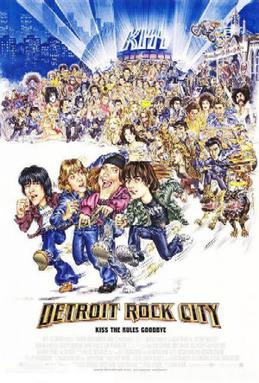
This week we watched Detroit Rock City, the 1999 teen comedy. This 95 minute film was directed by Adam Rifkin and grossed $4,217,115 out of its $34,000,000 budget. Wow. The journey of these four boys, Hawk, Lex, Trip, and Jam, is a little crazy. Albeit there were a few issues with continuity, but if you suspend your belief a bit you still manage to follow the film just fine. The boys have to see KISS, there was no real option there. However, the things they have to do to see the band are crazy, yet I was laughing the whole time. It was really hard to take them seriously. The film was overall pretty funny, feigning on the idea of being a bit much. I really enjoyed watching each of their journeys, even Jam’s overbearing mother, come together in this long story-line to go see a KISS concert.

This week I got to present one of our readings. My reading was “Classical Hollywood Cults,” by Ernest Mathijs and Jamie Sexton. This ten page reading was really interesting and worked really well to tie in major themes of classic Hollywood cults. The major themes that made up the classical Hollywood cults were nostalgia, gaiety, intertextuality, forms of labor, and violence.

Nostalgia is a sense of yearning for a better time, or home. Nostalgia also became the yearning for that initial impression of a film left after the “first time” exposure of a film. This “first time” nostalgia sets classical Hollywood cult viewers apart from the other cultists. You can never get a first take on something again, but it’s so much more than that. This first time is also really important to the “true” capture of the film, focusing on originality and reality. In the mid-1950s nostalgia stops having an impact on the present and from then on only relates to the definite past. This sense of nostalgia is reinforced by what they called time travel, essentially interrupted by flashbacks or songs and it is sometimes over-cluttered with the past, to the point where the story cannot progress functionally. This is really important. Nostalgia is a key factor in almost all of the other parts that make up a classic Hollywood cult.

Something I found really interesting was the discuss on types of labor. Basically, the kinds of labor or perceptions of labor are prone to attract fan devotion through their imperfect fit within, and challenges to, the system. The labor of stars with cult reputations of the classical era are drenched with the impression that they stand for a “truer” kind of “professionalism, sophistication, glamor, or charisma from a time when such qualities were said to be of a more pure constellation” (187). Their focus on the category of labor, that was deemed to have the most cult appeal, is that of a child actor as it combines the innocence and purity associated with the child and the mental and physical endangerment of their well-being by Hollywood. This debate on innocence and purity versus the perverse adult world of Hollywood don’t coincide, which is what makes child actors such a big deal. They are opposites, yet the same all at once, which could describe classical Hollywood cults in a nutshell because they are mainstream and marginal, and center and periphery at the same time, both of which contradict the other.

If there was only one other thing you can take away from the reading I’d pick the impact of television on the classic Hollywood cults. From the 1960s onwards, and particularly through the 1970s and 1980s, television gradually replaced the repertory theater. Television became the main form of family entertainment, and it also became the medium classical Hollywood cults migrated to. Seasonal television re-runs, and occasional theatrical re-releases, add to the already nostalgic-heavy long-term receptions of classical Hollywood cults. The consequence of this development has been a gradual disappearance of classical Hollywood cults from the studies of cult cinema. . “Peary’s first volume of Cult Movies (1981) lists 41 classical Hollywood films, out of a total of 100. In his subsequent collections that ratio declined drastically” (193). This narrowing of the perspective also affects how some of the themes of classical Hollywood cults highlighted, such as gaiety, or nostalgia, are remembered. “The danger exists that classical Hollywood cults will soon be cast out of considerations of cult cinema altogether. Before long the current nostalgia within classical Hollywood cults may soon be replaced by a longing for classical Hollywood cults” (193).

I feel uptight on a Saturday night
Nine o’ clock, the radio’s the only light
I hear my song and it pulls me through
Comes on strong, tells me what I got to do
I got to

Get up
Everybody’s gonna move their feet
Get down
Everybody’s gonna leave their seat
You gotta lose your mind in Detroit Rock City

I Think I’m the Dazed and Confused One

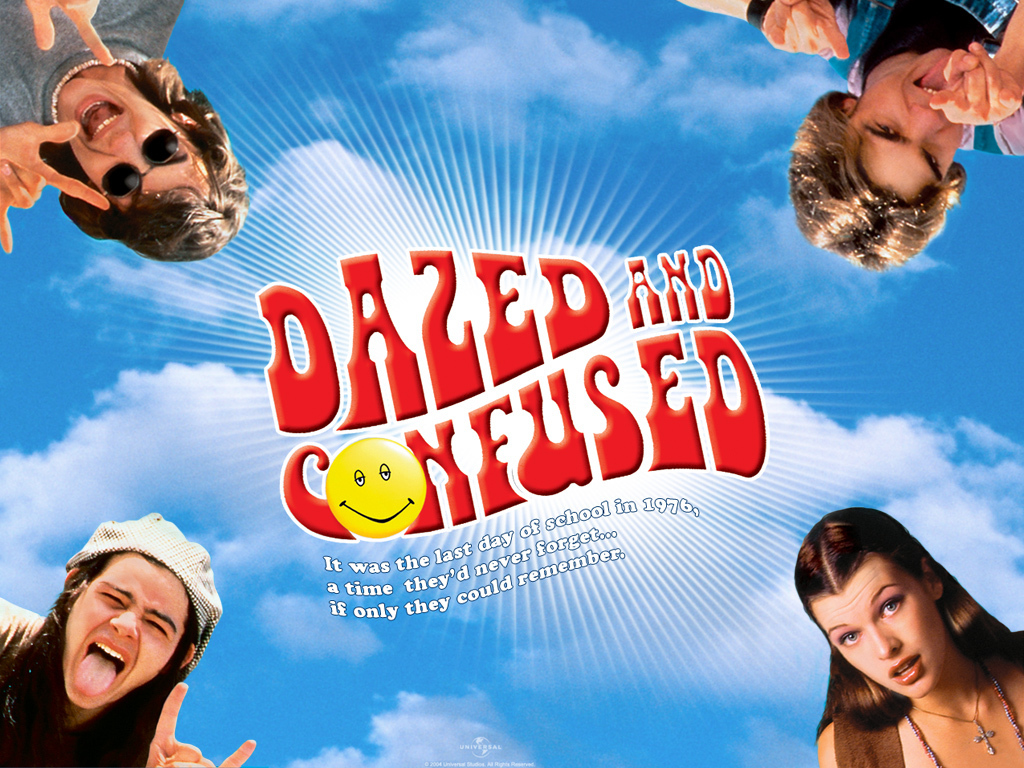
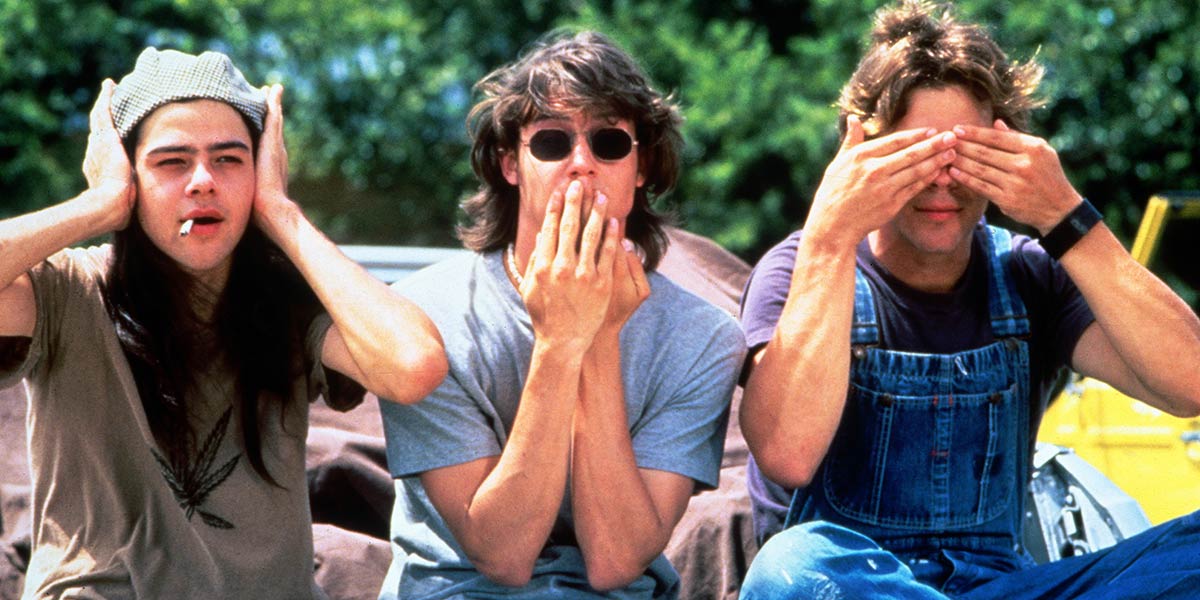
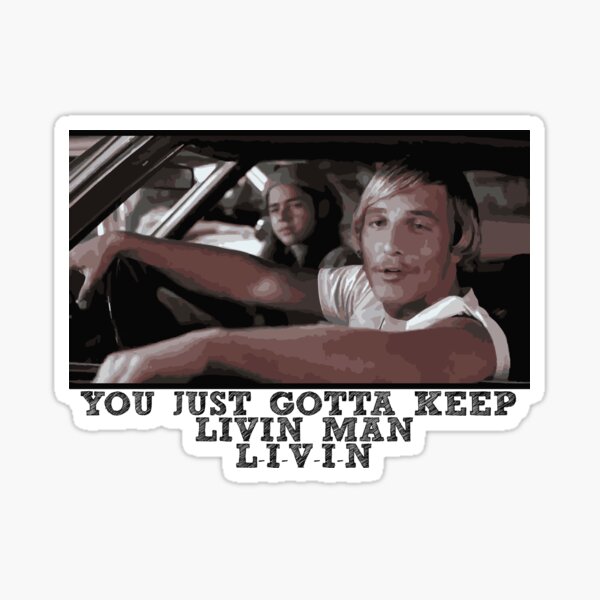
This week’s film was Dazed and Confused written and directed by Robert Linklater. This 1993 film starred Jason London, Matthew McConaughey, and Wiley Wiggins. These adventures of high schoolers on the last day of school in 1976 are crazy. From hazing freshman, to parties, to knocking down mailboxes, and to “stealing” beer. This intense coming of age story follows rowdy teenagers in a Texas town. We watch as the seniors phase out and the incoming freshman are initiated in. The entire thing feels like a sorority/fraternity house initiation, which is kinda cool and makes me really glad I never joined one.

Watching some of these older films really makes me question fashion of the decade. I watch different patterns and styles dance across the screen and I compare them to today’s fashion. The drastic difference and similarities in just wardrobes is phenomenal. If you compare that to the change in ideals and society’s rules you see the progression of our culture and some changes are better than others. In everything going on today with the pandemic raging though our country it was nice to watch a group of teenagers with no cares in the world. I was even a little jealous. But all in all, their journey, albeit not the one I expected to see, was an interesting one.

Now, my favorite part of this film. The soundtrack. Just a few examples of the amazing hits they played in this film are “School’s Out,” “Low Rider,” and “Sweet Emotion.” There are very few films I have been able to witness that had such a great variety of songs that I grew up listening to and loved. I’ve also played all of them on Guitar Hero on a loop, just as an example of how embedded these songs are into my life. I could go on for hours about “Slow Ride” by Foghat and “Hurricane” by Bob Dylan, but I will save you all from more appraisal on Jeff Charbonneau, Eeda Kitto, Art Ford, and Harry Garfield’s work in the music department for this film.

This week we had a great selection of readings. The one I am going to talk about is by Donna de Ville. Her piece, “Cultivating the Cult Experience at the Alamo Drafthouse Cinema,” shows the essence beyond just a simple cinematic screening. She brings in the audience participation and exhibitionism that the Alamo portrays in several different ways. This “full immersion” that the Alamo Drafthouse tries to do, and succeeds in doing is amazing. Everything from the retro gimmicks of a drive in theater to some great food make the Alamo successful. However, the part that really stuck out to me was the owners involvement. They work so hard to make the Alamo Drafthouse a unique and amazing experience to bring people coming back for more. The Alamo gives a variety of cult followings a place to call home, keeping its doors open to just about anyone. “in the case of the Alamo, a contingent of fans embrace an exhibition site and viewing experiences counter to, and even in resistance against, popular mainstream culture.” In every way the Alamo exhibits its own little world. They don’t conform it to what’s most popular, and they don’t let the world dictate how they run their cinema and that in itself is worthy of praise.

The Strange Artistic Event That is Suspiria

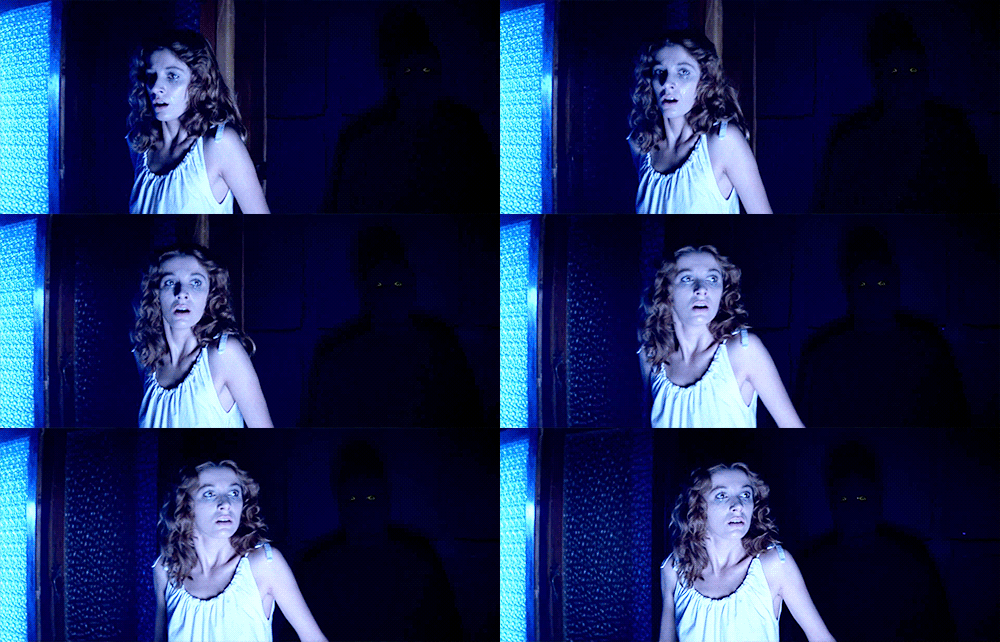
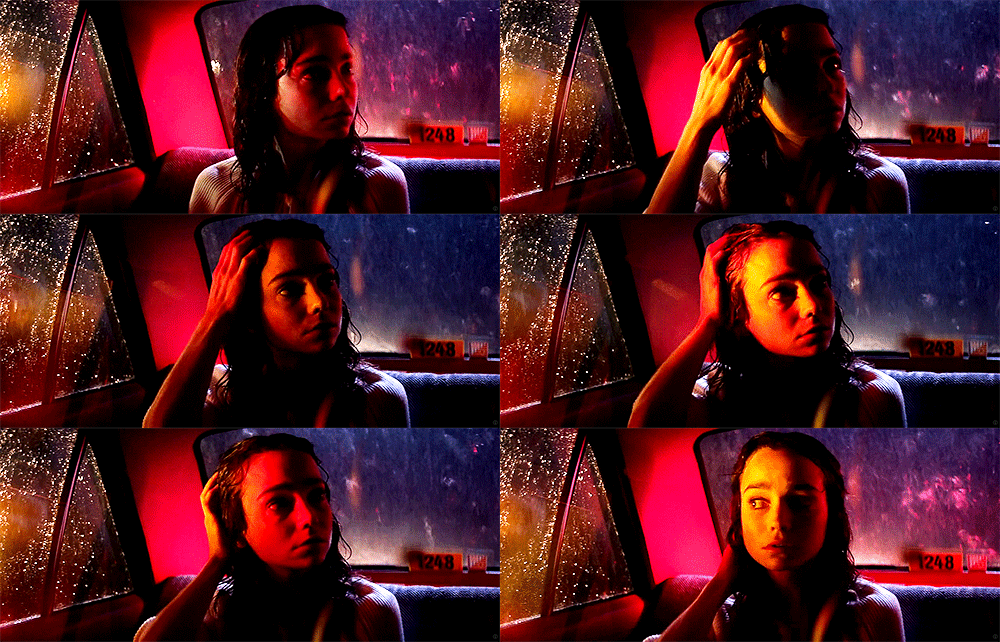
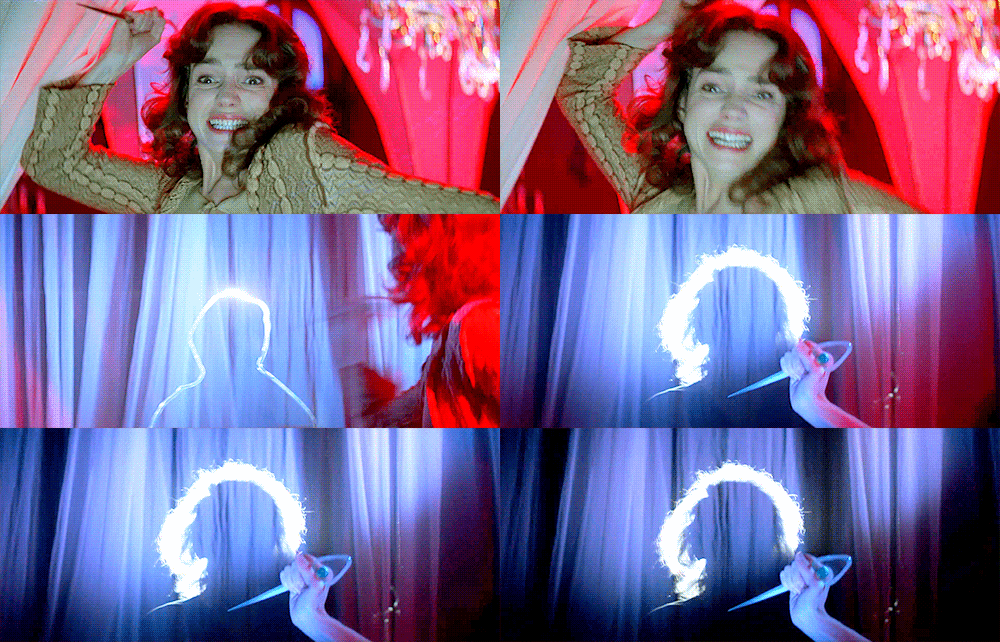
This week we had the pleasure of watching Suspiria. Suspiria is a 1977 film directed by Dario Argento. This artistic horror film exemplifies a lot of art decor, lighting changes, and very ornate set designs. Although the film has a lot of strange scenes it’s interesting to watch. However, the biggest let down is we don’t know who the killer “animal” is by the end! We get glowing eyes and hairy arms of some mysterious being that isn’t totally human or animal, but we never quite find out what or who he is. This plays heavily into the supernatural aesthetic of the film that also involves magic, witches, and unexplained phenomenons.

Setting is one of the most important parts of the film. The darker scenes are accompanied with dark locations, shadows and sharp structures, while the calm and safe meetings are in open and bright spaces. This is done on purpose. They want the audience to really see the difference. Everything from where Daniel was murdered to the dance academy is adorned with darkness, or sharp structures. It creates a jarring effect when Suzy goes to meet the psychiatrist out in the open in broad daylight. Setting is very important to the narrative, even if a few things are cliche. Who can resist a dark and stormy night?

The display of colors and light effects are jaw-dropping. I’ve never quite seen anything like it. It is so distinct and articulate that there are not enough words to describe the vast array of emotions it evokes in the audience. Pairing the visual with the audio only hits harder. The music playing in the background of every scene tells you how to feel, whether it is chanting or an intense choral music. These sinister lullabies are creepy, albeit one of the creepiest parts of the film.

This week we had several readings. One of the biggest things that stuck out to me is that Suspiria is a “horror” film. It is listed as a “cinematic giallo” which is Italian for a mystery film. I was never actually scared during the film, so I would agree with mystery over horror. If anything the film was more creepy and strange than scary. There was a lot of murder, but even when the arm shot through the window to kill the first girl I wasn’t scared. If anything the scene intrigued me more.

In our reading “Doing Violence on Film” by Andrew Cooper we see an in-depth insight into the mystic part of the film. “The witches’ invisible power thus carries out their will.” This invisible power was hard to pick out at first. Until Suzy looks into witches herself, seeking out the psychiatrist and talking to an occult specialist the phenomenon doesn’t make much sense. Once the thread we are missing is put into play everything starts to fall into place. The fact the dancing academy is run by witches, powering a “Black Queen” is fun and an interesting plot twist. I am upset that poor dog became a casualty of the magic, being used like an instrument as if he were the same level as the attic of barbed wire. And lastly I still want to know what that mysterious creature was that killed the girl from the dance academy.

Valerie and Her Week of Weird

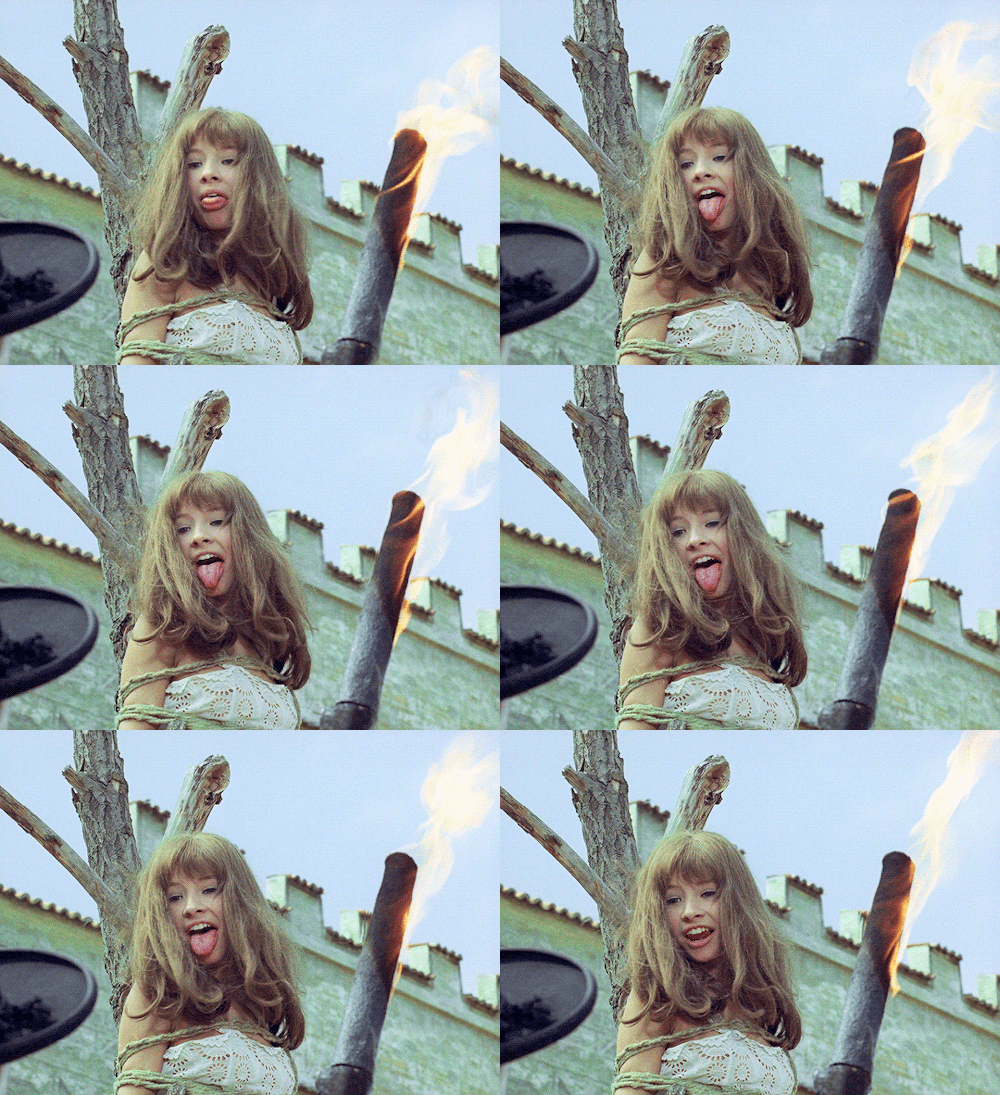
This week, our first online week, has been an interesting one to say the least. The film we watched, Valerie and Her Week of Wonders, is insane. I am going to focus heavily on the film because there is so much to unpack with it. The only thing we no for sure is that we know nothing. The surreal setting and shooting of this film creates an alluring hallucination that captivates the audience in confusion and intrigue. Although we have no idea what is going on as we follow Valerie in her rite of passage from maidenhood to womanhood. The acid trip of a dream we have to witness to get her to womanhood is very hard to sum up in just a few words. It is such an amazing artistic film, but if you aren’t focused the whole time you have no idea how you got to where you are. (Sometimes even if you are paying attention you have to rewind and try again.)

This thirteen-year-old girl lives an interesting yet messed up life. So much of her life revolves around familial relationships, that are warped and improper. Society would frown upon how supposed siblings and parents act. The fine line between how taboo the relationships are and aren’t is the fact we have no idea if anyone is actually related or who they say they are. This strange trail of events is hard to comprehend, but in the article “HORROR Transgression, transformation and titillation Jaromil Jireš’s Valerie a týden divů” by Tanya Krzywinska, the desire and sexual attraction between apparent family members.

“In accordance with Freud’s central notion that fantasy is subject to the distortions of the primary process, the Oedipal connection becomes diffuse here, subject to disavowal. It is never clear that Valerie’s brother is indeed her brother, for example, or that the vampire-priest-constable is her father. They are both objects of Valerie’s desire (as she is the object of their desire), yet to keep such a pretty game in play, these potential sexual relationships are invoked only to be deferred. That all the central characters in Valerie’s world do not have definitive, stable identities locates that world as subjective artifice. Valerie imagines a range of scenarios in which her family members are endowed with magical powers,their status inflated to fairytale proportions, all along the lines of Freud’s family romance.”

Valerie has to experience and understand what her body is doing, how it is changing. The unclear Oedipus complex happening in this film is hard to shame. Because everything goes back and forth on if anyone is actually related it is hard to completely classify as taboo. At most we can call it “icky” because society’s rules are borderline being crossed, but we don’t know for sure. Not knowing for sure is how this film skates by, which was done deliberately, not only in this film, but in the novel it was based from.

The surreal imagery of this film is beautiful. The harsh shifts between scenes, the nature, the over focus on white, flowers, and fruit is at the forefront of the film. Most of the imagery pertains to purity and Adam and Eve. These over-focused images and hidden messages only add to the illusion that we know what’s going on in this film.

“Valerie jolts along with the logic of a hallucination, its more conventional vampire plot intercut with odd visions and heightened by a soundtrack of choral chants and disembodied dialogue. Sometimes these dislocations bring us intimately close to Valerie herself, from various appealing angles, and on a second or third viewing you see how these shots often punctuate moments of conflict, as if Valerie’s inner equanimity were guiding the course of events.” (Prikryl)

This weird twist on Adam and Eve with a dash of vampires is a truly questionable. This mythical world that Valerie lives in is hard to follow. The biggest problem is we don’t know if its reality, or a dream. The film is centered around Valerie in her bed sleeping, or her returning to it, an underlying idea that its all a fantasy in her head that her body has rampaged because of the adolescent hormones blooming inside her.

Coming of age stories are a huge hit, especially among the younger generations. This taboo version of one addresses many of the darker themes and desires that weren’t allowed to be addressed. However, in the late 1960s, the code that restricted what was taboo and could come on the screen was finally squashed out. Anything and everything was allowed, it was an open and taboo free future. Moral standards could be lowered and had no real guidelines, so when people filled the theater to watch near incest it was allowed, perhaps not Kosher, but it was no longer against cinematic codes. The film itself was a must see. Although the language barrier may be an issue the subtitles help a lot. The confusing ride is worth it in every way. This film requires more than one screening, as there is so much to unpack, notice, and experience.

The Warriors and a Glance at Fandoms

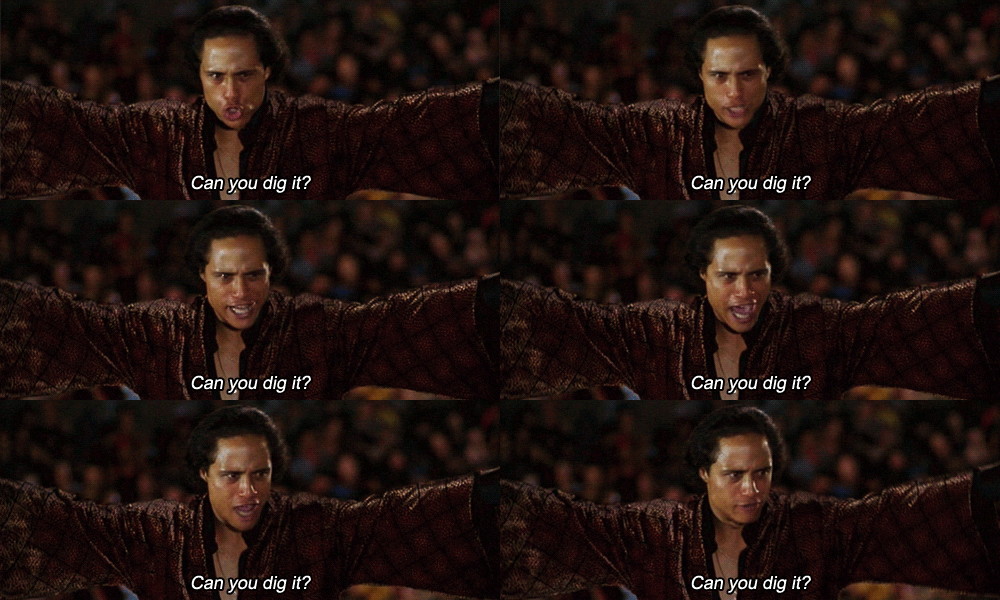
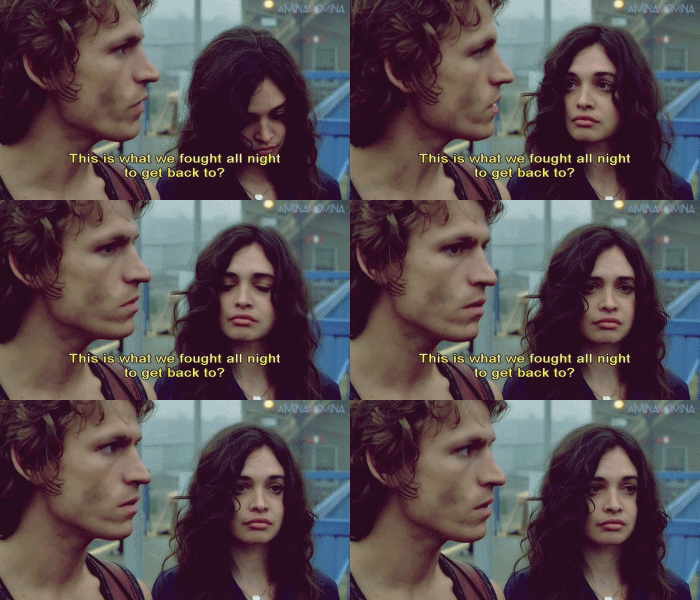
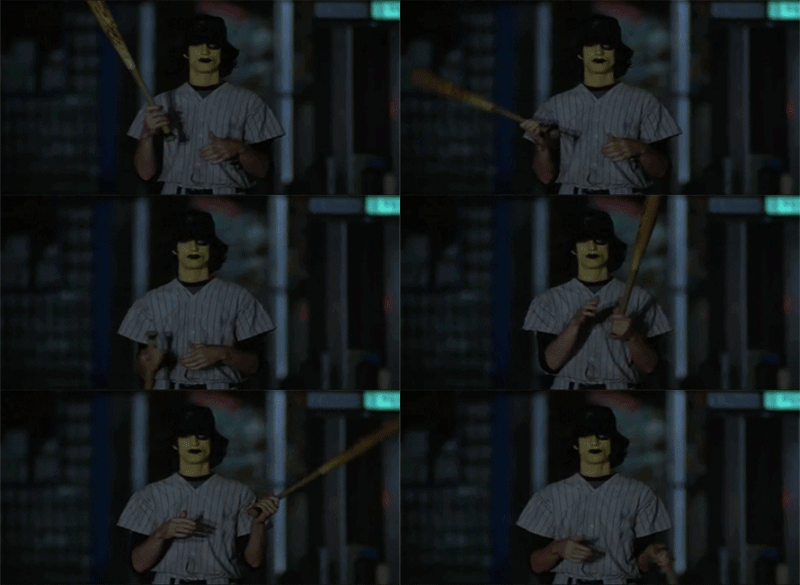
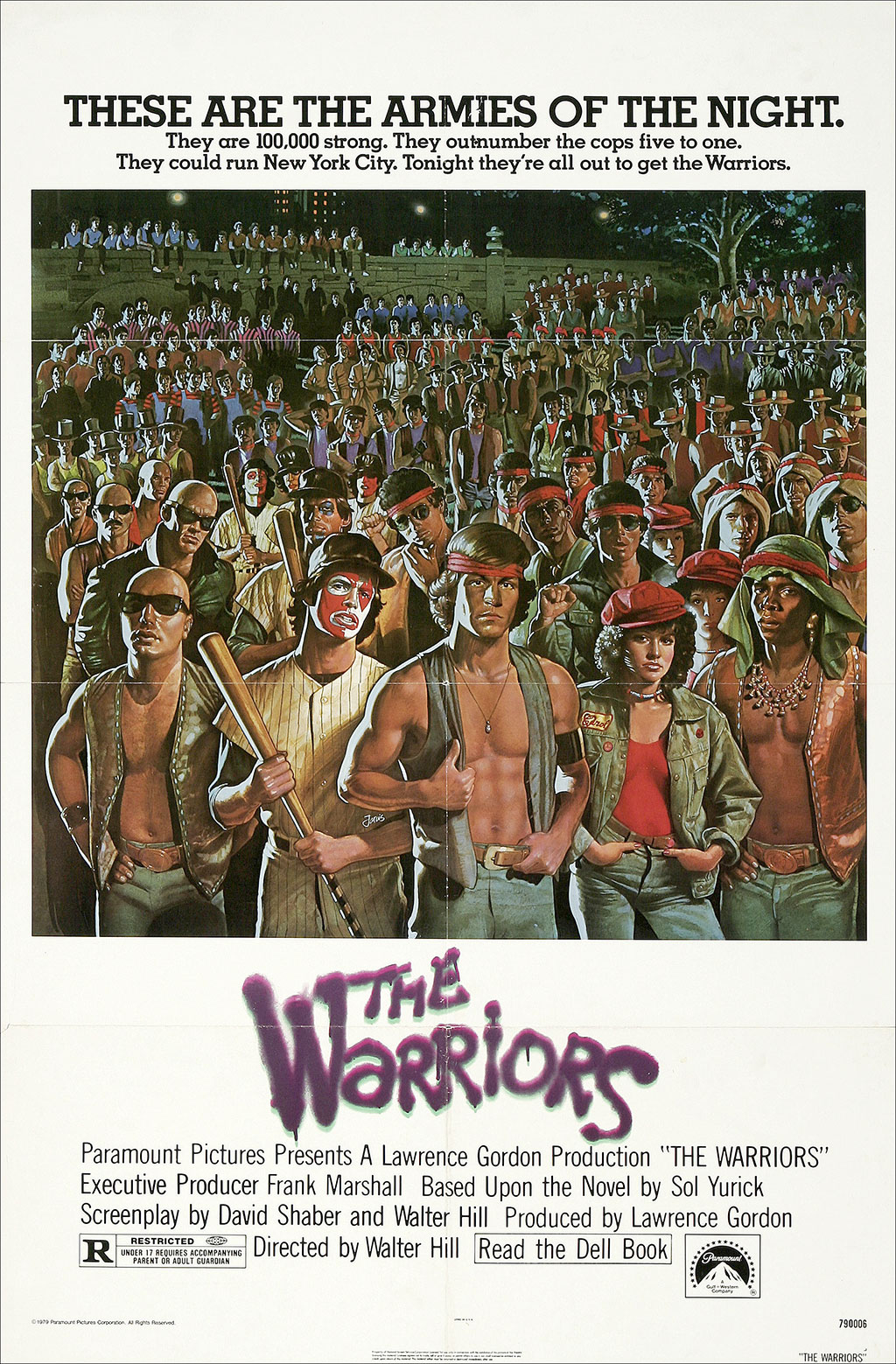
This week we watched the classic cult film The Warriors, a 1979 film directed by Walter Hill. The Warriors was based on the novel by Sol Yurick. This amazing film is a must watch. The congregation of gangs in the park, all lead by Cyrus, is a cacophony of noise and mania. Cyrus presented a gang utopia, where everyone ruled New York City, and claimed it from the cops, something progressive yet terrifying to some. This results in him being shot by Luther, the Warlord of the Rogues, played by David Patrick Kelly. In an interesting twist Luther claims the gang, the Warriors, killed Cyrus, starting the massive hunt for the nine representatives that came to the rally. The Warriors’s Warlord, Cleon, played by Dorsey Wright, is killed immediately, leaving only eight members to make it home to Coney Island. The wild ride of watching the gang escape the 100,000s of gang soldiers in a desolate New York City atmosphere isn’t what you would expect. The action and comedy keeps you on the edge of your seat, wondering what curve ball is about to come around the corner. It is not surprising that this film has gained such a following, to the point where a video game was developed.

While studying this film we also studied fandoms, as they are a very large part of cult culture. It is important to understand the many layers of fandom and its impact on not only the economy, but on cult culture. One of our readings was “The Cultural Economy of Fandom” by John Fiske. Fiske claims there are three main characteristics of Fandom and they are: discrimination and distinction, productivity and participation, and capital accumulation.

Discrimination and Distinction: Discrimination is the lines clearly drawn to decide what is fandom and what is not. Fan discrimination has two affinities the socially relevant pop culture and “aesthetic discrimination of the dominant” (448). The key difference is that the subordinate has to be for something, making it functional. The aesthetic discrimination talks about hierarchical power and categorizing things, such as canonization, deciding between who and what is canon and what should be excluded. Nothing that doesn’t make the mark gets let in. Its a cut throat nature, yet also very inclusive. It becomes its own community.

Productivity and Participation: The three types of productivity are semiotic, textual, and enunciative. “Fan productivity is not limited to the production of new texts.” It includes the original texts construction, pop culture performance, and the commercial narrative. (451) Without the fans participation and their own production of content in regards to their fandom the stars and work would be lost. Stars owe their stardom to their fans. This productive nature for the fandoms only further the fame and fortune of the culture.

“Semiotic productivity is characteristic of popular culture as a whole rather than a fan culture specifically. […] An enunciation is the use of a semiotic system (typically, but not exclusively, verbal language) which is specific to its speaker and its social and temporal context. […] Fans produce and circulate among themselves texts which are often crafted with production values as high as any in official culture. [Textual production is when] fan texts are not produced for profit, they do not need to be mass-marketed, so unlike official culture, fan culture makes no attempt to circulate its texts outside its own community. They are ‘narrowcast,’ not broadcast, texts.” (450)

Capital Accumulation: In fan culture they accumulate knowledge, collections, and cultural and economic capital. As fandoms are a widespread network system that shares and collects data, whether it be canon information, new discoveries, or memorabilia. This wide range of people and ideas makes this capital accumulation endless. By having a massive fandom it brings in a massive amount of money. Producing something people love and thrive on will accumulate massive amounts of money for stars and those who produce it. There is a mass market in fandoms and making money will always be a major motivator in society. Any time corporations and companies can make the big dollar they will.

Blacula: The Blaxploitation Horror Film

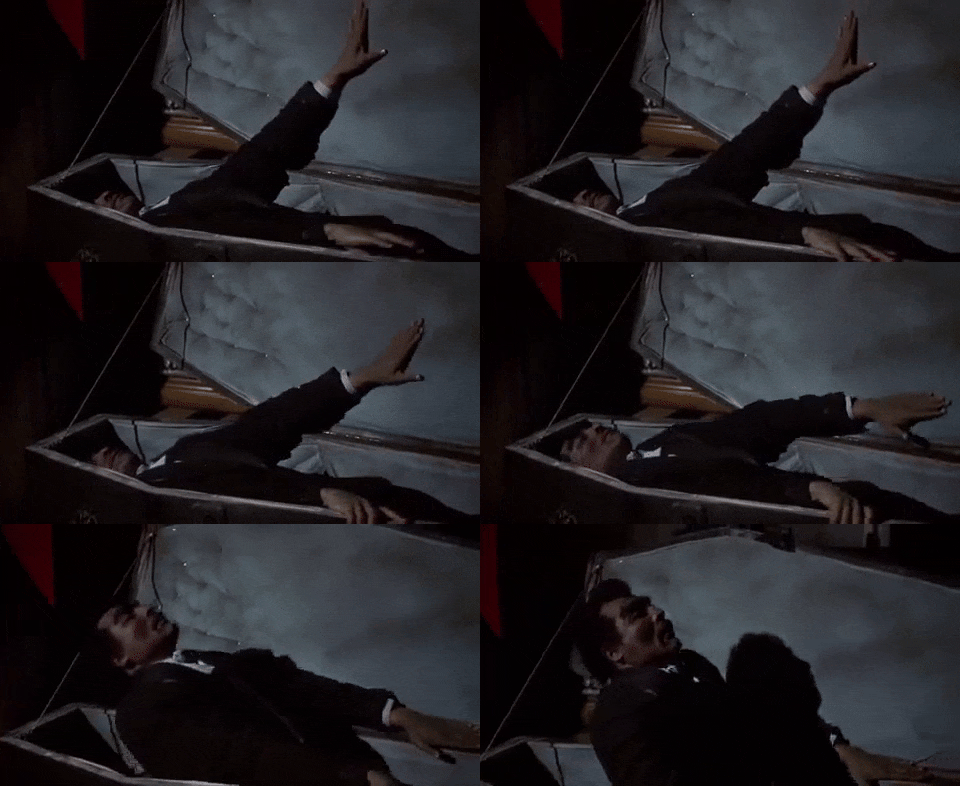
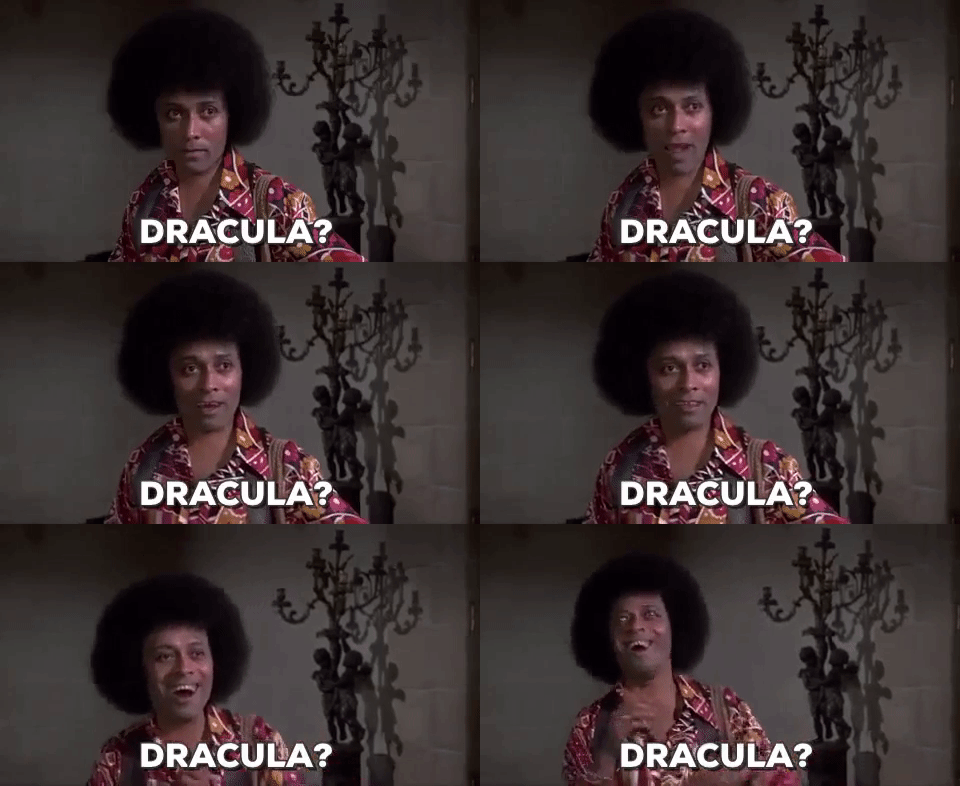
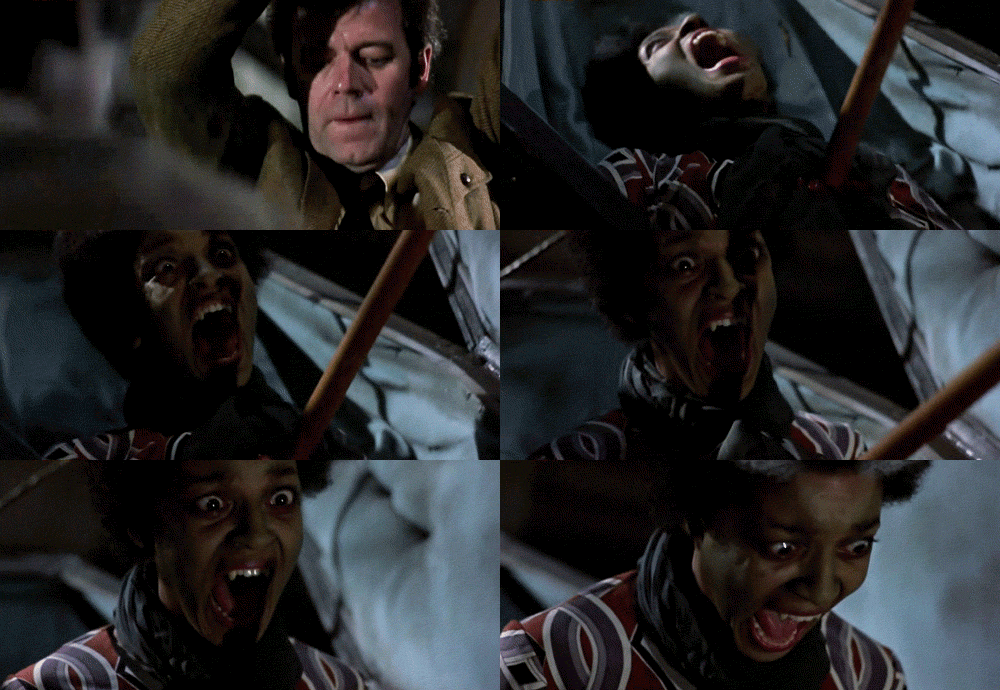
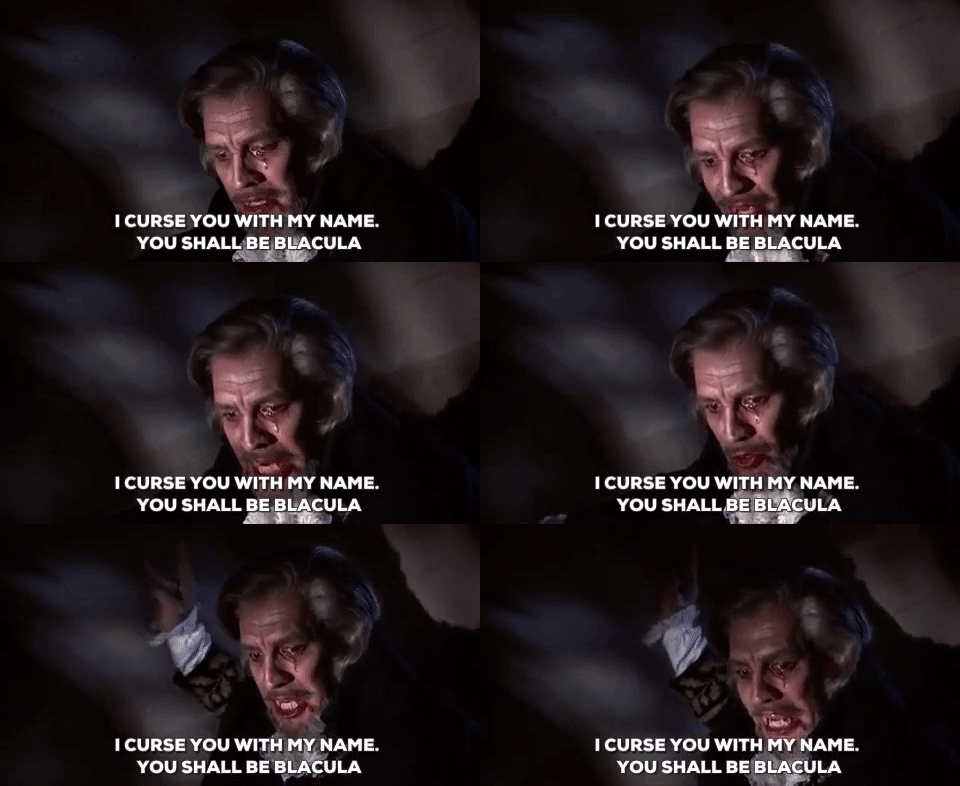
This weeks film was Blacula the 1972 blaxploitation horror film conquered by William Crain that takes on not only white racism in America, but the monstrosity tropes of horror. This 1970s film is considered “relatively conventional” because it takes blaxploitation out of the crime genre and into horror, trying to take on the “demonization of gender and sexuality, which are arguably more deeply embedded as monstrous within both the horror film and the culture at large” (Hefner 63). The film successfully does so. Blacula is a radical film because it knocks down the exploitative stereotypes usually associated with blaxploitation and offers a different reality to black and white partnerships.

The film itself is very entertaining, even with a few of its badly captured stunts and attacks. Although it is a horror film it has some comical moments because of its badness. However, my favorite part is it follows Stoker’s Dracula(1897) novel rather than the screenplay. The novel itself is one of my favorite classics and a very popular one, as it has been repetitively reproduced through several forms of media and genres.

“the film collapses the semiotic divide between race and sexuality and provides a clear break with the vampire tradition, which traditionally demonizes both racial and sexual difference as potential threats to social order. Ultimately the film provides a metacommentary on the emerging blaxploitation action film […] presenting a more radical stance on racial unity and oppositional politics than the vast majority of blaxploitation films” (Hefner 65).

The readings for class this week consisted of several critiques and academic readings on Blacula. The one that stuck out to me the most was “Rethinking Blacula: Ideological critique at the Intersection of Genres” because it focused both on blaxploitation and the horror genres and reexamines the films impact on both. I like that Brooks Hefner comes at the film with a new way of thinking making it radically self-reflexive rather than just a critique on the film. He takes the idea of the film and shows how it reverses racial stereotypes and criticizes white heteronormative authority rather than the usual racial tropes with black and white crime genres. The romantic monster, Mamuwalde, has created a community for the oppressed, generally African American audience, and even during his “monster scenes” he doesn’t include white men or women in his vampire clan, killing them like a human would rather than turning them into vampires.

Hefner takes the time to not only analyze Blacula but the blaxploitation genre as a whole, taking in the other films into his critique and how it forms the idea of the genre. He continuously calls the genre a cycle because of the action films associated with the genre. Blacula breaks this cycle, bringing a diverse look at blaxploitation and horror. Crain tackling such a huge task and not falling into the usual tropes is transgressive and unconventional within itself. William Crain does an amazing job with the $500,000 budget he is given.

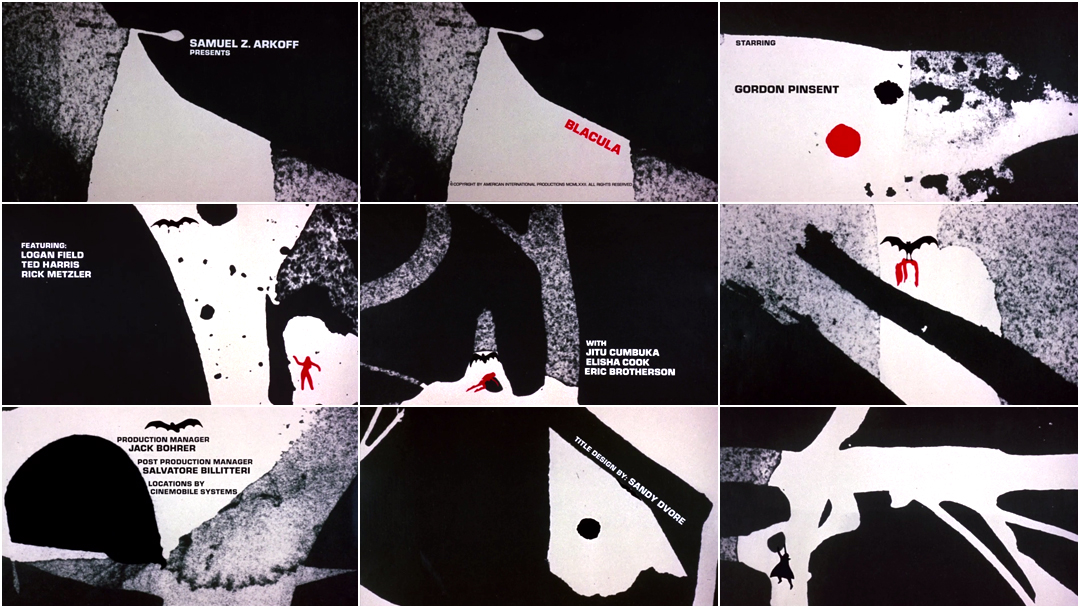
The title sequence, done by Sandy Dvore, was one of my favorite parts of the film, and clearly had a lot of thought and time put into its animation. The effort is appreciated and enjoyed. Its concept follows along with the plot of the original Dracula and its tropes about female frailty and sexuality involved with vampires. These are also shown in Blacula with Mamuwalde and Luva/Tina. Their attraction and passion happen before he is turned and only increases after and falls under the vampire stereotype. Even its more modern reality it follows Stroker’s story line and themes, which is what I appreciate the most from Crain’s film.