Author Archives: ChelseaRae

Pink Flamingos: Transgression and Freakery

Had a budget of about $12,000

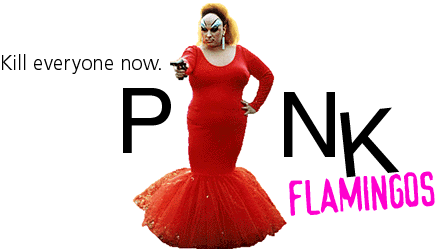
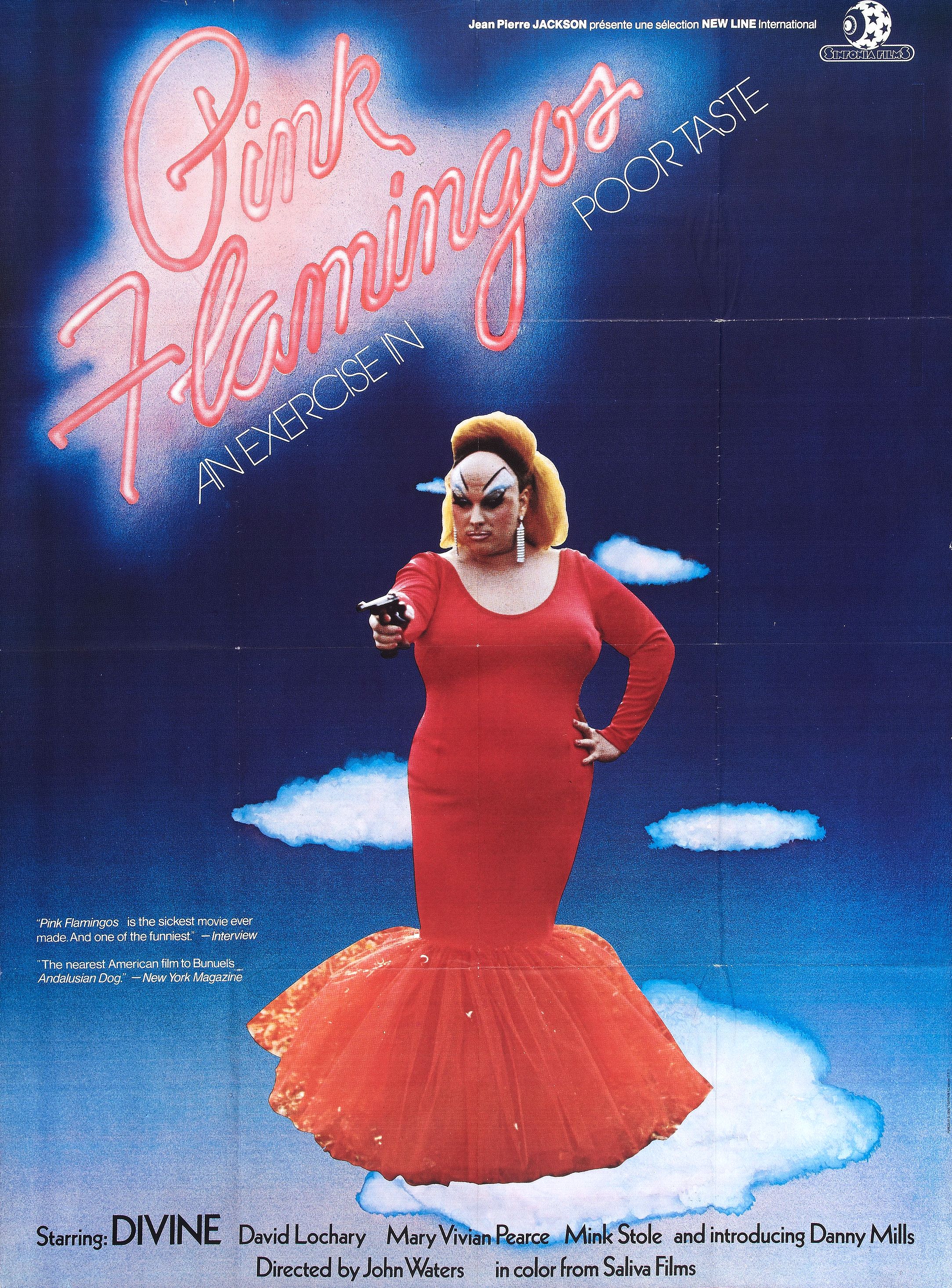
John Waters directed, produced, and wrote the 1972 cult film Pink Flamingos. The film is called “an exercise of poor taste” as it’s filled with “outrageousness ” with its transgressive nature. This was the perfect film to pair with our readings on transgression and freakery. Divine, our main character, a well-known Drag Queen, has been deemed “the filthiest person alive,” a title that seems to be very important to them and their rivals, the Marbles, Connie and Raymond, played by David Lochary and Mink Stole. The film is transgressive in the sense it exploits several taboo topics of the human body including: nudity, voyeurism, sodomy, masturbation, incest, rape, cannibalism, and murder. These harsh and intense topics are normally hard to talk about, which only furthers Waters’s pride in his truly disgusting film.

“Transgression and Freakery” by Ernest Mathiijs and Jamie Sexton was an enlightening reading. They define transgression as “any act that violates law or morality; more broadly it refers to the act of passing beyond any imposed limits” (Mathijs and Sexton). With the strict rules that society dictates that isn’t very hard to do. In Pink Flamingos transgression is set to an extreme octave, including freakery and abhorant topics that in turn categorizes the film as a “sick film.” Freakery shifts social ideologies to obscure naturalism and show the abject, the grotesque, and the impure. These major factors give way to the film, giving the audience an escape into a disturbing alternative reality. The challenges of reality faced in this film show how shallow the pool of normalcy is. Waters’s film makes one question how people can behave in such a way. The film goes to these extremes to reassure the audience that they are normal, this isn’t real, and that they get to enjoy these sick and twisted story lines in this cult film without fear of judgement.
To truly identify this film as a sick film we have to pause and look at the very last scene of it. Divine picks up dog feces and ingests it. A disturbing and disgusting moment that brings the incredulous movie to a close. The narrator, Mr. J, then calls Divine not only the filthiest person alive, but also the world’s filthiest actress.

What were they thinking? The film is still shocking in modern times, let alone in 1972. Although sex was a very public thing in the 1970s the other topics, like dressing in drag, were not considered socially appropriate, whereas now being a Drag Queen is more commonly accepted and empowered as we keep sex behind closed doors. As stated in class the world is becoming sanitized of sex. This cultural transformation is shocking, yet also exciting. The flip in social changes is enlightening, now that we keep sex hidden and encourage dressing in drag, among other ways of expressing oneself. It begs the question what Waters was trying to show. He is seemingly ahead of his time, capturing this glimpse of a different world, but even his extreme ideas in 1972 send us in 2020 for a loop. So where was he headed? What was he trying to say about the people then, and the people now? Pink Flamingos is a very new and very intense experience. However, its disturbing images and ideas are a gate way into understanding cult topics of sick films, freakery, and transgression.

John Waters the master behind it all.

Taboo, the discussion of impurity in the world, often relates to bodily fluids. The unknown, the inside is all impure because we don’t know about it. Society has dictated that the unknown is to be feared because it can’t be predicted or classified as anything. If taboo was looked up in the dictionary Pink Flamingos would be listed beside it. Although the film explores this freak show through humor it is touching on numerous taboo topics. The form of taboo we see in this film is abjection, “where cultural meaning collapses.” Anything considered normal does not exist. it is difficult to describe because language barely scratches the surface trying to accurately convey what is happening on screen.

Reception is the most important part of transgression. Culture changes and has drastically changed since the film was released in 1972. In 1972 the film shocked audiences as it does now. Pink Flamingos gained a cult following rapidly in the midnight circuit and still has one now. Modernity couldn’t tarnish Waters’s extreme ideas. His obscene film is still relevant and gets the reaction he was aiming for, which is the exact reason we appreciate and study the film academically. The film has more to say about us than we do about it.
Carnival of Souls: Mainstream Authenticity and Classic Horror

This week in class we watched the 1962 horror film, Carnival of Souls. This being our first taste of cult horror was an interesting one. Although it wasn’t terrifying it had disturbing images and creepy scenes. The faces popping up in windows and scenes where people could not hear or see Mary, the protagonist, were nerve-wracking. Her battle in trying to understand her place in the world, why so isolated and alone was sad and evokes a sense of recognition in the audience. People can relate to feeling alone, or even like they don’t belong.

The film itself was beautifully crafted and executed. It introduced a new concept, MOS, or mit out sound. This means they shoot the scene with no audio and add it in after filming from a sound booth or other audio track. Often if people are speaking in the scene you don’t physically seen any mouths moving to hide the fact the audio was added in after. This technique was really interesting to learn about.

Although we did not watch this in color, seeing it restored is exciting. The color of the “dead” made them scarier and made it much more obvious that they weren’t just creepy stalkers.

In our readings for class we learned about cult horror from Welch Everman in his essay, “What is a cult horror film?” from the introduction of his book on cult horror films.

“Cult horror films, then, are not classics and never will be. Classic horror films are those that have influenced the entire history of horror movies”(Everman).

Personally, I disagree with Welch Everman’s claims that cult horror cannot be categorized as a classic, unless it is derived from the classic stories of Dracula, Frankenstein, or Wolf-Man. To be considered a classic something must be of highest quality and have an impact, or establish value. Carnival of Souls does this. This film has influenced works of David Lynch and it is a high quality film, especially for its budget of only $30,000. In his essay Everman breaks down cult horror films into three categories: so bad they’re good, good despite restrictions, and just really bad. Carnival of Souls falls in the second category. It’s very low budget classifies it as a B-Movie, making one assume that it should not be all that spectacular and completely low quality. However, the film rebukes all of the usual standards for B-Movies and is a must see film.

Another essay we read was “Cult fictions: Cult movies, subcultural capital and the production of cultural distinctions,” by Mark Jancovich. He focuses on aesthetics and authenticity, debating on academic and fan based consumers, deciding which could be truly authentic. The comment he made that stands out the most to me was:

“The image of mass culture as the unauthentic Other, and of the consumer of mass culture as the simple conformist dupe, recurs again and again within this fan writing”(Jancovich).

He talks about creating the mainstream as if it were an outsider and this big show to pull the wool over people’s eyes. It amuses me that the ideas we find that are “supposed” to be the main culture aren’t actually what we enjoy the most, or the subjects we want. This puts a stronger desire for the cult genre, as it represents everything mainstream doesn’t or parody’s it. The idea that mainstream is just a hoax is fairly accurate. Mainstream is what society dictates “should” be enjoyed because it falls into their idea of right, or correct behavior. Cult doesn’t check off any of those boxes, as it isn’t for everyone, especially cult horror films, it takes a specific group of people to enjoy them. I appreciate that Jancovich doesn’t hold back in his criticize of mainstream media and consumption. It is a much longer read, but it does get its point across. Mainstream doesn’t mean authentic and it certainly doesn’t always mean the correct choice.

Carnival of Souls is a must see horror film, both for its authentic influence that was ahead of its time and for some really great running/chase scenes.

The Unreliable Narrator in Detour: a Film About Fate

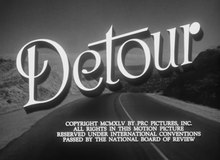
The 1945 film for this week was Detour, directed by Edgar G. Ulmer. This low budget film noir is classified as a B-Movie. B-Movies usually have no stars, low budgets, short shooting times, and massive creative liberty. Ulmer was a King among the B-Movie circuit. He worked best with these conditions and produced enough higher-quality films that he could have graduated to A-Movies, however, a few personal issues got him black balled from the major studios.

A 68 minute film noir starring Ann Savage and Tom Neal.

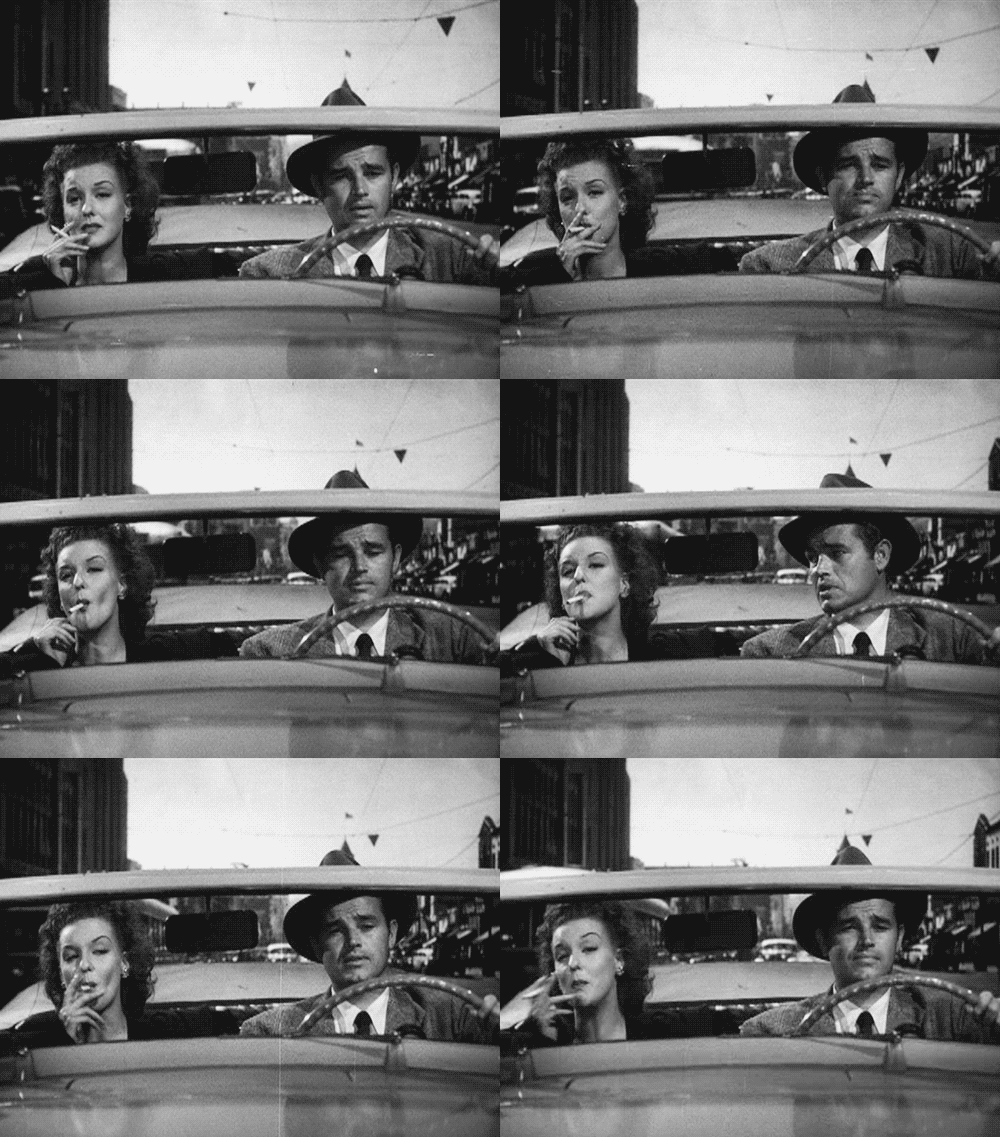
Detour is a quick film, with a fast paced plot and a lot of very bad decisions. Al Roberts is the self absorbed main character. He cares very little for those he surrounds himself with, and for those who care about him. The only thing he seems to truly care about is himself and what he can get from other people. His girlfriend, Sue, wants to up and go to Hollywood, a wonderful dream. Yet Al turns it into this bad idea, making it seem like she is abandoning him, rather than encouraging her to follow her dreams, or even offer to go with her. His mood becomes sour and he all but pouts as he walks Sue home. It isn’t until after she’s gone and his life is bad that he misses her, or rather, misses the fame she could get when she makes it to the top, so he goes across country to be with her. That is where we meet Mr. Haskell, the man who picks him up hitch hiking and takes him to California. How could he possibly mess this up? Haskell dies and Al abandons the body in a gully and robs him of his clothes, money, identification, and car, taking off on his own. And finally, we meet Vera. Vera is the one true match for Al, and the only one who doesn’t put up with him, taking over the role of the dominant one in their almost relationship. She won’t put up with any of his usual tricks or actions, and she doesn’t believe half of the stories he tells either. Vera is a lot smarter than Al, and she knows it, but she is a woman, and during this time a woman was nothing in the patriarchal world. Perhaps they’ve finally met their match, their partner, and can be happy together. Wrong. Money gets in the way again. Al’s assumed identity of Haskell has an inheritance, and selling off the car could bring in nearly $2,000. Al continues to make bad decisions and the cards are severely stacked against him. What is a guy to do? He accidentally hangs Vera with a phone cord, then runs away, leaving a dead wife in bed. Everyone believes Al Roberts is dead because he disguised Haskell as himself. Everyone thinks Vera was Haskell’s wife and that Haskell murdered her so they are looking for Charlie Haskell. So now he is no one and in the middle of nowhere. He is free to be anything and to be nothing. Yet he has never been more trapped than in the last few minutes of the film, sitting in that Nevada diner.

Vera (Ann Savage) and Al (Tom Neal)

It is hard to believe anything that Al has narrated is the truth. In his book of criticism, Andrew Britton has deemed Al Robert’s as an unreliable narrator. It is made very clear in the beginning that Al is very self focused and only cares about himself. His demeanor is often cynical and outright rude. Several instances that are recalled by Al are questionable to say the least. Haskell and Vera’s death scenes are clearly misrepresented by accidents that he couldn’t control, and he would never do such a thing, when it is quite clear that his horrible decisions are the direct link to all of his hardships. The circumstances that Al continues to find himself in is unbelievable, which is exactly what Ulmer is trying to do. Al’s world is supposed to be seen as completely ruled by fate and that he is merely a pawn in a pile of bad deals, but from our point of view we can clearly see that Al’s own subconscious has rewritten his life to benefit himself, and maybe evoke a hint of pity in whoever his internal monologue is for. Like most unreliable narrators Al has turned himself into the victim of fate, rather than accepting the consequences of his own actions and owning up to the hardships of life. Ulmer directs this beautiful fate driven story, but because of the narrator, Al, it is impossible to believe any of it. I firmly believe that Ulmer knew what he was doing when he had Al narrate the flashbacks.

The effects of shadows is an interesting one. Ulmer is known for the risks and liberties he takes with shadow casting and lighting maneuvers. The shadows cast over Al in the opening scene evoke a mystery about the man in the diner. Ulmer uses his lighting to show Al slip into his own memory, making the scene darker to show we are leaving the present time. There was a minimal budget with this film and Ulmer worked with what he had so beautifully. It was hard to understand that the little money he used to make the film itself could result in such a masterpiece of film.

With a low budget of about $30,000 Detour brought in $1,000,000 through Box Office.

Detour is an interesting film and a must see. Although the main characters motivations are questionable, watching fate interacting and mapping out their lives is rather intriguing and even comical. The ways “fate” ruins the life of Al Roberts is a journey like no other. I would definitely watch it again.

Cult Movies: This is Only the Beginning

What is a cult movie? Why are only some movies considered a cult movie? How do they achieve this status? Why do we care? There is no singular answer to these questions. Cult movies have shaped not only the history of cinema, but the history of America. These obscure and revolutionary films have acquired a fan base so dominant and encompassing there is no better term to describe them but cult. To break them down simply there are four major categories to determine if your film is a cult film: Anatomy, Consumption, Political Economy, and Cultural Status. What makes up the film? Was it loved or hated at release? Did it bring in a lot of money? Does it cover a sensitive topic? What makes people love it now?

The exploration of this category in film is a wild ride through the 1900s. If someone could think of it, it happened in a film. A major part of cult film comes from an exploitative culture, taking advantage of the otherwise “taboo” subjects of every day life and providing them in the cheapest way possible to make money. The best way to learn about the rollercoaster life of exploitative cinema is through the 2010 documentary American Grindhouse. This hour and twenty-one minute documentary throws a vast amount of information about the transition of exploitative style films, showing us examples of movies from the early 1910s to the later 1970s. These taboo films are reactions to the culture around them, although they may influence actions of the viewers, they ultimately react to the world as it already is and what the viewers want to see.

2010 Documentary about the history of exploitation movies, from the early 1900s to the 1970s. Directed by Elijah Drenner

Maniac is an anti-classic cult film, directed by Dwain Esper in 1934, written by his wife Hildegarde. It is a prime example of an exploitative film. As Robert G. Weiner would call him, Esper is the Prince of Exploitation, willing to do about anything to make a buck. Maniac‘s changing props, poor cut action scenes, and low quality audio begs the question of why this is a must watch film. Although it is commonly played off as a mess of a film with no true narrative, albeit true statements, it plays a far superior role in objectifying what is real and what we believe to be. Esper tackles a hard subject when he takes on mental disorders. During the Depression Era, in which the film was originally aired, there was very little knowledge on mental disorders. Due to production codes and regulations, Esper had to make his film into something “educational” or at least enough so that it passed, which explain the random cuts to disorder definitions. Although these definitions are no longer accurate enough today, during the time this is what the medical boards believed in and followed. Esper’s rough depiction of mania was at the extreme end of the spectrum, however, it fell in accurately at what the audience would have imagined themselves. This low-budget film almost painful to witness, but easy to enjoy. Most importantly it makes you ask what is real? What isn’t real? And reminds you to never look at grapes or oysters the same again.

“Why, it’s not unlike a grape or an oyster.”

Tom Gunning’s “The Cinema of Attractions” is one of the best pieces of literature to understand this. “Every change in film history implies a change in its address to the spectator, and each period constructs its spectator in a new way.” Gunning knows the best way to bring people to the cinema is to give them exactly what they want, usually the most extreme things and dark desires that most won’t admit to wishing for. People often live out their darkest desires vicariously through a form of media, whether it be a movie, song, or book. Society dictates how people conduct their lives, bringing about the ultimate suppression of needs and desires. As human beings we often have a moral compass to understand what is right and wrong, however, that doesn’t stop the darkness forming in the back of our minds. A majority live their entire lives without acting on these unwelcome desires. As people and culture change the media forms into the mold, filling the squares people aren’t allowed to fill. Blood soaked murder scene, transcendent highs, aggressive pornography, and nudity fill the screen and people buy a ticket. It’s all okay, its not real. After all, it’s only a movie.