Author Archives: reillyliberto

More on Camp

I’d like to start out by saying the cult film presentations have been great so far, really well done. I had forgotten how bad Troll 2 was, I hadn’t considered its’ cult potential before but it now makes sense considering the only reason I had watched it before was because of a review that had lauded its badness. While I hadn’t heard of The Black Cauldron, the presentation piqued my interest, mainly the fact that Disney’s target audience for this film was teens. Having seen fantasy themed animations at the high (Wizards) and low (Lord of The Rings) end of the age spectrum, I’m curious to see the where middle ground lies in terms of dark themes and ‘age-appropriate’ content.

This week Meg and I led the reading discussion in class, my readings being Transgressions and Freakery and Susan Sontag’s Notes on Camp. As far as Sontag’s piece, we hit the key points in class: camp is the celebration of human failure, leaning away from a judgmental view and instead holding an appreciation its’ effort and exuberance. In other terms; an act of love. While we talked about camp sensibility, there’s a few more elements of Sontag’s notes that I thought were helpful in understanding what qualifies as ‘camp’. In general, camp loves that which is created with serious intent but is unable to be taken seriously by others. But that does not mean that all projects that fail in seriousness ca be considered camp, they must also meet its’ specific aesthetic. Note 28 explains this best,

“28.  Again, Camp is the attempt to do something extraordinary in the sense, often, of being special, glamorous. (The curved line, the extravagant gesture.) Not extraordinary in the sense of effort. Ripley’s Believe-It-Or-Not items are rarely campy. These items, either natural oddities (the two-headed rooster, the eggplant in the shape of a cross) or else the products of immense labor (the man who walked from here to China on his hands, the woman who engraved the New Testament on the head of a pin), lack the visual reward – the glamour, the theatricality -that marks off certain extravagances as camp.”

Camp has an added flare to it, a sense of something being “too much”, but also must stand by that quality and not stray from it in the slightest. Sontag describes it as a sense of fantasy or theatricality, which is important to remember because camp is also the rejection of meaning. What camp ignores in concept it focuses on in style and the idea of surface detail, this relates back to camps playfulness. Reading about the style of camp can be tricky to understand, what helped me the most in recognizing camp quality were Sontag’s numerous tangible examples of camp:

swan lake

Swan Lake for its theatricality 

camplamp

Tiffany Lamp for its gaudiness

crystal doorknob

crystal doorknob for its frivolity

highreleifvase

Vase in high relief for its exuberance

 

IMG_5689

Novelty liquor bottle (yes, they exist)

We also watched the John Waters film Pink Flamingos, featuring poor production, poor acting, and the magnificent Divine. The film is set in Maryland as Divine plans for her upcoming birthday party and living as the ‘filthiest person alive’. Though, filth feels like an understatement. When Connie and Raymond, two perverts, threaten Divine’s title (and set her pink trailer on fire), Divine employs the help from her son, Crackers, and friend, Cotton, to set things straight. This is a mellow description for Pink Flamingos but, for the number of crazy situations, it’d be hard to adequately describe how repulsive the film actually is. Don’t get me wrong, I enjoyed the film; it was humorous, odd by all standards, and had a great soundtrack….but, I have to admit, some scenes I wasn’t as fond of. But it was John Waters intent to create a film that was outright nasty, in this week’s reading Transgressions and Freakery we learned that it would fall under the category of a ‘sick film’. Sick films are beyond transgressive and test the audience’s ability to sit through their duration, making them strong contenders for cult status.

Strictly Business

This was an especially busy week considering it was the first of presentations, so I’m going to jump right into Carnival of Souls. Directed by Herk Harvey and released in 1962, Carnival of Souls follows the lasting effects of a drag racing accident on Mary Henry, a young organist. The film begins with a drag race between two cars carrying a gaggle of young men and women. When they attempt to cross a narrow wooden bridge, creating a sense of anxiety as the cars begin to bump into each other, one of the vehicles to drives off the bridge into the river below. This uneasy feeling remains for the rest of the movie. Law enforcement and rescuers assess the situation and search the river for the car, soon after, a barefoot Mary wobbles out of the river covered in mud and alone. In the next few scenes we watch Mary travel to Utah to accept a new job as a church organist, odd circumstances considering the accident had only happened a few days prior. The film alludes to the Mary’s unusual situation when she begins to have visions of a ghostly man.

carcrashBefore the movie began, Dr. Schlegel warned us that the movie can feel slow. But I think the slowness adds to the overall anxiety of the film, we are constantly wondering what is wrong with Mary? Throughout the film I found myself trying to decide whether the strange events Mary experienced were psychological or something more paranormal, the idea of purgatory didn’t dawn on me until the end of the film. Perhaps the alignment of the carnival theme with purgatory threw me off. Nevertheless, it was an interesting concept that offered great opportunities for scenes inside the pavilion, specifically the eerie dance hall scene. The slowness of the film might also contribute to the theme of purgatory, souls stuck in limbo between heaven and hell. While some signifiers were clear; Mary’s insistence that her work with the church was strictly business and her ability to see the dead. Others stood on the border between symptoms of the dead and symptoms of personality; how easily she seemed to move on from the accident and introverted attitudes.



I enjoyed Carnival of Souls, it was beautifully shot and some parts were actually scary (windows are terrifyingly reflective at night). One question that has bothered me since the screening, who is the man in the church stained glass window? Unfortunately, I couldn’t find an answer to this question, but I did find this house listing for where the boarding house was shot.

A few elements of the film that I personally enjoyed:

The organ, for its use as a connector between the church and the carnival but also because of how amazing it sounded.

organsoul

Look at the size of that organ!

While on the topic of organs, Mary’s musical trance inside the church was definitely my favorite scene. I loved the way her hands and feet moved across the keys and pedals.

carnival

The shots from the dashboard of Mary’s car and from the outside looking in through the driver’s side window. Wow! Different from looking back at the road as we saw in Detour.

carshot

Saddest Man Alive

This week’s film was Detour (1945), directed by Edgar G. Ulmer as a B-movie film noir, starring Tom Neal as Al Roberts and Anne Savage as Vera. Detour follows the self-pitying and world loathing Al Roberts’ account of a trip to Hollywood gone wrong. The film starts off with Al’s recollection of the events that led up to the ‘detour’ that caused him to be to be hiding in the diner in the opening scene. For the entirety of the film Al narrates the scenes to the audience as he sees it, this can appear as an inner monologue but also as narration to the audience, as theorized by Andrew Britton in the reading “Detour”. Al’s character is deeply concerned with fate, but not the type of fate that answers a longstanding question or leads you to make the right decision, no, Al is concerned with all the ways that fate has screwed him over. It is not hard to feel as though the world is out to get you or feel as though you have bad luck, but Al takes it to the extreme. Al has low-motivation due to his constant battle with what he perceives as ‘bad luck’. After deeming his dream of becoming a successful piano player unachievable, he aims his little bit of ambition in a different direction; profiting off the success of others. When his decision to follow Sue and her dreams to Hollywood goes awry after a man he picks up a ride from, Charles Haskell, dies during the drive. Al then has to reshape his plan and steals Haskell’s identity. From here on it really goes downhill; meeting Vera, the only person who won’t deal with his nonsense, entering an aggressive and manipulative quasi-relationship with Vera, and then killing her in an odd and hard to believe way. Britton theorizes that Al’s narration is his way of providing reasoning for the audience, and himself, for his actions, ultimately disowning them because they were his only options. Al didn’t have to leave Haskell’s body on the side of the road, he didn’t have to steal Haskell’s identity, and he didn’t have to stay with Vera. The last one is a little tricky because of Vera’s aggressively manipulative manner but that is beside the point. He cannot blame “bad luck” and “fate” for his bad situations because they are abstractions and therefore not solid excuses.

mr. pouty

Mr. Pouty

This movie is driven by Al’s struggle with fate, he does not like his life and is constantly lamenting about his bad luck without making any effort to change it for himself. Most of the situations Al uses as examples of how fate is out to get him are trivial and he treats them that way too, with a “nothing new to me” attitude. There is a sense of irony in his situation because in a way, fate finally does bite him in the ass. And he sees it too when things really start to get bad; after each death for a split second we can see his panic and in his diner scene reflection that begins and ends the movie.

We talked in class about B-movies and what they usually consisted of: low-budget, short production time, unknown-actors/actresses, iffy plot. Detour is a shining star among B-movies and a prime example of their potential for innovation. Little money and little time breeds creativity, Ulmer was quite clever in the technical tricks he used to communicate with the audience. One particular shot that was so simple but showed Ulmer’s ability to work within the B-movie genre was when Al realized he had strangled Vera and the camera scanned the room, zooming in and out of focus on Vera’s belongings. In combination with the lens, Ulmer used cheap methods of set design to reshape reality. Without being told so, it wasn’t completely obvious that Ulmer used a fog machine to create a moody street scene.detour fog

What was obvious, was Ulmer’s proficiency in the language of film and he shows it right off the bat as we start off Al’s flashback in the diner. Dark lighting creates a sense of mystery and the close-up on Al’s face is a classic technique used to communicate to the viewer what the character is feeling, aiming a strip of light at his eyes only enhances the drama. They say, “the eyes are the window to the soul.”

lightdetour

Gaining a Sense of Cult

What is a ‘cult’ film? Where does one draw the line between unconventional and obscure? What’s the difference between exploitive and outright bad? These are all questions that have come to mind over the past two weeks as we begin to unfold this category of film. Starting with the first question of “what is a cult film?” I, personally, cannot answer that with complete certainty, but with the help of The Cult Film Reader by Ernest Mathijs and Xavier Mendik, we can begin to familiarize ourselves with the qualities of this category. Mathijs and Mendik define four major elements of films that possess cult value: anatomy, consumption, political economy, and cultural status.

The anatomy of a film refers to the quality of the film itself, this category contains the film’s genre, uniqueness, aesthetic value, transgression, narrative, etc.  The cultish quality that suggests a sense of worship and group involvement has to do with the film’s consumption. This is the way the audience receives a film and the practices or rituals formed around it. The ways fans choose to celebrate cult films vary from midnight showings, dressing the part for new renditions or re-releases, group viewings, and anything organized around the film by viewers. One recognizable example of this is a shadow cast during special viewings of Rocky Horror Picture Show; in which a live cast acts out each scene while the movie plays behind them, along with initiation of newcomers and a call and response from the audience during the screening.

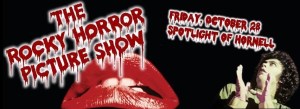
IMG_5585

A poster from a shadow cast performance at the movie theater in Hornell in 2015, if you’re interested in a local example of cult film’s reach.

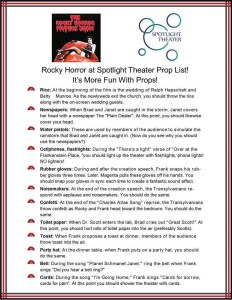
IMG_5586

List of call and response props used during this specific showing.

The political economy of a film has a lot to do with the potential likability of a film, whereas consumption is the actual likability. Anything that could be used to promote the film and its cult value adds to its political economy: scandals, controversial actors, even events that occur after the film can be monetized. The political economy opens up opportunities for revivals and rereleases, it helps keep the movie on the screen and the fans, old or new, in the seats. The last element stated by Mathjis and Mendik is cultural status. Cultural status can challenge the mainstream by discussing inappropriate or unusual topics, or use allegory to comment on the social and political scene at the time.

This is a lengthy list to refer to while weighing a films cult value; but there isn’t a clear distinction between the four categories, they share a lot of the same qualities. We saw this in this week’s screening of American Grindhouse, a documentary about the history of exploitation films. What was most eye-opening to me was the large list of films that are considered exploitive. Maniac gave me a sense of what I thought were the exploitive properties within cult cinema, but little did I know that ‘exploitive’ has as many subcategories as ‘cult film’. Who would have thought teen beach movies would be thrown into the mix? Not me, apparently.

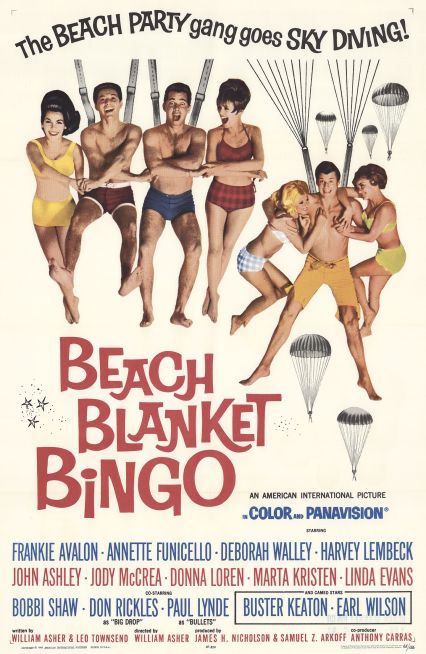
beach thing

Surfing and dancing lost their thrill, so the gang moved on to more life-threatening activities to get their adrenaline-fix.

Besides providing an interesting and attention-grabbing history, it also helped me understand the purpose for these films and why they’ve survived for so long. American Grindhouse clarified and opened my eyes to the possibilities of exploitation. (and gave me a list of movies to really put my attention span to the test)