
Author Archives: talullat

Horror at The Carnival

Before I took this class, my definition of a cult horror film was pretty narrow. In my eyes, cult horror movies had always one of two elements: they were either so bad that they are good, or they were, in essence, gore porn. This idea, however, is taken further in Welch Everman’s essay, “What is a cult horror film?” Everman writes,

“The phrase cult horror film has come to mean “bad horror film,” and that’s a bit unfair—but only a bit. The truth is that, yes, most movies that are called cult horror films are bad, an. That’s certainly true for most of the movies discussed in this book. They have minimal budget, they are poorly written and directed, the production values are near zero, and the acting is appalling.”

Everman goes on to put “bad horror films” in three categories:

1. They’re so bad they’re good—or at least they’re funny. Think of Killer Klowns from Outer Space (1988) or Dracula’s Dog (1978).

Killer Klowns from Outer Space Trailer

2. They’re so bad they’re just bad. Think of Hillbillys in a Haunted House (1967) or Tentacles (1977).

Hillbillys in a Haunted House Trailer

3. They’re really good, low budget and all. Think of The Asphyx (1972) or The Mind Snatchers (1972).

The Asphyx Trailer

All-in-all, cult movies aren’t bad, and when they are, they’re still enjoyable—with a few exceptions.

Our screening this week, Carnival of Souls (1962), was a beautiful example of a cult horror film that falls into the third category: it’s really good, low budget and all. Directed by Herk Harvey, the film’s budget was only $30,000, which is astounding to me, considering the bridge scene. After a bit of research, however, I found that the damage to the bridge in the opening scene of the film only cost $38. The town of Lecompton, Kansas, (where the scene was shot) only required the railing of the bridge be replaced to grant permission to film there. The film’s original release in 1962 was a box office failure, but late-night television airings helped Carnival of Souls to gain a cult following and paved the way for the purgatorial horror subgenre. The otherworldly, dream-like atmosphere created by the film went on to be incredibly inspirational to filmmakers such as David Lynch.  

Carnival of Souls Trailer

Harvey’s inspiration for the film came when he drove past Saltair amusement park on the shore of the Great Salt Lake. Remembering the first time he saw the old amusement pavilion, Harvey said, “It was sunset, and I was driving to Kansas from California when I first saw Saltair. It’s an amusement park located at the end of a half-mile causeway out into the Great Salt Lake. The lake had receded and the pavilion with its Moorish towers stood silhouetted against the red sky. I felt I had been transported into a different time and dimension. I couldn’t believe what I was seeing. I stopped the car and walked out to the pavilion. The hair stood up on the back of my neck. The stark white of the salt beach and the strange dark quiet of the deserted buildings made it the spookiest location I had ever seen.”

Despite being a slow film, Carnival of Souls was a feast for the eyes, and the leisurely pace of it just added to the dream-like atmosphere of the film. Every single shot was wonderfully composed, and the mise-en-scene was a thing of beauty. The abandoned pavilion was just as creepy as it was dreamy, much like the score. Carnival of Souls has an undeniable Twilight Zone feel to it, which makes total sense because the story was inspired by the Twilight Zone episode The Hitch-Hiker (1960). I can confidently say that our screening of Carnival of Souls transported me to another dimension, and that this film will stick with me for a very long time.

Scene from Carnival of Souls

Camp Cult

In the ‘60s and ‘70s, a phenomenon occurred that changed exploitation cinema and helped mould films that would eventually become cult classics—Midnight Movies. Midnight movie screenings were the start of filmmakers including more sex and violence in their films, an era of provocation. This era gave birth to Blow Job, Sins of the Fleshapoids and El Topo

Trailer for El Topo
Scene from Pink Flamingos.

The ‘60s were also the time where the term “camp” became well known. Camp is an aesthetic style that is regarded as appealing because of its bad taste and ironic value. Camp aesthetics were popularized by filmmakers such as John Waters in films such as Pink Flamingos (1972). Films with camp aesthetics can be closely linked to films that fall into the category of paracinema. Paracinema refers to film genres that are out of the mainstream. Jeffery Sconce, the person who wrote the defining article on paracinema, has described paracinema as, “badfilm, splatterpunk, mondo films, sword-and-sandal epics, Elvis flicks, government hygiene films, Japanese monster movies, beach party musicals, and “just about every other historical manifestation of exploitation cinema from juvenile delinquency documentaries to … pornography.” 

What makes these films cult—a crucial aspect of cult cinema—is reception, which I will dip into very briefly. Cult cinema can be a number of different experiences. Cult cinema can be a phenomenal experience—an aesthetic one that is sought for its own sake or a spacial relationship (both geographical and mental). Cult cinema can be a bad experience, one that constitutes as poor or distasteful filmmaking. Cult cinema can be a collective experience, one that forms community. Ernest Mathijs describes this as, “a commonality of congregation that sees itself at odds with normalized culture.” Cult cinema can also be a connected experience, where a “network of relationships” is created, whereby this creates a feeling of belonging. Lastly, cult cinema can be a surplus experience. This is what Paul Ricoeur describes as a, “surplus of meaning and of value which is qualified but not exhausted by analysis.”


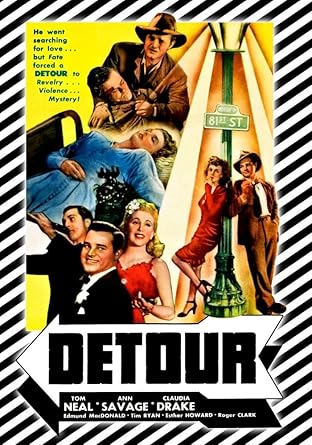
This week’s screening was a 1945 American film noir directed by Edgar G. Ulmer, Detour. The film follows a piano player, Al Roberts (Tom Neal), as he hitchhikes from NYC to LA to go to California to marry his girlfriend (Claudia Drake). During his trip, he is forced to make a few detours which, ultimately (with a couple of bad decisions), lead to his downfall.

Trailer for Detour

Detour is a “B” movie. This means that it was made on a low-budget, did not make use of very famous actors and was made over a very short period of time. During the Golden Age of Hollywood, “B” movies were intended to be the less publicized half of a double feature.  Detour was relatively well received when first released, it was a “B” movie that was worthwhile. Overtime, it became a primary example of film noir. Film critic Roger Ebert has written that Detour was, “from Hollywood’s poverty row, shot in six days, filled with technical errors and ham-handed narrative, starring a man who can only pout and a woman who can only sneer, should have faded from sight soon after it was released in 1945.” Detour was, however, far from this. Ebert continues, “it [Detour] lives on, haunting and creepy, an embodiment of the guilty soul of film noir.” 

Dissecting Cult

To fully grasp the concept of what a cult film is, it is important to understand the anatomy of a cult film: the film itself, the ways in which the film is received and what exactly puts the “cult” in the film.

The Evil Dead (1981)

Many elements make a film cult–from innovation and strangeness to loose ends and promotion–which is not to say that all these elements need to appear in a film in order for it to be considered cult.

In cult cinema, audience reception is just as crucial as these elements. Directors do not set out to make a cult film, it’s the audience response, fan celebrations, and critical receptions to a film that make it cult. Take The Rocky Horror Picture Show (1975), for example. This film has a dedicated audience that watches the film repeatedly, quotes the dialogue, and actively participates. In fact, The Rocky Horror Picture Show has been called “the very definition of the term cult picture” by American film critic Danny Peary.

According to film historians Ernest Mathijs and Zavier Mendik, the anatomy of a cult film can be divided into four main categories:

The anatomy of the film itself:

  • Innovation
  • Genre
  • Intertextuality
  • Loose Ends
  • Nostalgia
  • Gore
  • Badness

The political economy of the film:

  • Promotion (Midnight movie circuits)
  • Production (Often, these films are the result of accidents)
  • Reception

The consumption of the film:

The cultural status it holds:

  • Politics
  • Allegory
  • Cultural Sensitivities
  • Strangeness
Scene from Maniac (1934)

As we learned in both our screenings–Maniac (1934) and American Grindhouse (2010)–exploitation lies at the very core of cult cinema. Maniac, directed by Dwain Esper, was possibly the most appropriate example of how the “badness” of a film can make it cult. With stolen footage, nudity, completely out-of-place shots and drug use, Maniac highlights what is at the core of exploitation cinema–exploiting taboo topics.

Maniac is laced with random titles in order to legitimize the use of these taboo topics, and give them educational value. A way to get away with drug abuse and, essentially, the exploitation of taboo topics.

Trailer of American Grindhouse (2010)

The screening of American Grindhouse was a glimpse into what the exploitation era was all about–sex, drugs, violence and nudity. Exploitation cinema is simply cinema exploiting just about anything. It makes all the sense in the world that exploitation and the dawn of the motion picture went hand-in-hand. People want to see what they shouldn’t want to see. The notion seemed quite normal to me; everyone is captivated by gore, sex, drugs and even childbirth.

The one thing that did leave me speechless, however, was the exploitation of gender-based violence. The part of the documentary about “roughies” was, for me, extremely difficult to watch. I can’t imagine anyone wanting to watch those kinds of films for entertainment, but there’s something for everyone, I guess.

All-in-all, it’s been a great two weeks learning about cult cinema, and I am beyond excited for what’s in store.