Category Archives: Uncategorized

The Strange Artistic Event That is Suspiria

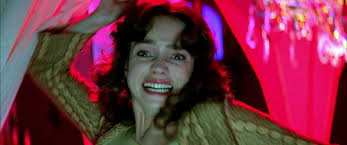
This week we had the pleasure of watching Suspiria. Suspiria is a 1977 film directed by Dario Argento. This artistic horror film exemplifies a lot of art decor, lighting changes, and very ornate set designs. Although the film has a lot of strange scenes it’s interesting to watch. However, the biggest let down is we don’t know who the killer “animal” is by the end! We get glowing eyes and hairy arms of some mysterious being that isn’t totally human or animal, but we never quite find out what or who he is. This plays heavily into the supernatural aesthetic of the film that also involves magic, witches, and unexplained phenomenons.
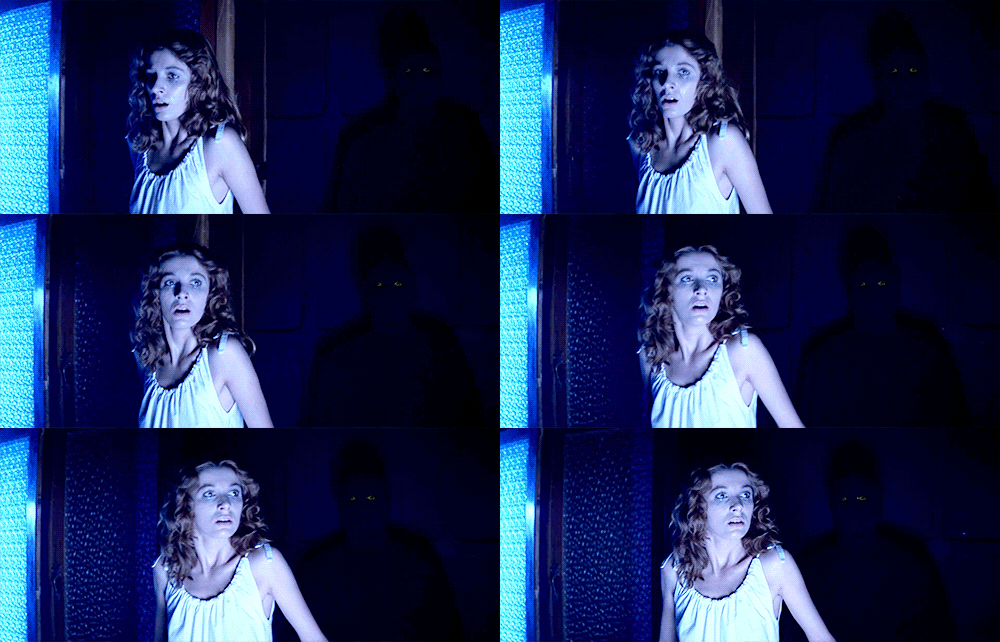
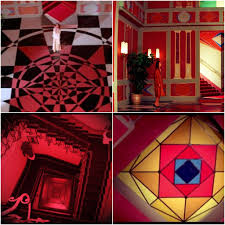
Setting is one of the most important parts of the film. The darker scenes are accompanied with dark locations, shadows and sharp structures, while the calm and safe meetings are in open and bright spaces. This is done on purpose. They want the audience to really see the difference. Everything from where Daniel was murdered to the dance academy is adorned with darkness, or sharp structures. It creates a jarring effect when Suzy goes to meet the psychiatrist out in the open in broad daylight. Setting is very important to the narrative, even if a few things are cliche. Who can resist a dark and stormy night?
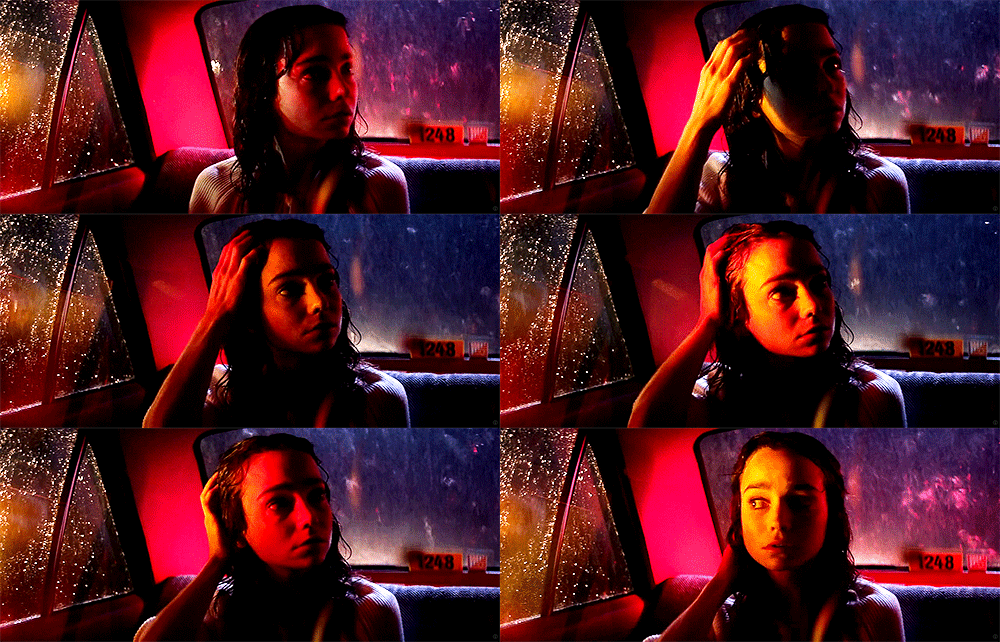
The display of colors and light effects are jaw-dropping. I’ve never quite seen anything like it. It is so distinct and articulate that there are not enough words to describe the vast array of emotions it evokes in the audience. Pairing the visual with the audio only hits harder. The music playing in the background of every scene tells you how to feel, whether it is chanting or an intense choral music. These sinister lullabies are creepy, albeit one of the creepiest parts of the film.
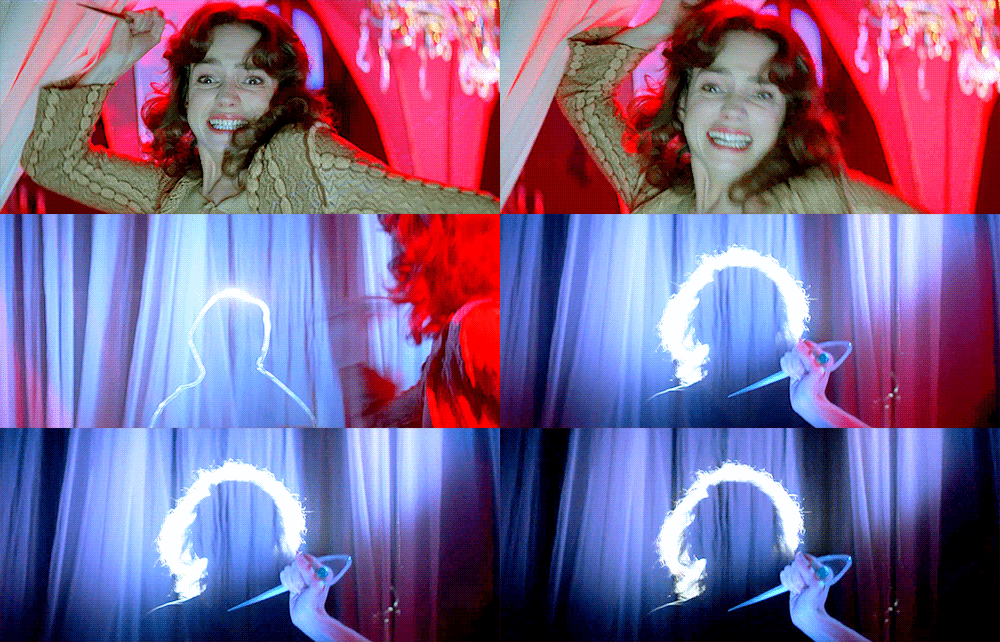
This week we had several readings. One of the biggest things that stuck out to me is that Suspiria is a “horror” film. It is listed as a “cinematic giallo” which is Italian for a mystery film. I was never actually scared during the film, so I would agree with mystery over horror. If anything the film was more creepy and strange than scary. There was a lot of murder, but even when the arm shot through the window to kill the first girl I wasn’t scared. If anything the scene intrigued me more.

In our reading “Doing Violence on Film” by Andrew Cooper we see an in-depth insight into the mystic part of the film. “The witches’ invisible power thus carries out their will.” This invisible power was hard to pick out at first. Until Suzy looks into witches herself, seeking out the psychiatrist and talking to an occult specialist the phenomenon doesn’t make much sense. Once the thread we are missing is put into play everything starts to fall into place. The fact the dancing academy is run by witches, powering a “Black Queen” is fun and an interesting plot twist. I am upset that poor dog became a casualty of the magic, being used like an instrument as if he were the same level as the attic of barbed wire. And lastly I still want to know what that mysterious creature was that killed the girl from the dance academy.

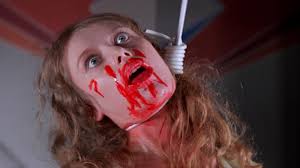
Suspiria

Suspira is a horror film about witchcraft. It starts off with the main character touching down in Germany to attend a dance school that teaches Ballet. As Suzy pulls up to the housing that she would be staying at, a young lady who we learn name is Pat is see exiting the building scared and repeating words that we later learn are significant. Suzy is not able to enter the building so leaves and the setting switches to Pat and her friend who is questioning Pat about what happened to her and she answers that her friend would not understand and locks the door on her friend who leaves the room. We witness the murder of Pat who was stabbed multiple times and was left hanging as the ceiling glass shatters which ends up killing Pat’s friend who was yelling for help. Suzy returns the dance building and is welcomed in. They wanted to control Suzy but realized that she was hard to control because she was so strong-minded and spoke up for herself. That motivated the witches to want to keep an eye on her. She was living with a friend but they put a spell on her that made her sick and they gave her no choice but to stay in the room that they provided for her and brought all her belongings. They were putting something in Suzy food to make her sleepy. Her friend Sara was skeptical about what was going on in the building and got herself killed exploring the building. Suzy one day decided to find out what was going on and ended up finding the hidden place and killing the witch and leaving the building and we watched the place explode. The Witches were plotting to kill Suzy so she got out in time.

The readings that were assigned to the movie were very much related to the movie.In the reading “Expressionist Use of Colour Palette and Set Design in Dario Argento’s Suspiria” we learn about the use of the colors blue red and yellow nad how a specific camera was used to capture the visuals that we saw. Two types of color palettes were used and they are a realistic one and a gothic palette. The realistic palettes are used in more common settings like the airport and convention center. The more gothic setting, which was also talked about in the A (Sadistic) Night at the Opera reading, is when we see the black magic happening. In the opera reading it talks about the New gothic era emerging and movies that came out after the release of the film and how cheap impersonations of German movies were being released also. In the reading Dario Argento Suspiria, we just get a rundown of the movie and get a better understanding of why things happen the way it does. The part of the film that stood out to me the most was the maggots and how the dog was under a spell and killed his blind owner that plays the piano so well.

Valerie and Her Week of Wonders

*POSTED LATE WITH PROFESSORS PERMISSION*

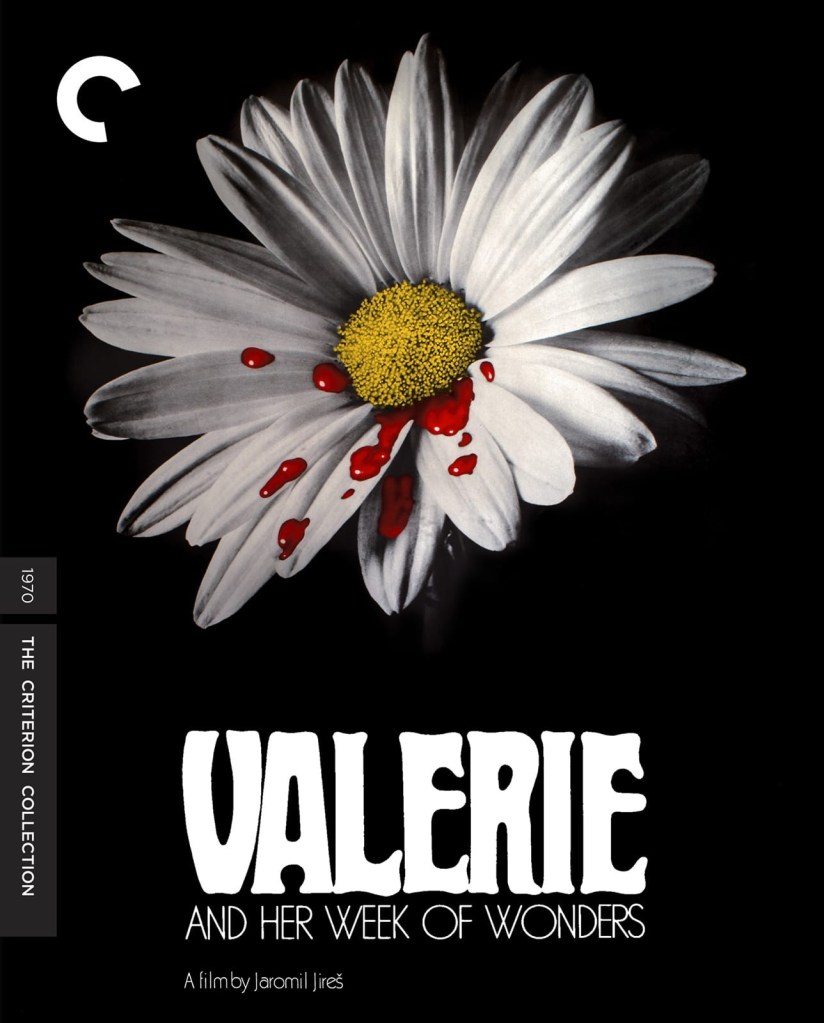
valerie.jpeg

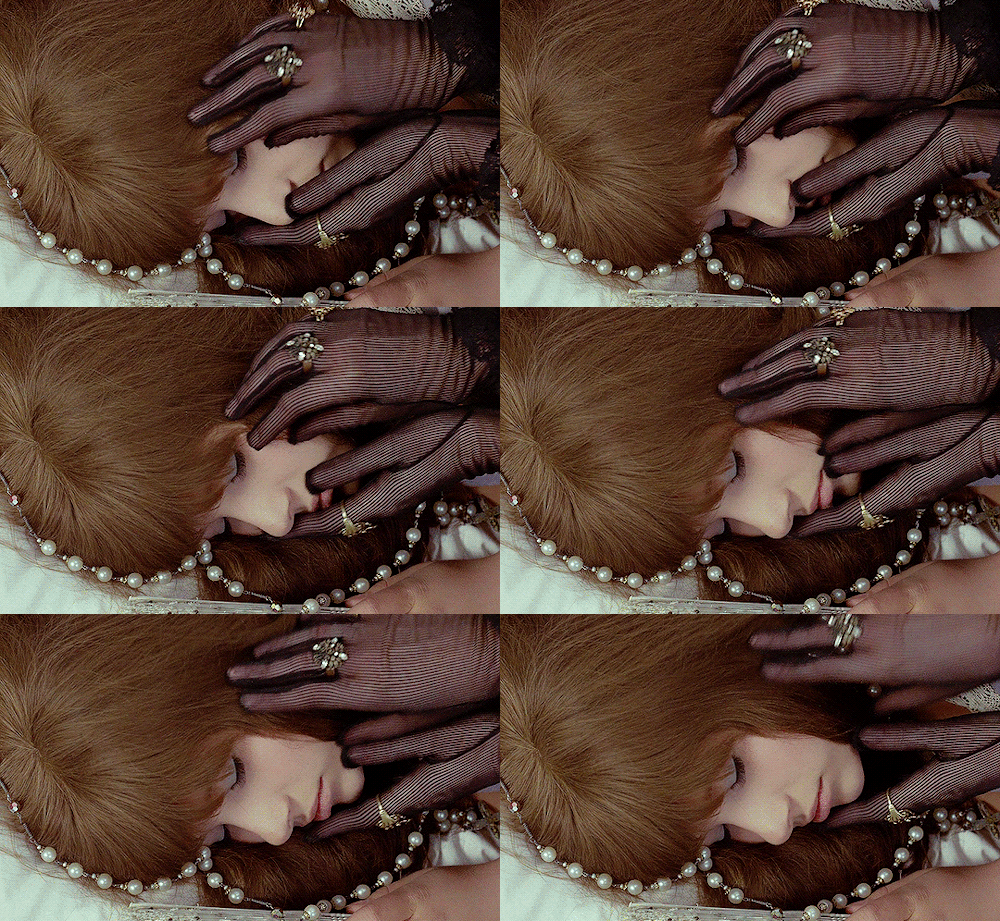
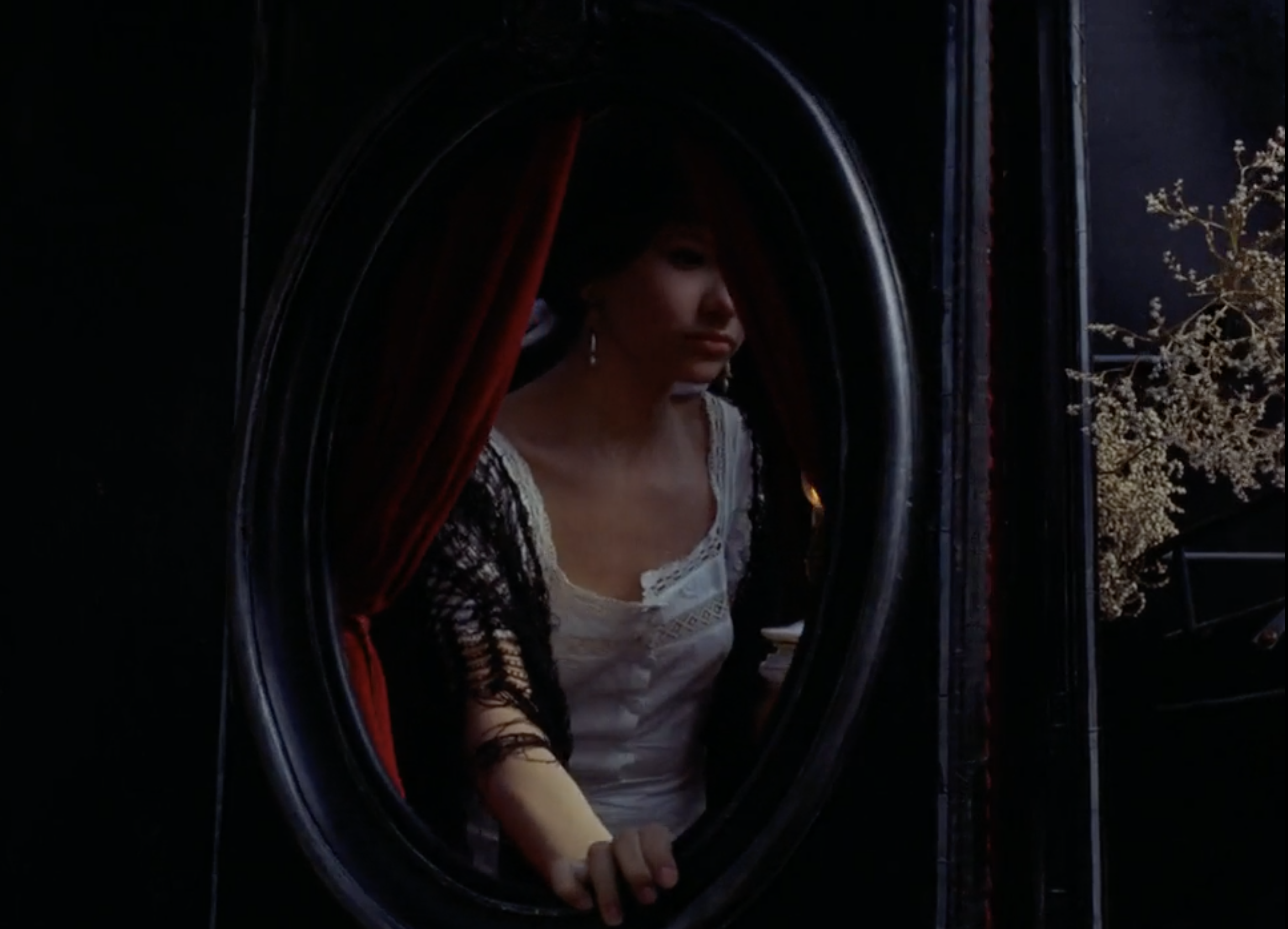
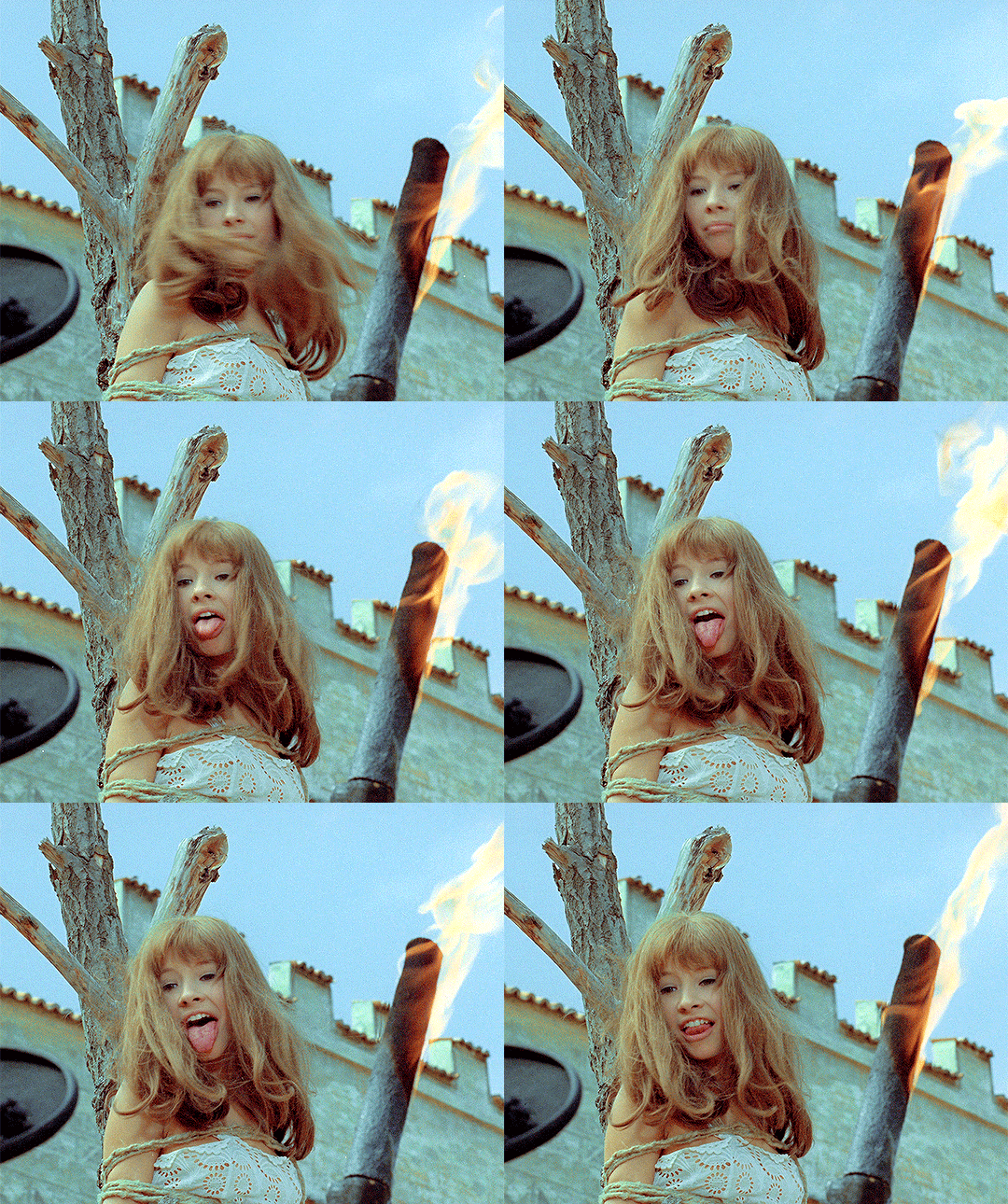
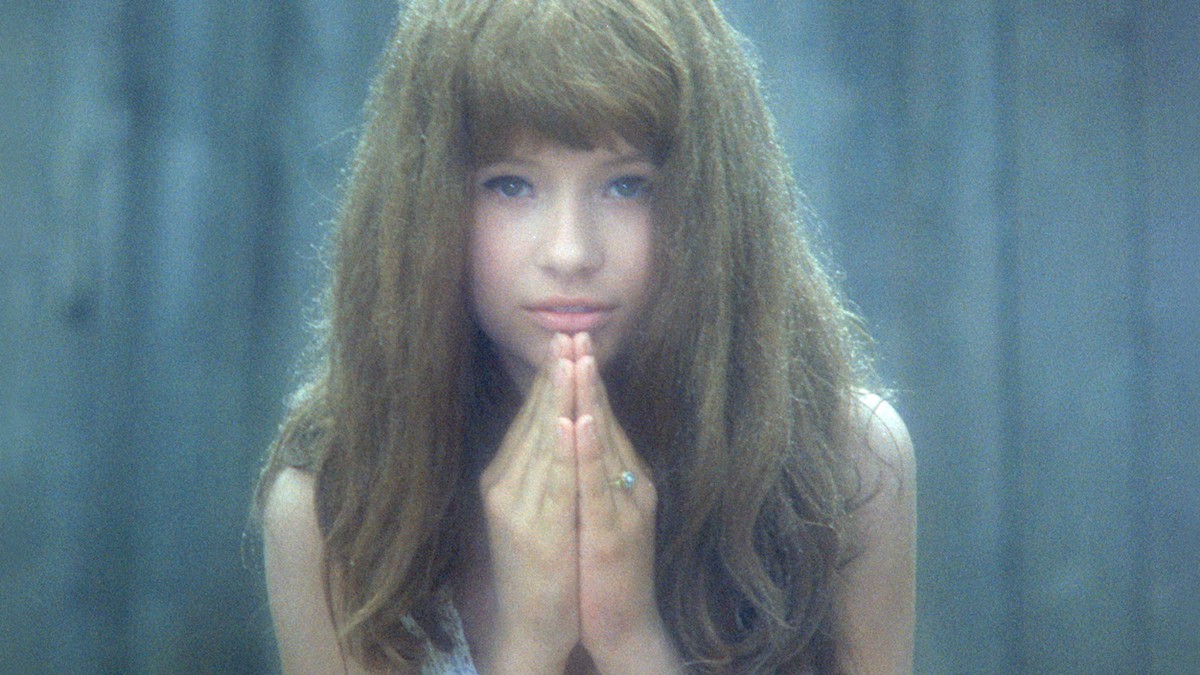
This viewing is exactly what I needed a confusing distraction leading my mind awake from the harsh realities of life and leading to the mind-boggling cinematic thrill that is Valerie and Her Week of Wonders. The film is a beautiful rendition of a young woman blossoming into womanhood and what comes along with that. The readings really helped to expand my knowledge of what the director was doing what is very short cuts in quick edits to help keep the viewer in the viewpoint of being almost enchanted. The score that also went wrong with the film was so beautiful you couldn’t help to think that you were in a magical place. The plot was all in all confusing and the readings did not clear up any questions or clarify any of the plot and discrepancies but when the director did this he left it completely up to the audience to interpret this and the way they wanted to. it’s a “loose plot“ which I find more appealing than a plot that tells you exactly what’s gonna happen is exactly why it happened. All in all, it was a beautiful film and I had a lot of fun watching it with all my family members. my dad just kept yelling at the TV say what’s going on I don’t understand I guess he doesn’t like foreign films.  All in all, it was funny to watch and funny to watch people’s reactions while watching it.   

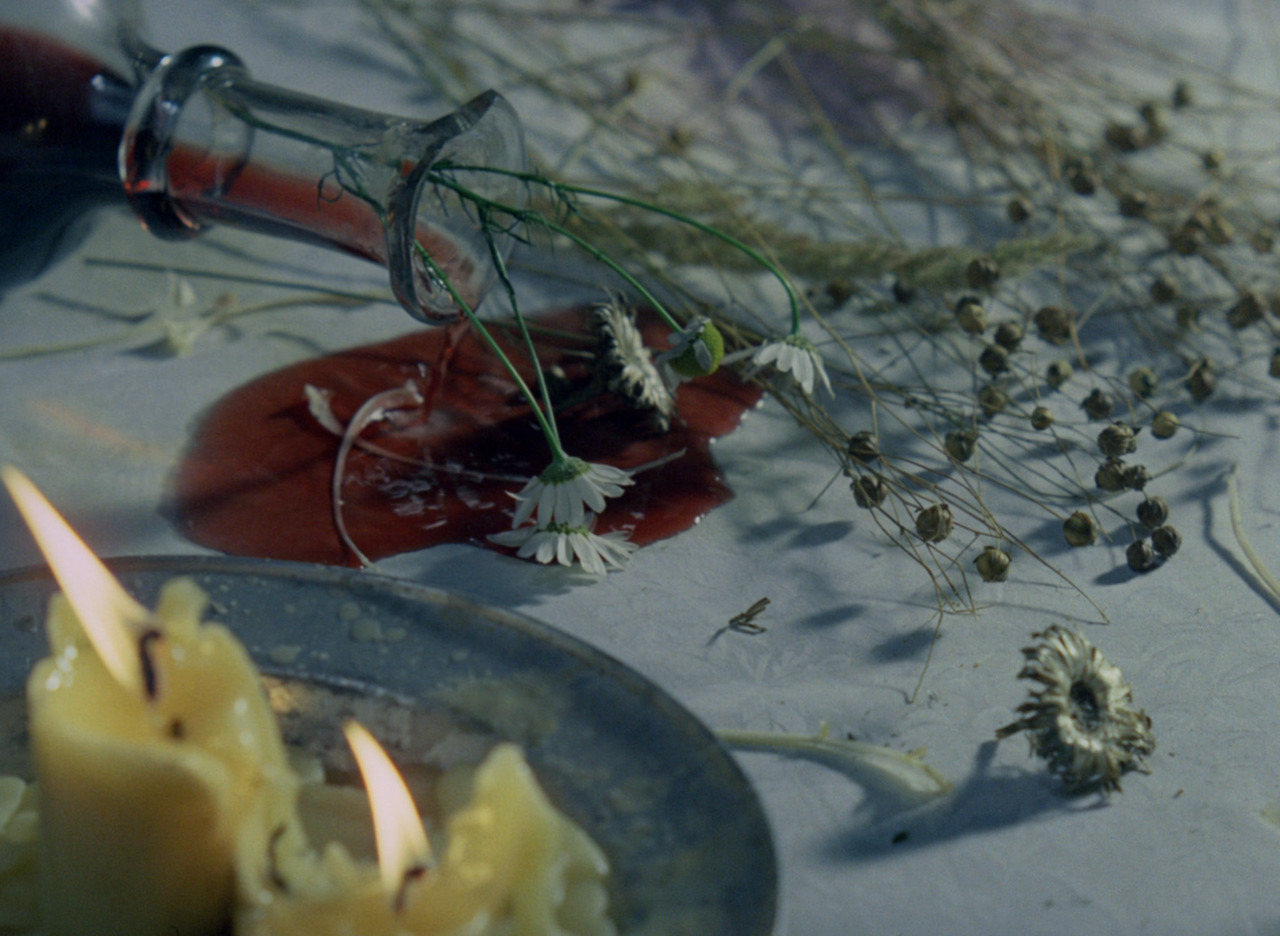
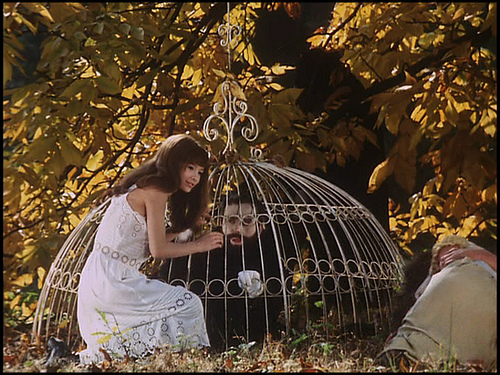
This movie also surprisingly tackled a lot of troops in the cult film world such as the fantasy trough the blossoming into womanhood troll on the older woman had a few tropes as associated with her character and I felt that the movie was really using these tropes to there advantage. Such as putting blood on a flower to be compared to a young woman turning into womanhood and also using a priest as the bad character in the film.

valerie 2.jpeg

We also had a few presentations this week one was about blade runner which I found particularly interesting so I went to go watch the movie and I was blown away. It in a way is kind of like Valerie and Her Week of Wonders because it keeps you one your toes the whole time second-guessing yourself the whole time on what’s happening.

The way the movie used light was particularly interesting to me at certain points in the movie there was a certain light used and in more dramatic points of the movie there were other lights used and throughout the movie, the characters would get into darker life and some characters we are placed in brighter light I thought it was particularly beautiful the way the director uses this method of filming.

By: Victoria Empson

Valerie and Her Week of What the Hell Did I Just Watch

Valerie and Her Week of What the Hell Did I Just Watch

A polecat-faced vampire, named simply Polecat—campily aware of his own hideousness—arrives and does his best to reclaim the family seat. Valerie’s grandmother becomes a vampire herself,hoping to win back her former lover (a sinister Catholic priest). Thanks to her magic earrings, Valerie manages to slip from the priest's clutches when he tries to molest her, eludes her grandmother’s fangs, cures (by means of a tender lesbian tryst) another young woman who has been bitten, and survives a burning at the stake. There’s also a handsome young man named Eaglet who gets her out of several sticky situations, and whether he’s her brother or her boyfriend remains ambiguous.

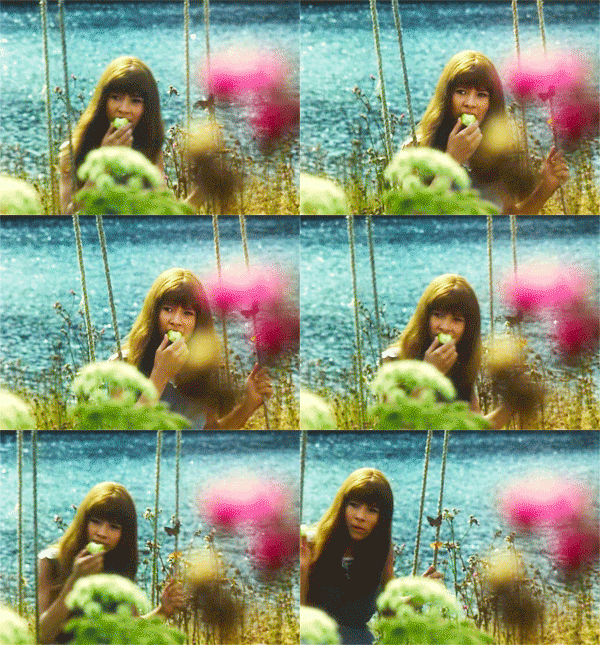
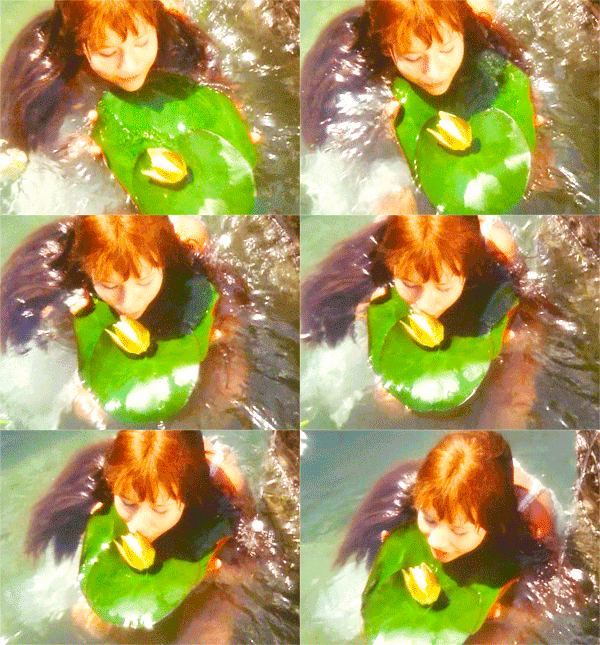
“Valerie and Her Week of Wonders” is a film of heightened surrealism, with a dreamlike quality that captivates its audience through the use of vivid imagery and an absolutely haunting score. The film is as mesmerizing as it is disturbing, leaving its audience feeling a confused sort of enlightenment – glad for having experienced its one-of-a-kind charm, and yet unable to fully process (or even follow) the plot line. This unshakable feeling of incompleteness isn’t the result of a poorly made movie; rather, it’s a stylist choice employed by Jireš in order to leave the audience questioning the reality of what they’ve just witnessed.

"in Valerie, a fable whose general outline is familiar, the quick and often disorienting shifts are intended to shatter any reliable sense of what is real and to lend the folkloric proceedings a mad, impish tone."

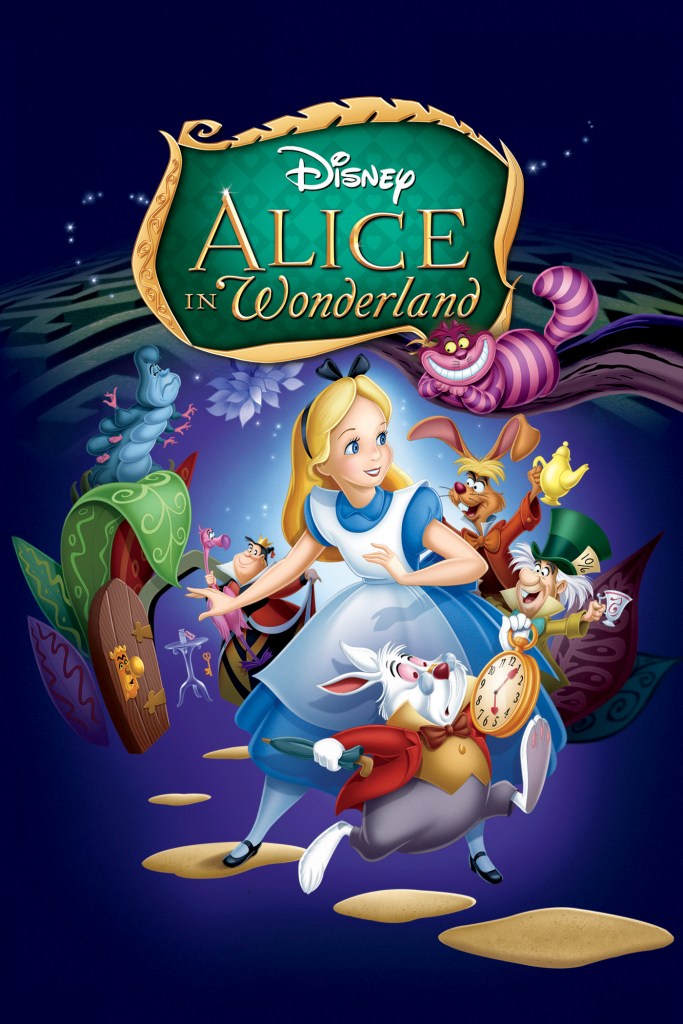
The movie is said to be reminiscent of “Alice In Wonderland,” with Valerie’s descent into womanhood the equivalent of Alice’s descent down the rabbit hole. The vibrancy of the world around her, the loss of childhood innocence, the series of unbelievable events and narrow escapes – these all contribute to this idea of disorientation. The disorientation that we feel in “Valerie” is meant to mimic that of a hallucination, and the absurdity of the journey she embarks on plays into this idea at every turn. (See: every scene with vampire granny) This feeling intensifies throughout the story, creating a sense of urgency that underlies the young girl’s abrupt emergence into adulthood.

Overall: the plotline, questionable. We never really get any answers to our many questions. By the end of the movie we’re somehow even more confused than we were at the beginning, only now we’re questioning everything we thought we knew. Valerie’s familial ties drive the movie, and yet they’re ambiguous to the point of discomfort. (Seriously, is he her brother or her boyfriend? Or both?) The womanly awakening Valerie experiences is disturbing at best -cue half a dozen child molestation attempts- but overall, the word taboo pretty much sums up this movie perfectly. Everything in it goes against societal standards, pushing the boundaries not only between good and bad but between fantasy and reality.

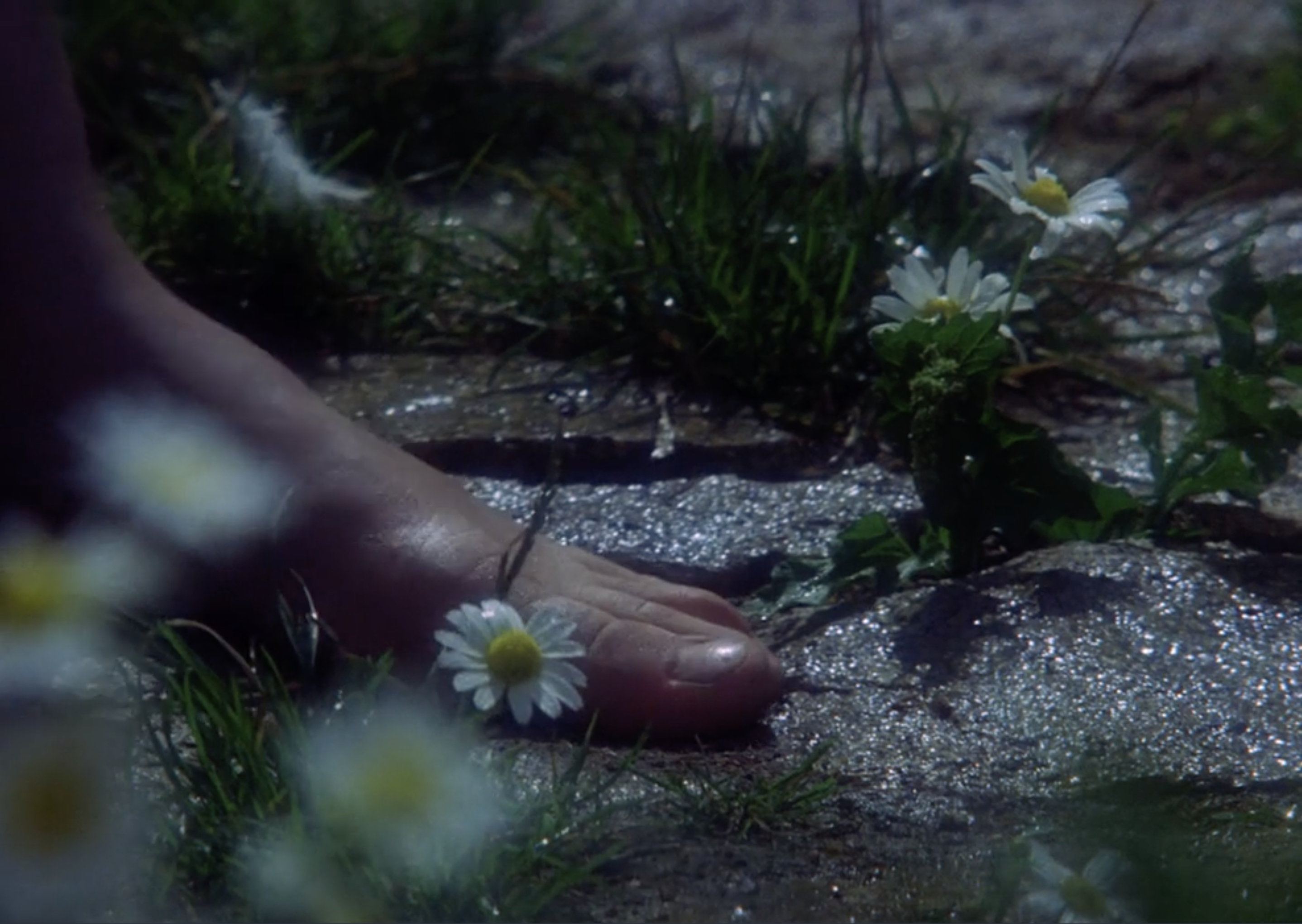
The imagery, however, is beautiful. The contrast between sharp, vivid colors that jump out at you and the muted whites that make you feel as if you’re watching through a haze plays perfectly into the movie’s dreamlike state. The score is beautiful and haunting, strange and yet somehow innocent. “Valerie” is a movie about experience, not comprehension, and in that aspect it excels at every turn.

Valerie

Whoa, first let me say, the film this week Valerie and Her Week of Wonders was beautifully filmed, I am a HUGE fan of contrast and the way they contrasted colors, black and white was just beautiful, I did feel a bit odd though, it was an obviously younger girl being constantly sexualized. On paper the film was interesting but I couldn’t help but just think of how disturbing it is to see a young girl sexualized the way she was. That being said, I do plan on watching this again, I just wish they could have made the main girl a bit older so I wouldn’t feel so uncomfortable watching a lot of the highly sexual scenes because if this girl was older, not 13 I would have thought this was a stellar film, that being said, I can’t deny artistically it was ethereal, some of the shots were just so satisfying.

Screen Shot 2020-03-20 at 11.21.44 PM

This film is dizzying, its like nightmare daydream. Before this film had watched The Wicker Man 1973 which despite being very different visually are similar so I enjoyed watching this film. Both films deal with taboo subjects. Surreal films are my all-time favorite. I  love watching an artist make a piece of work that is not necessarily grounded in the story but the visuals. With surrealist films such as this, I feel it is more so based on the visual atmosphere or narrative. This film definitely fits into the artsier side of art cult film, it also reminded me of Alice in wonderland, but a lot more sinister. It also reminded me of a Jodorowsky film just how much taboo there was packed into one film. This quarantine has had me watching so many films and side note I recommend Jordorowskys Santa SangreOne of the readings this week also noted Andrei Tarkovsky’s influence and I completely see the visual similarities. Very spacey, ethereal and atmospheric.

One reading I particularly enjoyed was The Exploitation Generation. The 1970s is one of my favorite eras in film, The reading discusses how many of the filmmakers at the time were dismissing normal themes in western culture and embracing feelings not usually talked about. Nihilism and cynicism were common themes, rebellion, sex, anger. A lot of this was a response to the world at the time, people were not happy and it is expressed via film which reflects cultural themes at the time. The happy golden years of Hollywood were over. The filmmakers of the exploitation generation were steeped in the rebellious mores of the1960s, which celebrated sex, drugs, rock music, pop art, high camp, low culture,épater le bourgeois pranks and wholesale rejection of venerable social institutions. They found inspiration in cultural detritus and south to reclaim the motion picture past that nurtured them as youngsters, filtered through layers of nostalgia, pop-culture savvy and self-awareness.” The new generation or New Hollywood directors challenged every idea of what a popular film could be and created wonderful films. Some of these include Bonnie and Clyde 1967, Scarface 1983, The Godfather 1972 (one of my favorite scenes in movie history is the baptism/boss killing scene in this film),  Chinatown 1972 and many more. Stylistically you see this in our screening, just in a more experimental way.

This era in the film was such a reaction to the circumstances of this time. I can’t help wondering during these less than ideal times which types of films we will be watching in a few years and how they reflect the paranoia and uncertainty we are all feeling. Again, the film is a tool to study the culture and political situations at a point in history and I am excited to see what comes from our current situation.

Valerie and Her Week in Wonderland and at Midsommar

So this week was the first week of online courses and I found it to be weird. I enjoyed watching Valerie and Her Week of Wonders and I found it to be a very beautiful film. I can see why someone would classify this as a horror film because of the creepy nature of the film and also because of all the supernatural things that happen in this film. I really liked every bit of the film and thought that it was also very good. If a person likes weird films I would highly recommend that they should watch this film. 

This week I tried to read as many of the articles as possible and also listen to the podcast. I was able to listen to the podcast and read two of the articles that was assigned and there was one that caught my attention. The article that caught my attention was the article “Valerie and Her Week of Wonders/ Grandmother, What Big Fangs You Have” by Jana Prikryl. The reason this article caught my attention was because of its mention of “Alice In Wonderland” and how the film seemed to resemble that story and I saw it during the course of the film. This thought came into my head actually after I read something on IMDB and then it came back into my head during the movie and then again when I was reading the article. I saw elements that reminded me of Alice and these elements include the evil priest, which reminds me a bit of the Queen of Hearts in Alice. Another element was Orlík and he reminded me of either Cheshire Cat or the Rabbit in Alice. This stuck with me during the course of the film and I couldn’t get it out of my head. I believe that this could be a much darker version of Alice compared to the regular Alice story that we have grown up with. 

There was another thought that kept crossing my mind during this movie and that is how much it felt like another film that watched. That film that I am talking about is Midsommar and there are a few reasons as to why I think I am comparing the two films to one another. One main reason that I can think of comparing the two is that both films are very beautiful. One of these is that the way both films are shot is meant to make the films look beautiful and the shots in Midsommar are meant to make you appreciate the camera work that is done and all of the shots that are presented. That is sort of the same for Valerie in my opinion. Another thing that I compared about both films is that both films are meant to make you question what is going on and who you can trust. The only person that Valerie can really trust during the film is Orlík and she ends up pushing him away. That is the same for Midsommar and the main character of that film, she can really only trust her boyfriend up to a certain point in the film. The last thing that I compare about both films is that they seem to be both very unique horror films. Valerie is basically a combination of fairy tales and Alice in Wonderland type horror. Midsommar is a daytime horror film and what that means is that basically all of the creepy stuff happens during the day and the place that they are at during the film is constantly daytime.

Trailer for Midsommar

To conclude this, I am going to say that Valerie and Her Week of Wonder was a very good film that I won’t forget anytime soon. It reminded me of another two things that I have watched and there is one last thing I have to say, and that is you should watch Midsommar if you liked this film. Midsommar is a bit more disturbing than Valerie, but it is a very beautiful film in my opinion.

Studying Valerie– in year 3000

Boy oh boy has this been one hell of a week! But thank goodness Schlegel has this whole teaching through the web hoopala under wraps real well, especially considering some of my classes got straight up canceled. But nonetheless we still enjoyed a completely smooth week of online facetime class presentations by Patrick, Kelsi, Spencer, Avery, and Chris. Kelsi gave a presentation on Buffalo 66, which is also her home town hehe. I had no idea Vincent Gallo was such an asshole, but its understandable then as for how he nailed that role so hard. Chris also gave a very loving presentation of the second Blade Runner, your passion still shone through the audio waves Chris, props. They were engaging even with just audio, so props you guys for being the ginny pigs for the rest of the cyber semester.

Spencer and Patrick summarized the readings, and the Valerie and Her Week of Wonders reading very well. Main points I found important in the readings They made compelling connections that helped me grasp the reading even more, and more deeply connect with though film, so that’s my main topic this week. Needless to say I am in LOVE.

This film was released during the Czech New Wave movement, a result of new directions in the arts generally and the pressure for social and political reform during a communist in Czechoslovakia . Therefore many transgressive ideas are illuminated in these films, such as desire, subjectivity, childhood, social or political authority, the imagination and, in its broadest sense, language. Our reading states a transgressive idea that “like many fairytales, Valerie’s wondrous world is rife with the seductions and aggressions born of family relationships, a factor that continues to give Jireš’ film thematic relevance.”

After watching this film once, I knew I was going to have to view it for a second time to ensure I I grasp all its glory, and again I am greatly enthused that I was introduced to this movie. The avant-garde director Jaromil Jireš “would probably be remembered today as a filmmaker in the satirical vein, with a taste for poetic juxtapositions and vertiginous edits.” Each frame was a perfectly framed photograph– depicting a fantasy nightmare dream utopia. Probably the most entrancing beautifully captured film I have ever seen, and will most defiantly impact my art practice. The use of symbolism and motif

The way Jireš uses the camera and editing alludes to the film following classic fairytale tropes, but with a dreamy-surreal-horror twist. “The movie’s color design is so vibrant,” the campy enigmatic acting, and set design make the film extremely poetic. Repetition of frames and scenes also gives the viewers a sense of a skewed reality. This reminds me of The Great Gatsby and after reading the book and watching the movie it follows a similar poetic manner that mimics the book. I can presume that the book version of Valerie and Her Week of Wonders was written in a poetic manner, considering the author was a poet.

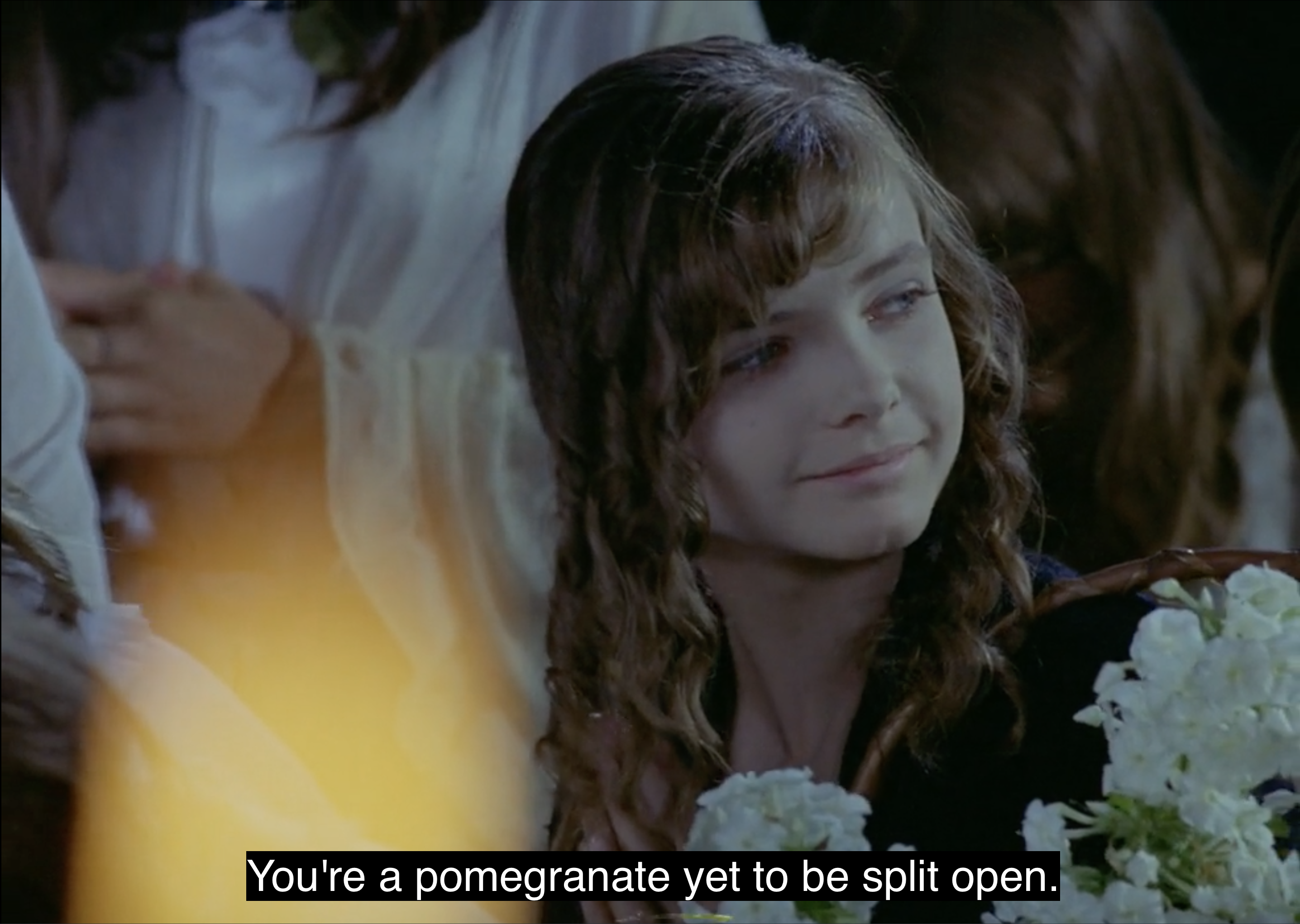
Though this wasn’t a visual symbolic reference in the film, the priest or whomever was using symbolism in his descriptive language. Pomegranates are a symbol of fertility and womanhood etc., what the film is loosely about. I like pomegranates, I use them in my work and analyze the uses of symbolism with them more deeply. I enjoy this still and all it holds.

Valerie and the Screaming 66 yr. old Blade Runner

This week was a very engaging one for me, and I am sure for many of my peers. Despite being thrown into this new universe of online learning and film observation, we’re still studying cult cinema, and interacting with our classmates.

See the source image

This week’s screening (From the comfort of my room) was “Valerie and Her Week of Wonders.” This film got a lot of praise from our professor prior to the screening, while we were still at AU 😥 . And I can say without a doubt, it lived up to it. One of the craziest things I noticed during this film, was the MASSIVE amounts of cuts. As talked about in the podcast, “The longest single shot seemed to be like 8 seconds.” At first glance of this technique, I thought it was a great way to edit this film, and I felt it made things even more chaotic.

See the source image

The reading I presented this week was called “Valerie and Her Week of Wonders; Grandma What big Fangs You Have.” I found this reading to clear a lot of aspects of the film up for me. It helped guide me through the masterful “screen play gone movie.” My reading gave me the insight that Jires does these frequent cuts in order to create the chaos that I was feeling. He does not want any member of his audience to be able to grasp onto a singular plot line, or even be able to distinguish from real-life and folklore.

See the source image

 If I am being totally honest, I could not distinguish either dimensions of location or time while watching Valerie, and I feel that this experience added to the film’s beauty. Not only was each scene and cut masterfully executed, beautiful, and accompanied by an incredible score, but I found myself lost in every conceivable way, and I LOVED that feeling.

See the source image

I was beyond impressed by all three of our presenters this week. Each one of them was extremely confident in their film and proved Cult status very well. Buffalo 66 is a movie that I have not seen, but the presentation has led me want to watch it. As for scream, even though its apparently a funny horror movie, I will not be watching it, unless I have to, because horror only works for me in a well-lit room, with plenty of people around, and no cruel jokes pertaining to the film after the completion of the movie. Blade runner 2049, is a movie that I can really get behind because I have seen the first one in the series due to its availability on Netflix. I honestly cannot think of why I haven’t seen it yet, but now it is added to my list of must-sees.

See the source image

Overall, this online learning has been awful for most of my classes. However, for some reason my outlook for this class has not changed. I think that it has a lot to do with the energy that is somehow still thriving, even though we are all hundreds of miles away from each other. I’ve said it before, and I’ll say it again, you guys and gals are awesome.

Polecats and Pandemics

Me on day 5 of self-quarantine

This week was a bit rocky, considering everything that’s currently happening on campus and in the world, but we somehow managed to make it work. Our screening this week, Valerie and Her Week of Wonders (1970), was by far the highlight of my week, a sort of escapism that I didn’t know I needed.

Czech film expert, Peter Hames.

The entire film felt like a trip–unearthly from start to finish. I would like to start off by speaking about the mise-en-scène of the film. Perhaps it’s the fact that it was impossible to follow the plot, but the entire film had a very heavy mannerist feel to it all, full of hyper-idealization, distorted human forms and ambiguous spaces. I had no idea where the film was set (or when) and Jana Prikryl’s “Valerie and Her Week of Wonders: Grandmother, What Big Fangs You Have!” explains the reason behind this beautifully, staying:

“Aside from the folkloric nub of the story—in which a thirteen-year-old girl is initiated into the perilous world of adult desire—little about this fantasia reflects its time and place. Maybe that’s why, over the last forty-five years, it has peeled off from its historical moment and been embraced by foreign audiences, who have kept it in circulation because of how irresistibly it combines some very soft-core delights with the trappings of horror. “

Jana Prikryl

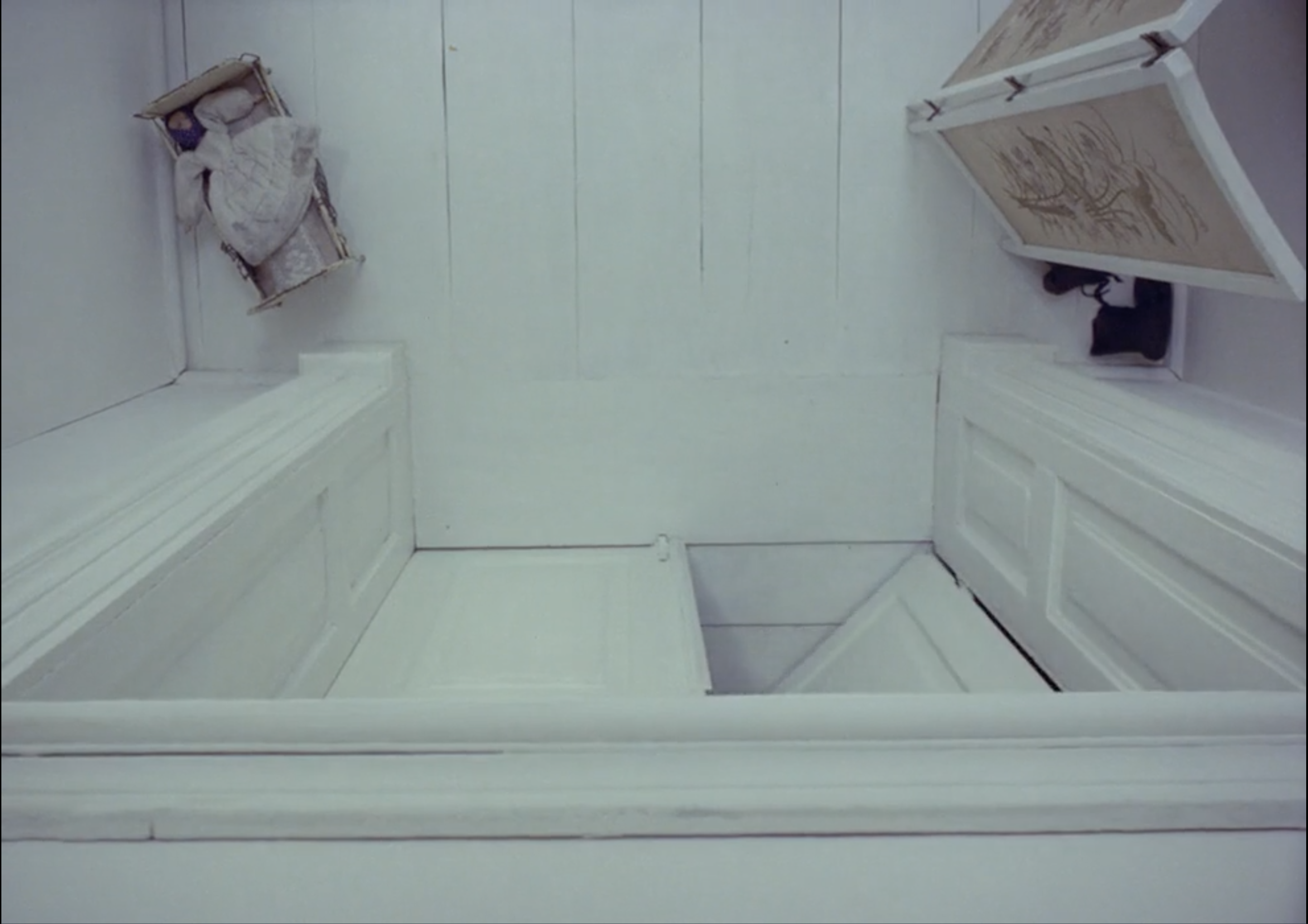
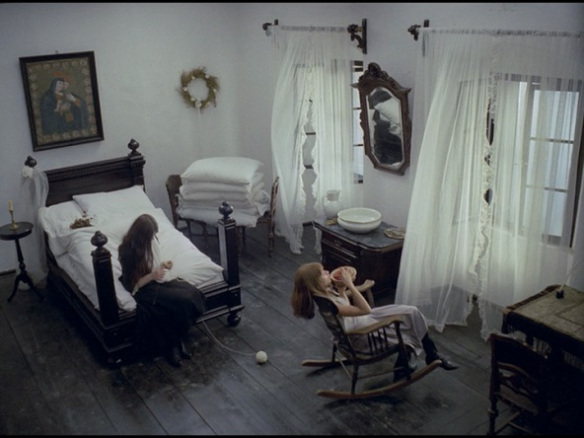
More so, I was totally enamored by the set designs, especially Valerie’s white room:

Something that was incredibly interesting to me, was the intersection of so many different genres–fantasy, horror and soft-core (everything you need for a bomb coming-of-age film). In the late ’60s, other directors were starting to play around with the intersection of horror and sex, like in Roman Polanski’s ‘delightfully sardonic’ The Fearless Vampire Killers (1967), and in Ingmar Bergman’s Hour of the Wolf (1968).

I loved Valerie and Her Week of Wonders because it felt incredibly nostalgic to me. For some weird reason–weird because before this week, I had never watched Valerie and Her Week of Wonders–it transported me back to the really intense Sunday-blues I would get in high-school, which I would cope with by watching weird films in bed all day. A lot of the time, I associate nostalgia with surrealism and dreamlike memories, which is perhaps why Valerie and Her Week of Wonders felt so familiar. I found a quote about this film (more specifically, the surrealism in this film) which, hopefully, helps to explain what I’m trying to say:

By their very nature, surrealistic or phantasmagorical films offer little to those who fail to connect with a specific, bizarre juxtaposition of images and ideas, aimed directly at the viewer’s central nervous system. There’s not much in the way of a middle ground when it comes to such works—one is either delighted and transfixed or bored to tears. 

Mike D’Angelo

While this has not been my favorite screening of the semester, this film was by far one of the most beautiful films I have ever seen. The whole film looked like a dream.

Our Week of Wonders

I just want to start off by saying this week has definitely been different to say the least, but we have gotten through it. I love how everyone is still making the most of the class with everything going on! I want to talk about Chris’s presentation before I start in about Valerie and Her Week of Wonders. I have personally never seen Blade Runner 2049 but I could tell by Chris’s presentation the love he had for this movie. I think he did a great job presenting the film and why he believed it was a cult film! I also presented Scream this week and I almost hated that I presented with Chris because I know how much he loves films but I think we both did a great job showing how much we both had loves for our films and why they were cult films.

Now I want to start by talking about Valerie and Her Week of Wonders. All I could say was what was happening in that film. I had a hard time following the film as it was in a different language and confusing at times. I do know however that Valeries earrings were magical in some way which I found very interesting that a lot of the film is that these magical earrings almost protect her in some way. What also confused me is why was there vampires? This film was so whimsical and different from anything I had ever seen I am almost more at a loss for words for this film than I was when I saw Pink Flamingos. What I found most intriguing though was how Eaglet or Orlik stole her earrings from her at the beginning but then we learn he might be Valeries brother even though he confesses his love for her? It almost to me seemed like a fairytale but not because this girl is having a sexual awakening while there are people trying to attack her for having these earrings that protect her. Overall I think the movie could definitely be a cult film just because of how different it is compared to other films. I can see many people who love horror but also love some kind of whimsical fantasy films would love this film.

I also want to talk about the some of the readings this week. I think Pat and Spencer did a great job really digging in to the readings and Dr. Schlegel’s podcast he did on the film. One thing that stood out to me that we talked about was the very quick cuts of scenes the film had. I do agree that the cuts were almost to fast that you were left wondering if something was still happening. Something that we also said that these low budget films like Valerie and Her Week of Wonders was what we needed to get big blockbuster movies. Valerie and Her Week of Wonders was a movie that helped pave the way for other low budget and high budget films even if it didn’t go over well with most in the country it went over well with people in the United States.