Category Archives: Uncategorized

Valerie and the Week of Wonder

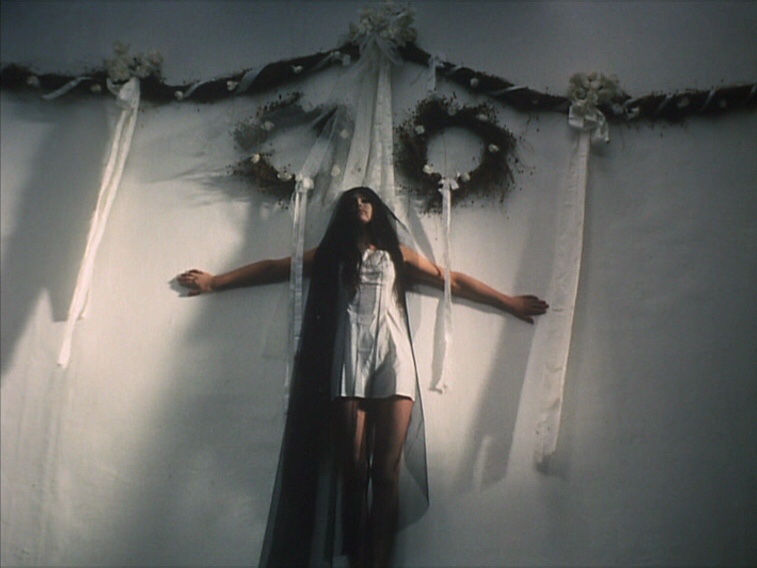
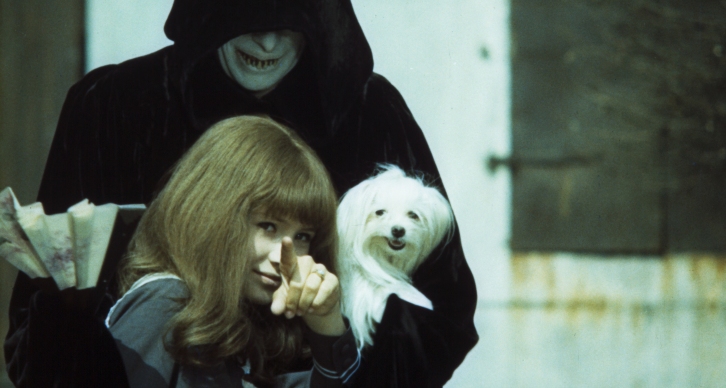
This movie is a Czechoslovakia film. It is about a girl named Valerie. It is about her groth into a woman. The movie was very artistic. She has her earrings stolen. Her grandmother informs her that the earrings were from the family. She gets a letter and they want the earring back. The grandma is a vampire and bites the neighbor to make her young again. A lot goes on in the movie. Valerie is always trying to get killed but her innocence and love keeps her alive. Vlaerie saves the man’s life but he still tries to kill her even though Valerie saved her life. Valerie kisses her neighbor. The movie ends with Valerie asleep in the woods. A Lot happens in the movie. The movie is full of kissing. The music is nice. The imagery is powerful and the characters are in and out of age. For example, the grandmother is in and out of age. The movie to sum it up is about the coming of age of Valerie and how from her getting her first period, she is welcomed into the life of adulthood. The song that was played in the movie was interesting and is what made the movie. 
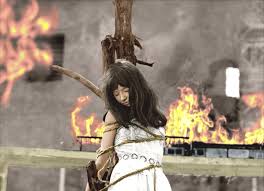
The reading “Valerie and Her Week of Wonders/ Grandmother, What Big Fangs You Have!” talks about the cry, the joke and screenplay and the effort within the film and what they symbolized. They were making fun of communism. The communist party tried to bury the movie because they felt as if it was too much and did not represent what they stood for, other than that the movie was not very appreciated. The reading” Czech Horror:Jaromil Jires’ Valerie a Tyden Divu” how this film is not the typical fairytale. The idea of the magical earring that protected her, it saves her helps her maintain her innocence. The idea of a Vampire Priest is not heard of. There is family romance. There is a desire for sexual tension and grandma asked for her age back, but mainly Valerie’s awakening of her sexuality. The concept of Adam and Eve is seen throughout the film.  The priest dies and she brings her back and the priest burns her and called her a witch and said that she tempt him. The reading “The Exploitation Generation” talks about the Paramount decision where there were five theaters that were selling a massive amount of films and the people owned the theaters so all profits were beneficial to them. The problem was that they only showed their movies so other films that didn’t belong within that theater would not have their movies played. This was how film got to the public. This is when exploitation started. “But then everything changed when the Paramount Decision attacked…”
Czult Republic

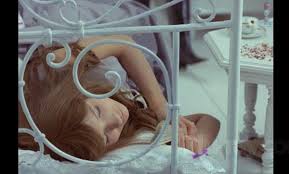
This weeks screening was Valerie and her Week of Wonders (1970). This Czech film was easily the most complicated or to say the most different of the films we’ve seen as of late. It leaks of symbolism to the point where it felt like a tumblr girl’s aesthetic wet dream. Following themes of womanhood, coming to age and ideas of reality, this film felt at first like it was going from wall to wall but after viewing and doing some reading on the film it’s a modern fairytale inspired by the originals of the past.

Based on a novel, with the same name, from 1935 it’s easy to see images of classic fantasy mixed with modern views on horror. Valerie is a young girl who finds herself in a world surrounded by monsters, vampires, and overall creepy people trying to use her for immortality. The films plot is incredibly confusing as by the end no of it makes sense, but when a film is trying to show the parallels of living in a dream and reality it’s best not to blatantly tell the viewers. As Valerie gracefully carry’s along with the mystical shenanigans that everyone puts her through it’s easy to see how she feels she in a dream and is curious as to what will keep happening. Keeping the viewers in the dark on the film’s reality made the film feel like a dream itself, beautiful sights but confusing horror that you can’t look away from. The films attempt to create an environment is unmatched by others. It’s not the best looking fantasy film but it takes you to a place so unfamiliar but easily recognizable that is similar to a dream state.

Though the film creates the perfect dreamy atmosphere it’s so much more to that. It’s showing the transformation from childhood to adulthood. Wonders may be a code word for sex and sexual awakening is all over this films core themes. Valerie seems to live a sensual dream sprinkled with bits of sin and lust in an attempt to show ones mental journey from innocent child to horny animal.

This week we also had a reading on The Exploitation Generation by Maitland McDonagh. A deeper look on the generation of filmmakers who broke through the conventional way of making films in the 70’s. With the guidelines being less restrictive to filmmakers they had a chance to create films that would depict real and un-lawful images of the world that wouldn’t have been shown on the screen before. The reading quotes Pauline Kael who called it “Hollywood’s real Golden Age, a brief period when films that defied time-tested narrative constructions and tortured easy genre NC formulas into weirdly challenging hybrids seemed the norm rather than the exception, a decade which, in retrospect, represented an extraordinary blossoming of talent in the commercial cinema.” These filmmakers would be the ones to inspire the modern film innovators of today using there out of the ordinary techniques and ideas un-heard of during their time.

Are you there God? it’s me, Valerie

I hope everyone is feeling healthy and not having too much trouble adjusting to online classes. I think our first week went really well, props to the presenters for amazing presentations despite the switch-up of learning/teaching style (might have to watch Blade Runner 2049 tonight). Now, to jump down the rabbit-hole, or in this case vampire dungeon, of Valerie and Her Week of Wonders. This was such a different film from what we have viewed this semester, not just because it was a Czech film but also because of the subject matter and narrative. There are many aspects of the film that I enjoy but, overall, the film left me feeling a bit uneasy. Understanding that a confusing narrative adds to the surrealist nature of it, I can live with my uncertainty.valerie9

Valerie was such a beautiful film to watch, it was visually stunning. There were multiple moments I had to pause the movie so I could take in the compositional qualities of the shots, the use of setting and props should be recognized for their contribution to the overall dreamlike essence of the film (I feel like this is a common takeaway from films with pastoral settings). We talked about how popular the movie score is, the trancelike choral music reminded me a lot of the soundtrack for The Wicker Man (1973) if you want to check it out (this might also be from the pagan undertones of Valerie).

Valerie and Her Week of Wonders is a coming of age story that follows a girl’s discovery of familial secrets during the week of her first period. Now, getting your period for the first time is already pretty rough but Valerie really had a crazy first run. At first, I didn’t see why this was called a coming of age movie, starting your menstrual period is only one step in transitioning into adolescence, but after sitting with it for a few days it makes more sense to me now. Adolescence is an odd stage in human growth; the waiting period between childhood and adulthood. No one wants to acknowledge you as an adult, but

valerie vampire

my face during that weird puberty church speech

you’re not treated with the same forgiveness as children. This film is compared to Alice in Wonderland, probably because they both are about young girls (though I believe Alice was around age 11) but also because Alice longs to be recognized as an adult but does not want to partake in the responsibilities that come with it. Where the stories differ, is how adulthood is introduced to them, I think Valerie’s story is more accurate to adolescence. I know that sounds crazy but let me explain (and ignore the vampire part).

During the first half of the film, Valerie spends a lot of time watching other people, usually engaging in sexual acts but also the way the adults speak to each other. The Tanya Kryzwinska piece discusses the role of family relations in adolescence in depth, but one of the main points that I found relevant to this specific theme was,

“As Freud argues in his 1909 essay ‘Family Romances,’ it is common for children to fantasize about family intrigues and secrets. Jean Laplanche expands on this idea by suggesting that the coded speech and actions of family members present enigmas to children that have their impetus in a drive to knowledge. These putative, puzzle-laden messages become repressed and thereby structure unconscious fantasy, only to re-emerge in retrospective form during adolescence.” (pg. 4, paragraph 4)

In short, observed conversations and behaviors amongst family members or other adults that were once confusing to us as children become understandable during adolescence. Of course, this is a theory; but Valerie did a really great job of exploring it. Along with the sexual transitions Valerie experiences (although somewhat intense), she is faced with her valerienungrandmother’s thirst for power and the possibility of losing her inherited home. These are all big changes for Valerie to unfold in just one week. It makes me wonder if her family members were actually vampires or if it was a fantasy she created in the midst of being exposed to more mature topics, as suggested in the Kryzwinska reading. In the podcast and in class we discussed how highly edited this film was, most of the shots lasting only a few seconds, this might be related 1) how fast these new epiphanies are occurring 2) Valerie’s own confusion. I feel like I’m running circles around the meanings of this film; what’s a symbol and what isn’t? I still have so many questions. Coming of age movies are a favorite of mine, this one was a different experience but a good one.
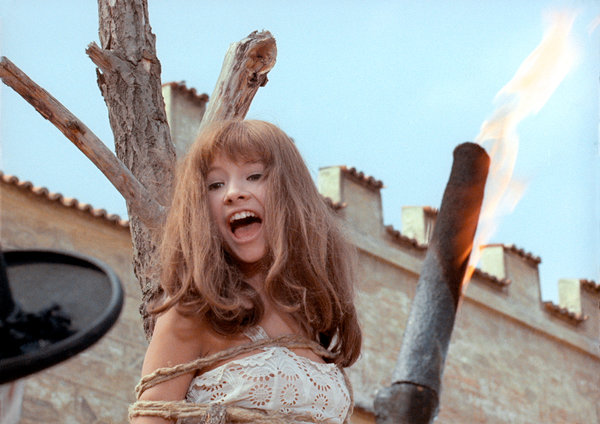

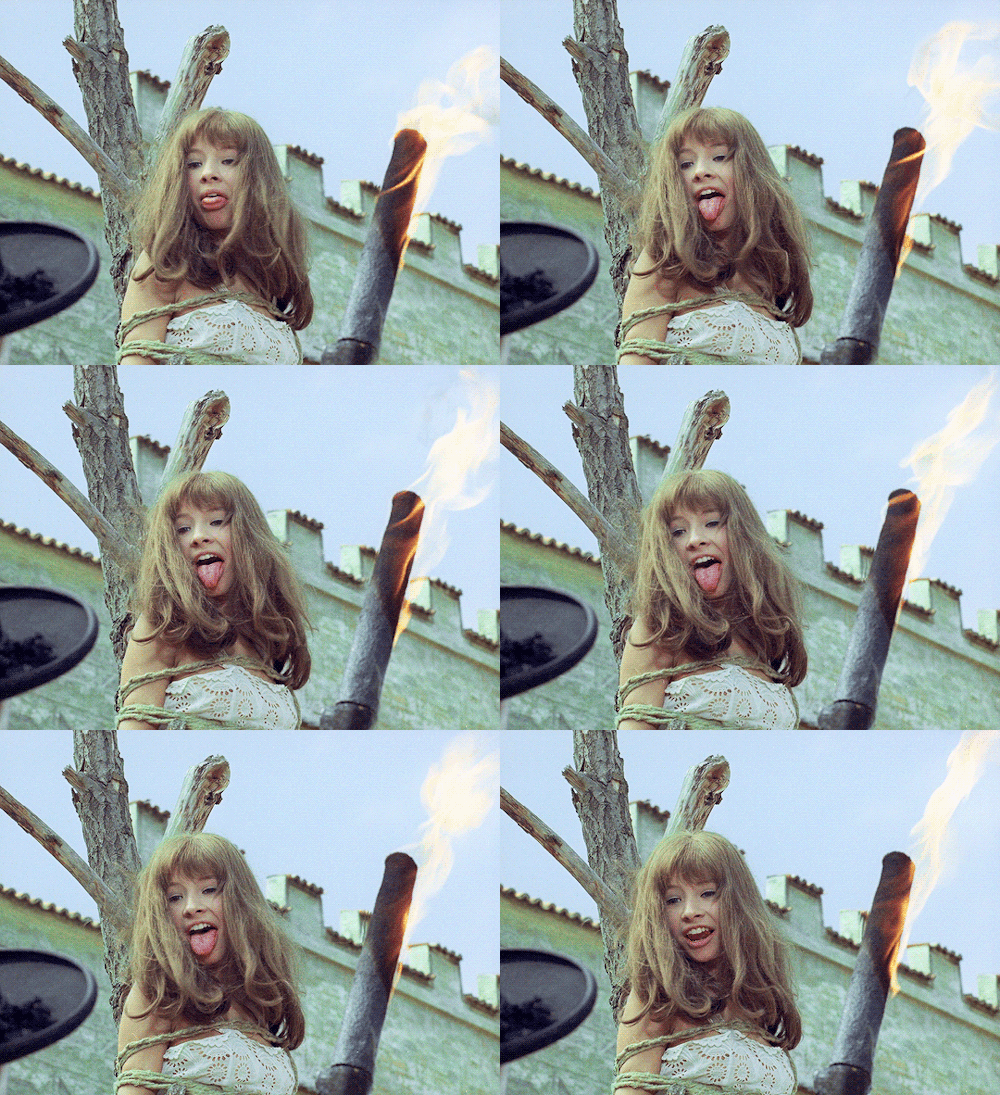
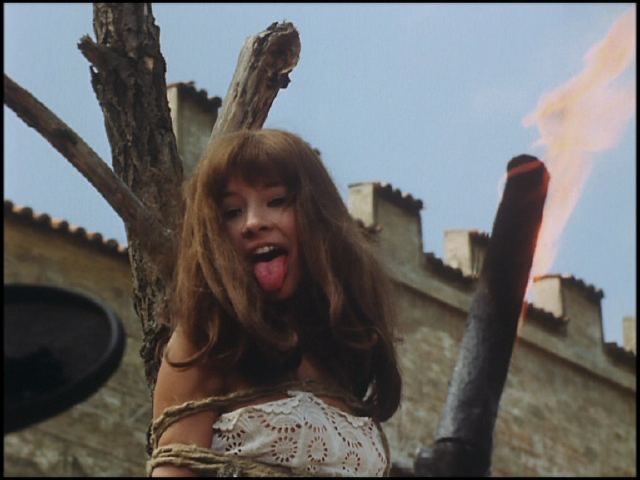
valerie laughing

My fav scene was when she started laughing as they tried to burn her her, little did they know, she has some magic earrings

Valerie and Her Week of Wonders

I’m gonna firmly say nothing going on in the world right now is as weird and confusing as Valerie and Her Week of Wonders. I mean seriously what did I just watch? I think the part that is really hard for me is that I get it. Like, with the readings and some online research I understand what the movie was about. But I think what really gets to me is that I expected a movie with a totally nonsensical plot so I would just be able to focus on the visual beauty. Instead I found myself scratching my head to decipher metaphors and symbolism the whole time because there definitely IS a plot. But even then, the events don’t really make sense still. I’m trying to put into words what I mean. I think the best way to put it is that this movie had just enough of a coherent plot that I wanted to follow it but it didn’t make enough sense in the end to reward someone who tried to follow it. That isn’t to say that I didn’t get the plot, it just wasn’t a satisfying way of getting there. I’ll be honest (and I might catch some flak for this) I think Valerie was an incredibly boring character. Every time she started to get interesting she would revert back to some scene to convey her innocence and it was infuriating. I felt like she would start to grow only to revert back to the way she was before. I’m not even entirely convinced that she didn’t revert back at the end of the movie. For a movie that was about growth and puberty, I felt like every step she made forward was followed by two steps back. On the other hand, I absolutely loved the visuals and the costume work. That was all fantastic. I guess I really don’t have an opinion past indifferent towards the movie. If I had to pick an incredibly pretentious art house movie it would be this I guess? I don’t really know.

Image result for valerie and her week of wonders

This week we had some really good presentations from the readers and also a presentation about Scream. Without the readings I definitely wouldn’t have known where to even start with my post about the movie so that was invaluable. Scream actually is one of the few horror movies I like because it almost feels like a movie you have to watch. I don’t like horror at all so it’s really weird that I like Scream, but I remember watching it at a sleep over with friends when I was young and having a great time watching it. It was an awesome presentation! I also presented this week and I want to apologize for how long mine went. I know mine started pretty late too so it was gonna go over anyway but still. I just had so much I wanted to talk about. My original presentation when I practiced it was closer to around 45 minutes so I definitely cut a lot out but I really hope I convinced some people to give Blade Runner and its sequel 2049 a watch!

Image result for blade runner 2049

Valerie and Her First Week of Online Classes

So we survived the first week of online classes and it is time to write another blog post.

Before I dive into our screening/readings this week, I’d like to take the time to quickly shout-out Kelsie, Patrick, Spencer, Averi and Chris! I think they did an awesome job leading the discussion and doing their presentations this week considering this is new territory for us all and they were sort of the guinea pigs for that. Great job guys! Also I know this maybe sappy but I am very appreciative of Dr. S this week, as he somehow made this week feel (almost) like a normal class so thank you for that!

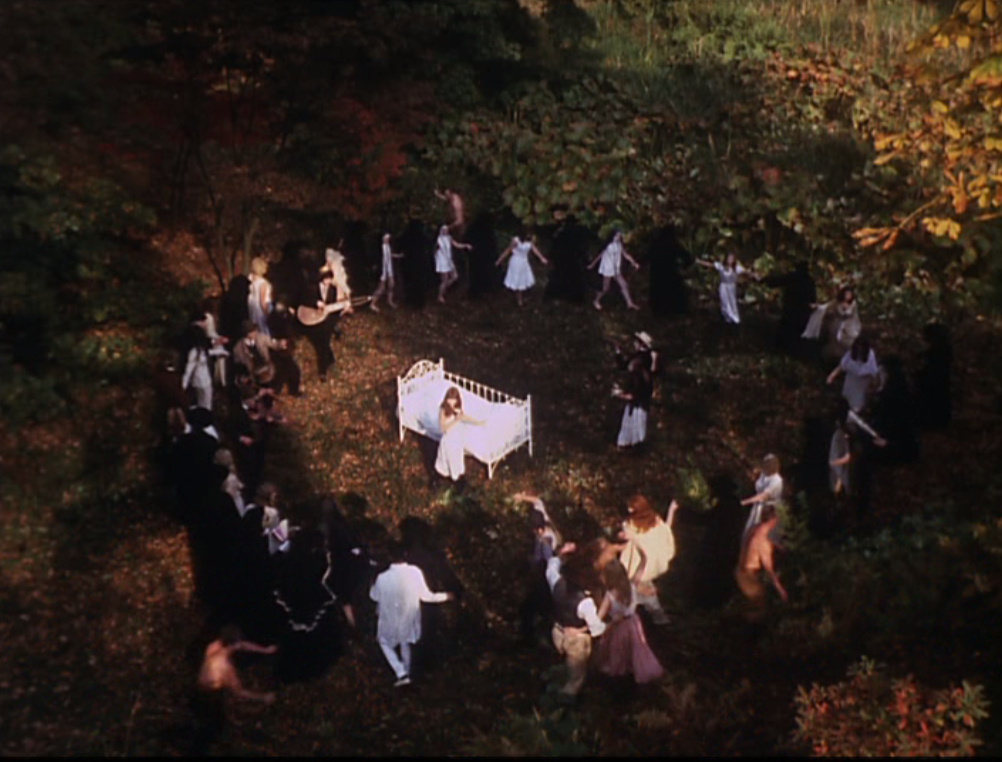
Ok enough with the sap lets talk about the film we all saw this week, Jaromil Jireš’ Valerie and Her Week of Wonders. How odd was this film!?! Am I right!?!?! I don’t know about you guys but I was kind of grateful for this new online format and having to watch this film on my own, just for the the fact that I was able to pause and rewind certain parts and process what I was watching exactly. This film was visually and audibly beautiful with its soft colors and haunting church music. Though, I don’t think I am alone when I say that I was confused for an hour and twenty-four of this hour and twenty-five minute long film. Everything seemed a little clearer in the last minute of the film though when Valerie seemed to wake up in a bed in the middle of a field and everything I had just witnessed was a dream??

Watching this film felt similar to the first time I watched Alejandro Jodorowky’s 1973 film The Holy Mountain, and even Terry Gilliam’s 2009 film, The Imaginarium of Doctor Parnassus. You’re going to have to bear with me as I try to describe to you this feeling as it is hard to put into words. With all three films it felt as if as I watched them I could not only physically feel my movie knowledge and credibility as a movie buff/nerd expanding but, also as if I had just fallen head-first into a new weird world that I was excited, scared, and confused by but still never wanted to leave.

I think that’s kind of what Valerie felt like in her world too, excited and scared. Excited by the ideas of growing up and the new sexual world around her, as men make love to women on fallen trees and drops of menstrual blood fall gracefully on flowers but never on nice white sheets, or nice white floors, or nice white dresses. (As a woman I had a hard time ignoring the logic on that one.) While she was also scared by fact that she is no longer living in the naive fantasy world of a child and she is learning that the people who are suppose to protect her and she is suppose to be able to trust can be evil and predatory vampires, or rodents disguised as vampires????

I think Patrick was right to point out the quote in Jana Prikryl’s article Valerie and Her Week of Wonders: Grandmother What Big Fangs You Have!, that describes the story as ‘concretely irrational psychic collage freely borrowing from the genre of so-called pulp literature everything belonging to the nethermost regions of our unconscious.’ as that perfectly describes the film I just watched and the world I just entered.

Now, if you’ll excuse me I am going to go watch it/enter that world again.

Valerie in Wonderland

BY SARAH BATY

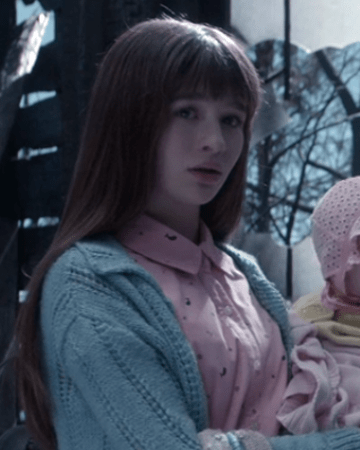
Not only was this film in a different language, the plot was hard to follow as well so that made for an interesting time! I always take notes to just keep my train of thought on the films we watch since normally we watch the film Monday and I don’t write the blog til Friday, it’s good for me to remember my thought process while watching the film. Majority of my notes this time consisted of questions to google later! Also, if anyone got the eerie feeling Valerie looked MAD familiar it’s because she looks EXACTLY like the actress who plays Violet Baudelaire in Series of Unfortunate Events, you’re welcome.

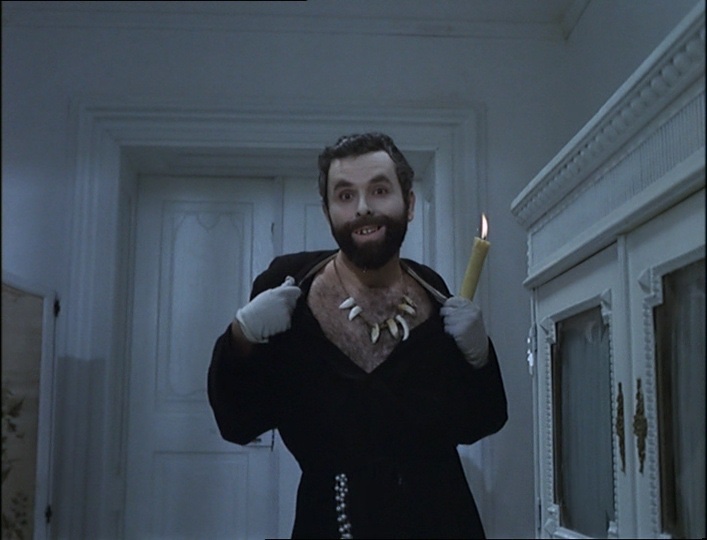
Very grateful for our reading “Valerie and Her Week of Wonders: Grandmother, What Big Fangs You Have!” by Jana Prikryl because it spends the first couple paragraphs explaining what happened and I definitely needed that. Prikryl describes Polecat as being “campily aware of his own hideousness” and that line really got me to LOL. He is pretty gross looking and gross is the correct term here because he is not as much scary as he is gross and that’s just facts. She goes on to talk about how Valerie “jolts along with the logic of hallucination” which is exactly how I felt while watching it. A giant hallucination. I was unable to tell what she was actually seeing and what really happened or if I was trippin’, but that was the allure of the movie. That’s what made it what it is. Entrapping its audience by how beautifully weird it all seemed. An allure of not ever truly knowing what was happening, you knew for sure that you knew nothing.

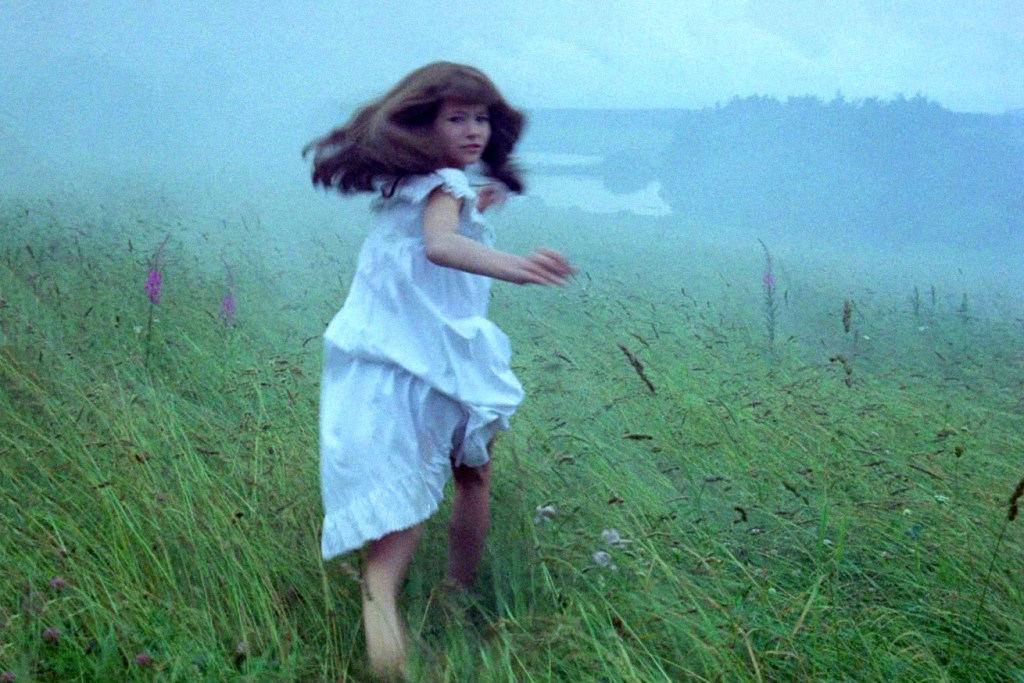
The theme of white is prominent throughout the film with the flower, her bedroom, the cluster of girls in white dresses, and finally her pearly white earrings that keep her out of harms way. This flows into the aesthetic of the whole movie how white represents innocence and purity. There is nothing like the old age flower symbolism. In our other reading on the Kinoeye, Tayna Krzywinska unpacks the fantastic fairytale. She first says a few words on how the ambiance of the choir-based music is so trance-inducing you can’t help but be completely invested in this soft-gothic horror story. The music combined with the significance of the white palette all adds to the overall “particular audio-visual ambience of the artifice.” She then connects the editing to the quality and completely stunning setting. The landscape is beautiful and they movie completely captures the “beauty of early summer light sparkling on water and illuminating the pastoral landscape, which is set against dark, decaying, cobweb-strewn crypts.” Describing how the aura of the film creates a surrealist imagery that gets people to tune into.

Valerie and her Week of Very Uncomfortable Situations.

What a crazy week!

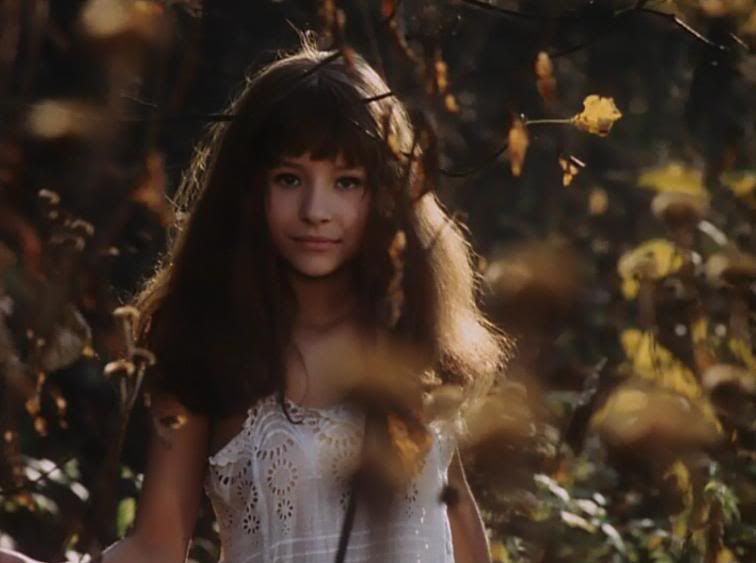
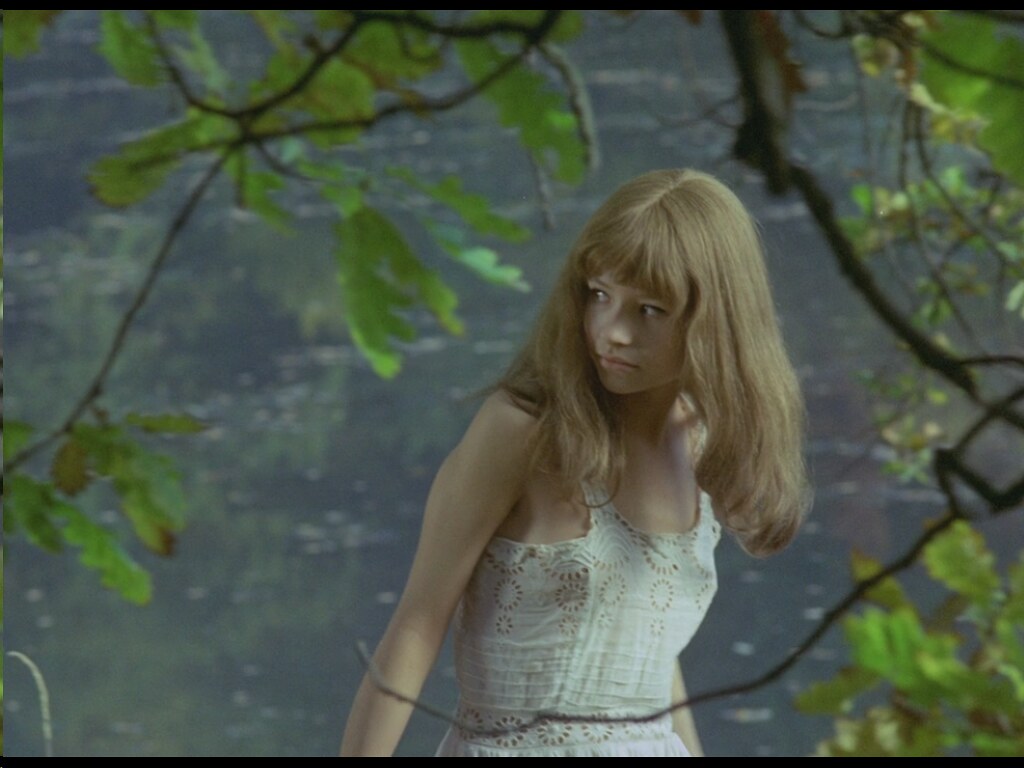
Valerie looks so young here in this image. It really captures her transition from child into woman. In this shot she is wearing a white dress, which symbolizes purity, but later she will be seen wearing gray and purple.

My first reaction after watching Valerie’s Week of Wonders was “Well, that was weird”. But the more I reflected on the film, the more I came to respect it. Based off the 1935 book by Vítězslav Nezval, the film was released in 1970 by a Czech film studio. The movie is part fairy-tale, part sexual awaking story, and part nightmare fuel. However, from the opening credits I knew the movie would be beautiful. The opening shots of Valerie just sitting pretty with the music playing let me know right away I was about to watch something wonderful, but surreal. I also see why this would be considered a cult classic, at least outside of Czechoslovakia. Not only was the film ignored in box offices during its initial release, but there was much political tension as the Soviets invaded Czechoslovakia countries. To quote the Kinoeye article,

“In accordance with Soviet maneuvers to enforce atheism, Valerie a týden divů embraces an anti-Catholic stance, particularly in relation to sexual morality,”.

As such, every character with a close relation to the church (The priest, the Grandmother, the Polecat) is seen as a hypocrite. The most disturbing character in this film, to me, was the priest. There’s a scene where Valerie is having dinner with the Priest, her Grandmother, and some other girls where the priest talks about ‘saving’ a black girl during a pilgrimage. It was incredibly unsettling. I wasn’t too surprised when, soon after, the Priest tries to rape Valerie in her bedroom. Even when he dies, he just comes back to life! Just stay dead man!

The whole time watching this movie, I felt like I was dreaming. Before taking film classes I would have found the abrupt cuts and rushed time skips annoying, but in this movie these techniques work. Take the first few minutes of the film. Without any explanation we see Valarie get robbed by Eaglet, encounter ‘The Polecat’, and then have her earrings returned thirty seconds later. But this works, because that’s how dreams work! Dreams aren’t don’t tell a clear linear story, and neither does Valerie’s Week of Wonders. There are also times, like when Valerie is watching her newly married neighbors make-out, that no one seems to notice that she is there in the room too. As bizarre and unnerving as this film was, I would have to call it a masterpiece. There is just…something so creepy yet wonderful and real about this film. And I will watch it again, if to only better understand it.

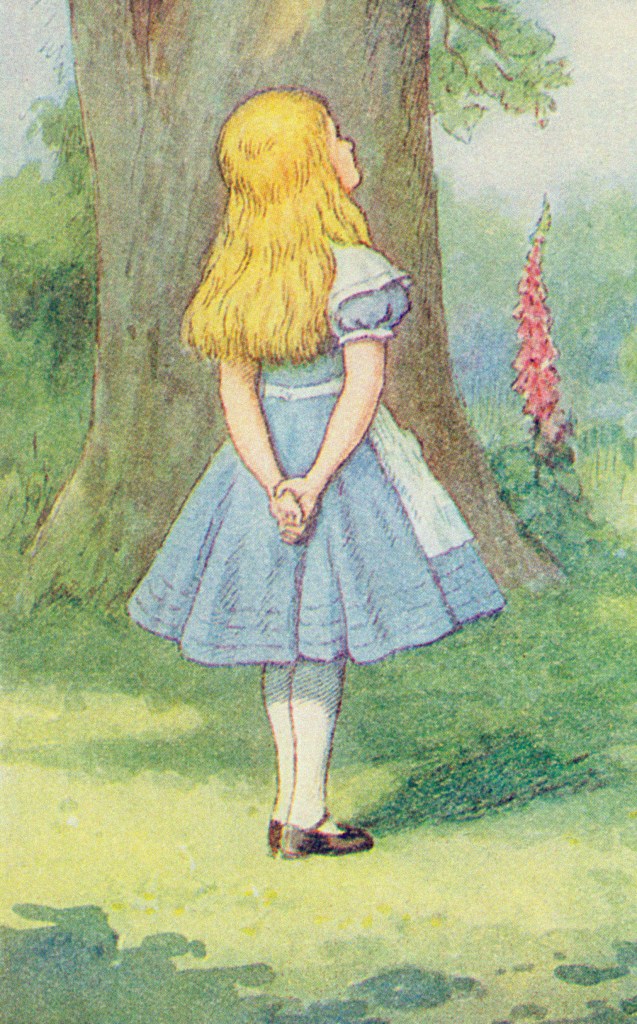
As Valerie’s Week of Wonders is a bizarre film, I found the essays we read this week (Kinoeye and Grandma What Big Teeth You Have!) incredibly enjoyable and insightful. The film is very much a fairy tale all on its own, but I couldn’t place what else Valerie reminded me of until “Grandma What Big Teeth You Have” stated the similarities the film shares with Alice in Wonderland. How did I miss that!?

Since Valerie’s Week of Wonders was released in the beginning of the 1970s, it’s time to talk about the Golden Age of Hollywood. The essay “The Last Great American Picture Show” describes the Golden Age of cinema as;

“A brief period when films that defied time-tested narrative constructions and tortured easy genre formulas into weirdly challenging hybrids seemed the norm rather than the exception, a decade which, in retrospect, represented an extraordinary blossoming of talent in the commercial cinema”.

It was a time of great freedom, for both film makers and movie goers. New genres, such as disaster flicks and Blaxploitation thrived during this time, bring us titles like The Poseidon Adventures and Shaft. Several critically acclaimed directors and studios made their first experience during the seventies, including Francis Coppola in his film The Godfather, and Steven Spielberg with the first box hit of the seventies, Jaws. However, the success many of these new superstars received during the Golden Age can be credited to Rodger Corman. The king of Exploration Cinema, Corman worked for AIP (American International Pictures) as the lead director of many classic B-List films. Put in simple terms Corman was cheap, fast and efficient when it came to film making. Perhaps his most famous film, The House of Usher, featured a young Mark Damon as the leading actor, kick starting the young man’s career. The essay “The Last Great American Picture” lists no less than 42 actors, producers, and directors whom Corman mentored during his time with B-list films. In a way, Corman is not only the Father of Exploitation films, but also the Grandfather of the Golden Age of cinema.

Valerie and her Week of Wonders

This week will be harder for me to write because I did the discussion, so some of my post may seem a little repetitive. I am going to touch on a few things that I brought up on Wednesday and go a little deeper.  With Valerie and her Week of Wonders, this was the first foreign film we have watched that wasn’t in English. I feel most time that this is a draw back for me because you spend more time on reading the subtitles than actually watching the movie. For this one, it was a little different because I found myself too busy trying to understand what was happening than reading. We talked about watching as a viewer and not an academic to better appreciate this film. I think that is the best advice for a film with such oddities. I mean the vampire-priest-constable is just one of the mind trick the film plays on you. Each character with the exception of Valerie seems to play so many different roles.  You find yourself trying to see who each person is and who they were at one point. The grandmother goes through so many changes, you can be easily crossed up.

One of the main talking points from my reading was the idea of the white clothing or the white flower. The symbolism in this film play a big part behind many of the themes. First you have the vampire-priest-constable who is preaching to a group of women in all white outfits. This shows how the group is pure and untainted by the vampire priest whose goal is to corrupt them. The next example of this is the blood that falls onto the flower or daisy. In the podcast, they talk how a daisy is there to represent more than just a white flower, but the daisy holds more symbolism than that. With the blood fall onto to this pure white flower, it shows how easily something beautiful can become stained. This is to represent how Valerie getting her first menstrual cycle have tarnished her innocents. I compared the use of the blood on the flower to be link the little girl in the red jacket from Schindler’s List. In that movie, the red jacket is the only color you see, and it stands out later when you see the little girl has died. It is the same way here because Valerie is no longer a little girl and can be considered a woman now that she has bleed.

After spending so much time talking about Valerie and her Week of Wonders, we got as chance to go back in time with my second reading. This reading was a blast from the past because it was a summary of so much, we had discussed in the first film class. It is always nice to go back and her about Roger Corman. A film director I have gained a lot of respect for because he not only changed the industry but mentored so many directors we have today. I can see why Dr. S likes him so much.

We then move into the cult movie presentations; this week ran a little long with passion. I have never seen Bladerrunner or knew very much on the film, but after hearing the presentation it shows how well it has resonated with some. I laughed because it took more to explain the background need to understand the plot of this film than the actual film. Once again, we got to see someone who really loves a movie and their passion behind it.

The next movie, Scream, is one that most people are more familiar with and can grasp. I could not see the title page without have “What’s your favorite Scary Movie?” pop into your head. That is such an iconic line and stands out. The only downfall is that I have seen parody more times than the actual film, and I think that takes a little away from the horror of the movie. Still a great movie and I do enjoy seeing Shaggy getting more roles in films.

Valerie and Her Week of Weird

This week, our first online week, has been an interesting one to say the least. The film we watched, Valerie and Her Week of Wonders, is insane. I am going to focus heavily on the film because there is so much to unpack with it. The only thing we no for sure is that we know nothing. The surreal setting and shooting of this film creates an alluring hallucination that captivates the audience in confusion and intrigue. Although we have no idea what is going on as we follow Valerie in her rite of passage from maidenhood to womanhood. The acid trip of a dream we have to witness to get her to womanhood is very hard to sum up in just a few words. It is such an amazing artistic film, but if you aren’t focused the whole time you have no idea how you got to where you are. (Sometimes even if you are paying attention you have to rewind and try again.)

This thirteen-year-old girl lives an interesting yet messed up life. So much of her life revolves around familial relationships, that are warped and improper. Society would frown upon how supposed siblings and parents act. The fine line between how taboo the relationships are and aren’t is the fact we have no idea if anyone is actually related or who they say they are. This strange trail of events is hard to comprehend, but in the article “HORROR Transgression, transformation and titillation Jaromil Jireš’s Valerie a týden divů” by Tanya Krzywinska, the desire and sexual attraction between apparent family members.

“In accordance with Freud’s central notion that fantasy is subject to the distortions of the primary process, the Oedipal connection becomes diffuse here, subject to disavowal. It is never clear that Valerie’s brother is indeed her brother, for example, or that the vampire-priest-constable is her father. They are both objects of Valerie’s desire (as she is the object of their desire), yet to keep such a pretty game in play, these potential sexual relationships are invoked only to be deferred. That all the central characters in Valerie’s world do not have definitive, stable identities locates that world as subjective artifice. Valerie imagines a range of scenarios in which her family members are endowed with magical powers,their status inflated to fairytale proportions, all along the lines of Freud’s family romance.”

Valerie has to experience and understand what her body is doing, how it is changing. The unclear Oedipus complex happening in this film is hard to shame. Because everything goes back and forth on if anyone is actually related it is hard to completely classify as taboo. At most we can call it “icky” because society’s rules are borderline being crossed, but we don’t know for sure. Not knowing for sure is how this film skates by, which was done deliberately, not only in this film, but in the novel it was based from.

The surreal imagery of this film is beautiful. The harsh shifts between scenes, the nature, the over focus on white, flowers, and fruit is at the forefront of the film. Most of the imagery pertains to purity and Adam and Eve. These over-focused images and hidden messages only add to the illusion that we know what’s going on in this film.

“Valerie jolts along with the logic of a hallucination, its more conventional vampire plot intercut with odd visions and heightened by a soundtrack of choral chants and disembodied dialogue. Sometimes these dislocations bring us intimately close to Valerie herself, from various appealing angles, and on a second or third viewing you see how these shots often punctuate moments of conflict, as if Valerie’s inner equanimity were guiding the course of events.” (Prikryl)

This weird twist on Adam and Eve with a dash of vampires is a truly questionable. This mythical world that Valerie lives in is hard to follow. The biggest problem is we don’t know if its reality, or a dream. The film is centered around Valerie in her bed sleeping, or her returning to it, an underlying idea that its all a fantasy in her head that her body has rampaged because of the adolescent hormones blooming inside her.

Coming of age stories are a huge hit, especially among the younger generations. This taboo version of one addresses many of the darker themes and desires that weren’t allowed to be addressed. However, in the late 1960s, the code that restricted what was taboo and could come on the screen was finally squashed out. Anything and everything was allowed, it was an open and taboo free future. Moral standards could be lowered and had no real guidelines, so when people filled the theater to watch near incest it was allowed, perhaps not Kosher, but it was no longer against cinematic codes. The film itself was a must see. Although the language barrier may be an issue the subtitles help a lot. The confusing ride is worth it in every way. This film requires more than one screening, as there is so much to unpack, notice, and experience.

Gang GANG

First off I just need to apologize for my awfully rocky start the readings discussion, truthfully I think I blacked out up there and lost all sense of mind… lol. But on the flip I watched the movie for a second time on Tuesday with Tal, Zane, and Mary. I’m obsessed to say the least, and am so glad that I was introduced to this movie. I was attracted the colorful, surreal backgrounds of certain characters and shots and the utopian feel that was done by shooting at night and filming hella fast.

Image result for the warriors scene     Image result for the warriors scene

This week the readings were straight to the point as well as the other links Dr. S sent us that gave us even more insight on the film and its background. The reading more specifically based on The Warriors that first spoke about how different the movie was from he book, more importantly it touched on how dreamy and groovy this representation of young boy gangs in New York City in the late &0’s (although it seemed like a different future version due to Walter Hills intentionally stylized atmosphere). The movie has quite the simple plot; hundreds of mini boy gangs from all five boroughs trek to the Bronx to a rally that Cyrus ***a gang god*** is hosting, Cyrus gets shot, and the one group The Warriors are accused of shooting Cyrus, they all try heading home to Coney Island whilst getting jumped by multiple other mini gangs around the city trying to report him to the Riffs. It is basically a big baseball game, subway stations as bases, marking a victory from another team. They eventually have a home run when the Riffs meet them on Coney Island to save them and get themes successful gang in the city. The movie is nothing like any New York City a real person has ever seen. No one else roams the streets unless they are there on purpose, it is foggy and saturated with color, gangs filled of provocative identities, and narrated by an unknown dj. 

When the film was released it had horrible feedback, viewers said it was insightful of violence and was almost even banned in Boston. On the other hand it enticed an immediate cult following due to the luxurious glam-rockeque sense embedded in the film. I respect Hills attempt to represent the youth of America with no moral judgment nor rationalize it through Bourgeois societal standards. I could understand the relation to the Warriors and the reading, Horrors at the Crossroads, which talks about the Rialto and its influence on cult movie goers. The Rialto were densely populated areas in the city that had an all inclusive invite to a huge post war gay culture funhouse. No matter your race, gender orientation, or sexual orientation, those stretches of movie theaters showed films that allowed people to dive into their true identities. Women realized they can kiss their girlfriends and they do not have to be stay at home mom while their husbands are off at a war. Men were cooped up across the sea and they do not need to be secretive about their love and attraction to their solider mates.

Image result for rialto nycThanks Schlegel for the opportunity to study and analyze this fantastic movie, that will surely impact me for ma whole life. Thanks fellow cult class for putting up with my presentation. I could have gone hard on my person impression and what not from the movie, but I figured that, I presented on the readings this week: why not reference them a tad more this week? xx