Tag Archives: Final Project

Final Project: Cult Horror Films

We should begin with the basics. What is cult? Why does it matter? The best definition I have read comes from Welch Everman’s essay “What is a cult horror film?”: “cult suggests a small group of loyal fans, so a cult horror film would seem to be one made strictly for the horror audience, the audience that will literally watch anything as long as it’s a horror flick” (213).  This definition suggests the extreme and is completely exclusive.  The dedication and work that goes into being a cult is extensive.  This work further separates the cult from the mainstream.  However, this is not all bad. Being part of a cult fan base brings about a whole community, giving someone an immediate friend. Someone walks into a room with an Insidious shirt and it is an immediate conversation topic, giving a connection to a complete stranger, forming a bond one never would’ve formed otherwise. It is one of the many reasons people love horror.

Classic films are unique works of cinema that have transcended time and trends, with indefinable quality. Classic films are often universal favorites that constitute rescreening. Cult classics are a bit different. Cult films are known for their dedicated, passionate fan base, quoting dialogue, and audience participation. But the term cult allows for major studio productions, especially box office bombs, or films that are more on the obscure side and are usually transgressive in nature, causing the films to be shunned by the mainstream. Cult films in themselves are a wide band idea that covers just about every aspect of cinema, by narrowing in different sections and distinguishing them from what constitutes as mainstream.

“Cult horror films, then, are not classics and never will be. Classic horror films are those that have influenced the entire history of horror movies—James Whale’s Frankenstein, Tod Browning’s Dracula, George Wagner’s The Wolf Man, and so on. It isn’t very likely, however, that movies like Dracula vs, Frankenstein, Mansion of the Doomed, or The Vampire’s Lovers will have any lasting effects on the genre.”(213)

First and foremost, this statement is disproved. Horror is not only a classic but is a major part of forming cult history and film history. Everman tries to create a distinction between classic films and horror cult films, as if they cannot be under the same classifications; however, horror cult films can be considered classics, even under his definition of classic. He claims they have to influence the “history of horror movies” and a lot of cult films do. Scene, tropes, ideas, and skills are passed on throughout the horror genre, no matter the film or the story line. Directors from Joe Dante, Tod Browning, Alfred Hitchcock, to John Carpenter we have the widespread of horror masterminds. Horror is a fine art and that is where the problem comes in with people not classifying it as cult. Not all horror is cult, but many of the best horror films are cult films, or are based on cult horror films.
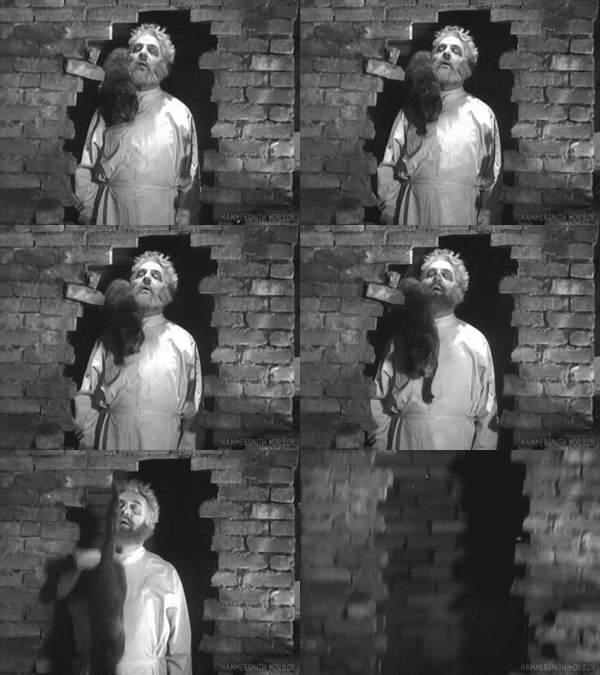
“A lot of these films, though, are so bad they’re good—or at least they’re funny.” (213) For example, Maniac by Dwain Esper is so bad it’s hilarious. It is supposed to be scary and warn people about mental illnesses, but the acting, script, and directing is so horribly done it turns itself into a whole comedy.  Maniac is loosely based on none other than Edgar Allen Poe’s “The Black Cat.” This one, however, focused more on this psycho who kills the mad scientist that tries reanimation. It ties in other aspects from Poe’s short story, like the black cat and the focus on the eye and the progression of insanity.

Esper was not the only one who thought Poe’s story was worthy of a horror film. Edgar Ulmer directed The Black Cat in 1934, the same year that Esper’s Maniac came out. The plot of The Black Cat is simple yet done so well that it seems like a huge elaborate scheme. American honeymooners in Hungary get into an accident and end up trapped in the home of a Satan-worshiping priest. The bride is taken there for medical help because of the accident and things just spiral out of control when faced with a satanic cult leader.

Both directors based their films off of Poe’s story, which was really neat to learn, because both films are very different. Maniac focuses a lot more on the mad scientist aspect, with its dead body reanimation; however, the acting is just so bad that you can’t take it as a horror film. Disclaimer, it is only the 1930s, acting can’t be that good, film is relatively new and perfecting it is going to take decades of trial and error. The Black Cat is such a different horror film and easily a classic. Ulmer and Esper are clearly two very different directors, taking the same story and creating two completely different films. Ulmer’s style of directing made his film scarier. Personally, I was not afraid, but it seemed less like comedic relief and more of a drama. So, in choosing between the two The Black Cat would be my choice for a staple in the history of horror.

The agony portrayed in the film is intensely layered on to the point where it is not a real scare, but gives a more dramatic effect, leaving the audience on the edge of their seat, rather than cowered down. However, the film progresses like a nightmare. The audience is living through this nightmare that is bizarre and will ultimately be forever printed in their mind, leading to the audiences to never forget the experience.

Freaks, the 1932 film directed by Tod Browning is set in a circus. The leader of the side-show performers is planning to marry one of the trapeze artists. However, his friends discovered that she is only into him for the money. Hans still marries Cleopatra. After all, who cannot fall for Cleopatra, the most beautiful trapeze artist? Cleopatra is ultimately the monster of them all, an interesting twist being as she was surrounded by people society dictated as “freaks.” Freaks initially failed in the box office because of its “sympathetic” nature towards side-show characters rather than an exploitative one. This film is a metaphor for classism, and shows the clear lines drawn in society by class. The topic is hard to talk about and showing and criticizing it is rather taboo. Freaks was ahead of its time and by the late 20th century was reevaluated. Freaks has become more popular in the 21st century. The concept of the “freak show” has long since been repeated and reproduced, but its portrayal here is one of the first great and terrifying moments, some of which are still classified as the scariest in horror history.  Browning chose to humanize the deformed in this film, rather than demonizing them like most would have, something the masses didn’t get behind until looking back on it. Freaks has led to several new uses of the trope of a freak show. American Horror Story had an entire season dedicated to “freak” in its season four titled “Freak Show.” The show was initially inspired by Browning’s Freaks and Herk Harvey’s Carnival of Souls. Both of these cult horror films came together and were able to form yet another staple in modern horror. 
The retrospective effect is important when understanding cult. More often than not cult films become more popular after they have been released, the same can be said for a lot of cult horror films. However, ironically, in recent years films that once tanked in the box office are now mainstream. For example, Saw VI, a flop at the box office, ended up being the best film in the movie series. The Saw series was very mainstream, but the outlier, Saw VI, falls under cult classification. It flopped at the box office, it has a dedicated fan base albeit one for the franchise, it is transgressive, and its quotable. Saw VI is a modern day cult film. It tests our ability with gorish games of hell that make people question their humanity. This film ended up categorized as one of the best films of the franchise because of its intense “B story-line” and psychological warfare.

“The phrase cult horror film has come to mean ‘bad horror film,’ and that’s a bit unfair—but only a bit. The truth is that, yes, most movies that are called cult horror films are bad,” (212). However, the films are not entirely to blame, usually the stacks are set against them. They have: “minimal budgets,” “are poorly written and directed,” “production values are near zero,” and “the acting is appalling” (213). Despite all of that, the films are still loved and cherished by their fan bases. If no one liked the films then they would just be forgotten. These cult horror films attract a certain type of audience, but that audience is more dedicated and in love with these films than most of mainstream media is with the major production films. My favorite films are coming out of this mix of obscure taboo groups. Once you love them, you love them forever, the next best thing does not and cannot replace them. Cult horror films are totally insane and are such a massive variety that you can find just about anything to satisfy your need. These films like to break down society’s standards, and do not care about the backlash. They are original and underappreciated by mainstream media.

The last thing I want to say on the matter is take the leap. Instead of saying “horror isn’t for me I’ll never watch this,” watch the film. If you do not know where to start, take any of the films I’ve written about and watch it, then watch it again. You get so much more out of a second watch. The nuances you missed, the little shifts in the background, the outfit changes, and so much more. You appreciate and understand them better after a second screening. These films are not for everyone, but even if you do not become a horror fan after watching them, you understand and appreciate the learning curve of film. Every film cannot be your favorite film. But every film is an experience that you can learn from and take into your next experience. Even if you do not like Maniac, because of its really bad acting, you learn you like the mad scientist idea and then you go watch Dr. Jekyll and Mr. Hyde and fall in love with that story, or there is the classic that is Frankenstein. Your possibilities are endless. At the very least you might get a good scare.

“If I cannot inspire love, I will cause fear.”

Sources

Everman, Welch. “What is a cult horror film?” The Cult Film Reader, edited by Ernest Mathijs and Xavier Mendik, Open University Press, 2008, pp. 212-213.

Shelley, Mary Wollstonecraft. Frankenstein. Ed. Patrick Nobes. Oxford: Oxford UP, 2008. Print.

https://en.wikipedia.org/wiki/Freaks_(1932_film)#Release

Stephanie Rothman: An Exploitation Film Icon

BY SARAH BATY

“Exploitation has never “gone away” so much as it’s experienced its own ebb and flow periods of mainstream cultural relevance,” writes film critic Dominick Suzanne-Mayer in his blog titled What Does a Modern Exploitation Movie Even Look Like Anymore? A look at how the subgenre can evolve (if it even can) in a more considerate film era. Exploitation films have evolved over the years and with the rise of directors and writers such as Quentin Tarantino and Robert Rodriguez, a new generation of Hollywood filmmakers has come to be. Filmmakers who looked at the films not as disposable entertainment fare, but as cultural touchstones. The films have all the same qualities as your average exploitation film; however, they are now considered art. Now these films can win awards or cross the nine-figure mark in the box office and we can hold college classes about the legacy of exploitation and its place in modern society.

wow, I wonder what that class would look like

Gene Wilder Thinking GIF - Find & Share on GIPHY

The film industry is still very much so a male dominant field; however, women in the industry today are becoming more and more common, creating films that are a must see. A woman who became a major icon in exploitation films was Stephanie Rothman, an American film director, producer, and screenwriter, known for her low-budget independent exploitation films made in the 1960’s and 1970’s. Even though Rothman never made the transition to mainstream media as most of her male counterparts accomplished, she goes down in history as a game changer by creating exploitation films with women characters who challenged the way they were traditionally portrayed. With films such as, The Student Nurses, Rothman trailblazed a path for herself, and for other women, in the industry for years to come.

Saturday Night Spotlight #11: Stephanie Rothman | The Iron Cupcake

Rothman, born November 9, 1936 in Paterson, New Jersey and raised in Los Angeles, California, studied sociology at the University of Berkeley.

The west coast is the best coast. | Memes de profesores, Escuela ...

When she was 21 she watched The Seventh Seal (1957), a Swedish historical fantasy film telling the journey of a medieval knight and a game of chess he plays with the personification of death who has come to take his life. I have never in my life heard a film synopsis that sounded so intriguing. Rothman will refer to this movie as what kick started her desire to become a filmmaker, even though she hadn’t a clue how she would accomplish that.

The seventh seal Ingmar Bergman vintage movie poster print | eBay

She also went and studied filmmaking at the University of Southern California where she was mentored by the chairman of the cinema department. After graduating she received the Directors Guild of America fellowship, which is awarded annually to the director of a student film. This was the first time the fellowship had been awarded to a woman. This award combined with her academic qualifications, gained her a job offer from Roger Corman in 1964 as his assistant. Corman is an American director, producer, and actor. He has been called “The Pope of Pop Cinema” and is known as a trailblazer in the world of independent film. It was rare finding a job in the film industry without family connections and it was even rarer for a woman to find one. Corman believed in Rothman and her abilities; therefore, she always tried to do her best work for him. Corman eventually gave her her first full directing job, It’s a Bikini World, a musical comedy film released in 1967 featuring many famous musical groups such as, The Gentry’s, The Castaways, and The Toys. Following a pro-feminist plot line it is the only film in the beach party drama to be directed by a woman!!

woohoo gifs Page 3 | WiffleGif

After the film Rothman felt depressed and started having ambivalent feelings about her future as a director. She took a few years off until the urge to create films became too strong and she returned to filmmaking on Corman’s comedy Gas-s-s-s, as a production associate. In 1970, Corman established his new production and distribution company, New World Pictures. He hired Rothman to write and direct its second film, The Student Nurses.

The Student Nurses (1970) - IMDb

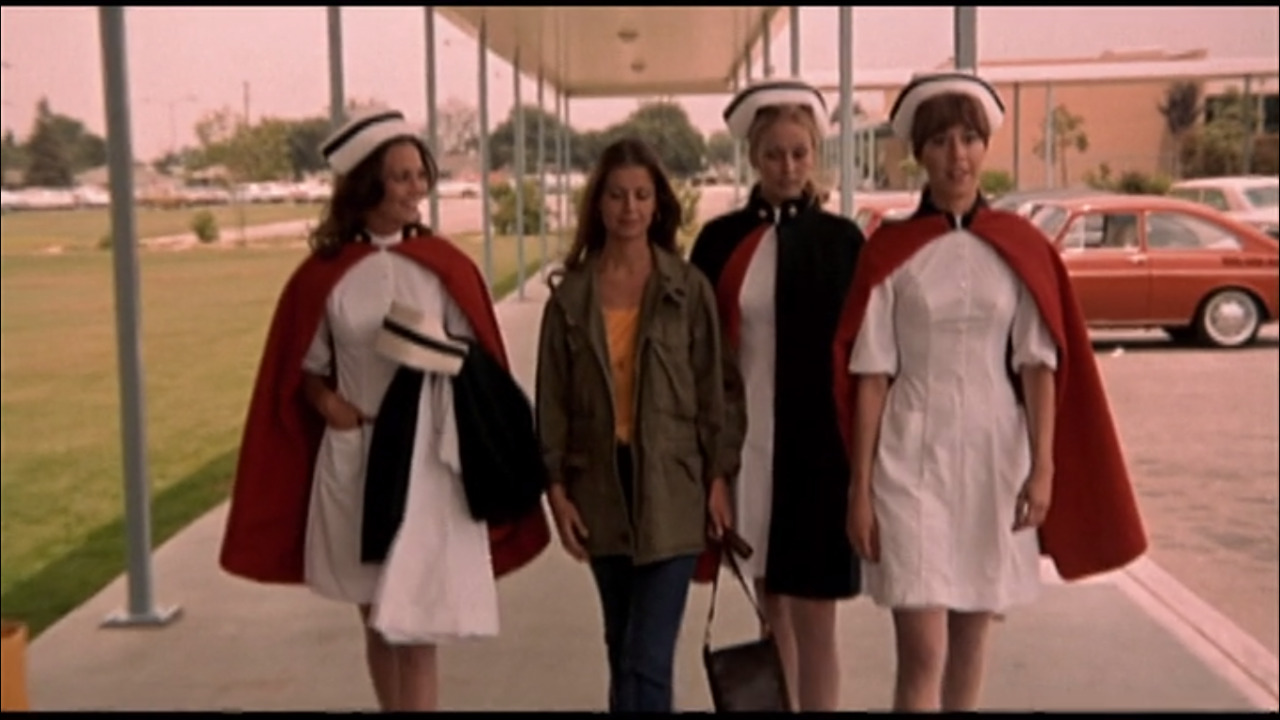
The Student Nurses involved a friendship between four young nurses from different backgrounds whose sexual, professional, and political adventures made up the episodic narrative. Phred, Priscilla, Sharon, and Lynn all share a house together as they study to be nurses. Phred falls for a doctor after accidentally sleeping with his roommate and free-spirited Priscilla gets pregnant by a drug selling biker who leaves her, causing her to seek an abortion. Sharon forms a relationship with a terminally ill patient and Lynn sets up a free clinic with a Hispanic revolutionary. Priscilla’s request for an abortion is turned down by the hospital so Jim performs an illegal one in the girls’s house. Phred becomes furious with them both and ends up breaking it off with Jim. In the end she remains friends with Priscilla. Sharon’s lover/patient dies and she took it hard. This prompts her to join the Army Nurse Corps and serve in Vietnam. Lynn’s lover is involved in a shootout with the police and goes on the run, she decides to go with him. The four friends graduate together and viola, we have a cult classic on our hands.

The Student Nurses | The Iron Cupcake

Rothman had creative freedom to do what she wanted with the film, as long as she still maintained the key points of an exploitation film: nudity, violence, graphic scenes, yada yada. Once she paid her debt to the requirement of the genre she was free to do as she pleased and was finally able to discuss issues that were being ignored in big-budget major studio films. For example, the topics discussed in this film included the economic problems of poor Mexican immigrants and a woman’s right to have a safe and legal abortion, in a time where abortion was still illegal in America. Always wondering why the mainstream media wasn’t discussing these controversial topics, she decided to tackle them herself. Never knowing when her time as a filmmaker would come to an end she never played it safe. She wanted to get what she had to say out there when she had the chance.

Elaine Giftos, Reni Santoni, Karen Carlson, "The Student Nurses ...

In our reading earlier this semester of Pam Cook’s Pleasures and Perils of Exploitation Films, Cook sings a high praise of Rothman and her films. Cook states how Rothman “took every opportunity to parody the basic principles of exploitation – in particular, the female body.” With casual sex scenes and a graphic abortion scene, Rothman doesn’t hold back when touching on the sophisticated discourse on 1970’s sexual politics, which is usually uncommon in exploitation films. Another unexpected scene was the drug-induced fantasy sequence with Priscilla, which I have learned was not fake! In Barbara Leigh’s (Priscilla) memoir, she discussed the scene stating how in the movie her lover gave her orange juice laced with acid. In real life her co-star put Sunshine Acid in her juice and she “was very stoned on camera.” Man oh man, what a time. Another instance involving Leigh was her audition. Rothman wanted her to expose her breasts to see if “they were actually worth photographing.” Rothman justified this by claiming that the reasons people want to see these films is because they delivered scenes that couldn’t be found in mainstream cinema. The struggle with these scenes was that Rothman wanted to justify the scenes by making them transgressive, but not repulsive. She tried to do this with the style in which she shot the scenes. I would say the way she shot the scene, and the other nudity scenes, was with main focus not really being about the nudity at all. Focusing on Priscilla’s scene specifically, she hallucinates a lot of different people watching her while she is having sex with weird biker man. The focus is on all the crazy hallucinations she’s experiencing. All- in-all, I believe Rothman completed her goal in making the nudity scenes transgressive, not repulsive.

The Student Nurses + Exploitation

Cook describes Rothman’s work as a prime example of feminist subversion from within. Rothman would use the generic “formulae of exploitation cinema in the interest of her own agenda as a woman director.” As stated earlier, Rothman wasn’t afraid to speak her mind. I would say her fear was that she wouldn’t get to express all she wanted to say. Exploitation films were problematic for women in a number of ways. A large one being the graphic depiction of rape and sexual assault, commonly viewed as pandering to sadistic male fantasies and encouraging the ongoing problem of sexual abuse. The Student Nurses came at a time when there was a growing demand for more interesting women roles. Showing Phred having casual sex and being so in control of her sex life, wasn’t something that was portrayed. Priscilla’s illegal abortion, obviously a topic not commonly discussed in films, received a certain amount of backlash; however, depicting a woman taking charge of her body is an idea that is still important today. I believe Lynn’s realization is less discussed, but is still important and deserves to be brought up. She was made aware of a situation she had previously been blind to. How the Hispanic immigrants never went to hospitals for their injuries because they didn’t want to be deported. She recognized that they’re people just like the rest of us and they deserve to be helped. Rothman tore apart women stereotypes and restructured them in a refreshing manner.

What Is Feminism and Why Is It Important - Everything to Know ...

“Such emotional complexity in exploitation films of the era was unheard of, and the carefree attitudes towards sex and frankness about terminating a pregnancy are often hard to find in contemporary film of any sort today,” states Violet Lucca in her blog on The Film Comment, titled The Student Nurses and Exploitation. Rothman wrote the women in The Student Nurses with such detail and each of their storylines are portrayed with such growth it is hard not to adore it. Each woman, through their vastly different experiences, find their way and then come together in the end to share what could be their last experience together. Back to Cook, she recalls an interview in which Rothman remarked, “The Student Nurses, was a big success. The male buddy films were out. There was a correct hue and cry about the fact that there were no more roles by women for women.” The film has all four women going through their own problems, sometimes helping each other out along the way and then coming together in the end for one final hoorah. This portrayal was what women had been waiting for, and Rothman delivered. Through her efforts to push her feminist agenda in her films, she gave women a new place in film and showed how women do have a place in the film industry and they won’t be silenced.

girl-power-background_23-2147974373 - Emerge UK

WORKS CITED

Jenkins, Henry. “Exploiting Feminism: An Interview with Stephanie Rothman (Part Two).” Confessions of an ACA- Fan, Henry Jenkins, 17 Oct. 2007, henryjenkins.org/blog/2007/10/exploiting_feminism_an_intervi.html.

Leigh, Barbara, and Marshall Terrill. The King, McQueen, and the Love Machine: My Secret Hollywood Life with Elvis Presley, Steve McQueen, and James Aubrey. Xlibris Corp., 2001.

Lucca, Violet. “The Student Nurses + Exploitation.” Film Comment, 10 Mar. 2016, http://www.filmcomment.com/blog/the-student-nurses/.

Pam Cook Reading- Chapter 4, The Pleasures and Perils of Exploitation Films

Suzanne-Mayer, Dominick. “What Does a Modern Exploitation Movie Even Look Like Anymore?” Consequence of Sound, 2 Mar. 2018, consequenceofsound.net/2018/03/what-does-a-modern-exploitation-movie-even-look-like-anymore/.

Jaylin’s Final Project

The Death of Cult - The Beginning of Modern Cinema

Cult is a genre of film grounded in all things transgressive and taboo, most often marked by passionate, dedicated fanbases, box office failure, controversy, camp, and -perhaps most importantly- exclusion from mainstream cinema. Originally coined as sort of an umbrella term to describe the culture surrounding underground and midnight movies, cult soon evolved into a medium entirely its own, with the most successful of the genre’s films being labeled as “cult classics.” The foundation of cult film was built on the desire to rebel against the mainstream and to represent a counterculture that was rejected by societal standards. And yet, as American culture has evolved, most of the defining elements of cult film have been absorbed and integrated into mainstream cinema, making it nearly impossible for anything produced today to be recognized as true cult.

The earliest form of cult cinema, the exploitation film, is argued to have been around since nearly the beginning of cinematic history. While some of these films were produced as early as the 1920s, it wasn’t until the 1960s and 70s that the genre truly became popularized. With traditionally lower budgets and lesser-known actors, many of these productions were dubbed “B movies” and were generally intended for less distribution than the major studio productions; however, the terms “B movie” and “exploitation film” aren’t quite interchangeable. B movies were still meant to be consumed by the mainstream, and accepted with their counterparts, the A-film to their double feature. Exploitation films relied on success through the exploitation of controversial subject matter; sex, drugs, violence, gore, nudity, etc. Popularized during an era of sexual oppression and high moralistic values, exploitation films provided exactly the thrill and/or release that many people were searching for, by playing into natural, human curiosity and desire. The Hays Code, adopted in 1930, and more strictly enforced as time went on, presented regulations that prevented seedier exploitation films from being shown in most major theaters in an attempt to “keep Hollywood clean.” Although it was meant to end exploitation in film, the Hays Code, and the accompanying denial it presented the public with, fueled the need for exploitation in film. And while these films weren’t allowed to premier in major theaters, there were plenty of “grindhouse” theaters on the exploitation circuit which allowed for publicity. As exploitation continued to thrive, it became the building blocks for the cultist cinematic movements emerging in the latter half of the 20th century.

What’s the difference between B movies and Exploitation Films?: a video that I found helpful in explaining the difference between the easily-confusable terms.


One of the most influential of these cinematic movements, known as the “midnight movie” movement, has had a monumental impact on cinema as we know it today. It’s agreed amongst most scholars that the midnight movie movement began in the late 1960s, as underground and avant-garde theaters started programming risqué and exploitative materials. The term “midnight movie” is most traditionally associated with New York City; despite the fact that the movement was worldwide and thrived in certain areas of both North America and Europe, it’s the NYC midnight movie scene that has been studied most extensively. There’s debate about which film was truly the first “midnight movie”; generally, Alejandro Jodorowsky’s 1970 acid-Western, El Topo, is recognized as the spark behind the midnight movie phenomenon. Midnight movies were, in the simplest sense, movies that were screened at midnight. There was no advertisement for these films, save a minuscule line on the bottom of a theater ad, simply stating that the film would be screened at midnight; all other advertisement was strictly word of mouth, and yet the theaters were completely sold-out with many movie-goes returning for multiple showings. One of the biggest draws to midnight movies was the fact that the mainstream hated them; they were against everything that these films stood for. Mark Betz describes the shift to midnight movies as:

“[when] “kinky” foreign art films and American underground films came together, near the end of the 1960s, in an exploitation/art circuit that emphasized the countercultural potential of cinema.”

A counter culture is essentially a culture that rejects the ideas valued by another culture; in the case of the midnight movie, this was a rejection of mainstream societal values and standards. However, as the 1970s progressed, the countercultural movement began to lose momentum. Midnight movies became even more outrageous than ever before, but as their popularity increased the counterculture ideology that marked the movement was replaced by what Mathijs and Sexton deem, “generic and aesthetic radicalism.” Art house and B-movie distributors became more engaged in the midnight movie, and the original films were replaced by a string of new sub-genres that included lesbian vampire movies, porn chic, blaxploitation movies, and foreign philosophical allegories.

Easily the most notorious among this new batch of films was John Waters’ 1972 exploitation comedy, Pink Flamingos. Every aspect of the film oozes transgression, even by today’s standards, with Waters’ goal being to push against every boundary he could – something he did successfully; he didn’t just push boundaries, but rather obliterated them completely. Waters himself has described the film as, “a terrorist act against the tyranny of good taste,” and it’s this approach of directly challenging “good taste” through utter revulsion that made his film such a hit.

Fun fact: John Waters has been quoted with, "I made bad taste one percent more respectable, and that was what I was put on this earth to do." This is, in my opinion, an incredibly important quotation when considering the shift from midnight moves to mainstream cinema; not only did Waters make bad taste more respectable, but he made it more desirable, and in doing so has used this aversion to good taste in order to breach the gap between cult and mainstream cinema, ultimately helping to normalize certain taboo elements and desensitize today's audiences against it.

By the late 1970s, the midnight movie had become so popular that it was actually considered “a staple of alternative cinema exhibition.” As more people began to partake in these midnight screenings, they quickly became recognized as cult. Many of said screenings were accompanied by their own rituals and celebrations; especially the “campy rock musicals,” such as Rocky Horror Picture Show. These films became as much performances of cult, as they were cult themselves. Everything about these midnight movies revolved not only around the rejection of traditionalism, but the sense of community and the experience that came along with the almost exclusive screenings. However, just as the midnight movie phenomenon was incredibly influential, it was equally short-lived. After the 1970s, midnight movies began to quickly die out. The invention of the VCR had a huge impact on how movies were received. People no longer had to go to a theater to see these films; they could still do all of the same things that they’d do at a midnight screening ( such as smoking pot and having sex) but now they were able to do these things from the comfort of their own homes. Not only could they stay home, but they could pause, rewind, and watch the films as much as they wanted. By the end of the decade many of the original midnight theaters had gone out of business, and filmmakers either went underground once more, or they began to gravitate towards the independent film scene. It was incredibly rare for new midnight movie cults to appear.

Not only did midnight movie cult become rare, but cult itself became rare. Midnight movies loosened everything up, and then the shift happened; the sensibilities of the American public were altered by the integration of transgressive, taboo, and radical elements into our films, our sense of humor, and our very identity. When it became possible to make big budget, big cult films, the mainstream shifted completely to encompass everything that it had been missing. These directors had communicated so particularly and so effectively to the audience that they’d found, and they demonstrated to generations of producers that success through these types of films was not only possible, but it was unparalleled. Even filmmakers who were involved with midnight movies became more mainstream themselves; only thirty years after the premiere of Pink Flamingos, John Waters produced Hairspray, a Broadway musical. The filmmakers themselves didn’t change, nor did their values and their humors, but rather it was the American public that changed as a collective.


Unlike many of the older, midnight movie filmmakers, the authors of “Cult Cinema: An Introduction” would disagree with the idea that the midnight movies have died. They say:

“As befits cult receptions, the midnight movie did not really die. Since the 1990s the demise of the original phenomenon was balanced by three other trends. First,new films found their ways into festivals, which increasingly included midnight showings as part of their programs. Second, midnight premieres also became a feature of blockbuster releases vying for cult status.Third, the midnight movie phenomenon went into meta-mode […] audiences at the New York Pioneer Theater, aware of the legacy of the midnight movie phenomenon, were not only continuing a tradition that had existed for more than thirty years,they also consciously knew they were contributing to the heritage of the phenomenon by keeping it alive, or honoring the tradition by paying lip service to it.”

I personally agree with men like John Waters, George Romero, and David Lynch; Hollywood embraced the values and ideas put forth by these cult films, and by doing so it caused the death of the midnight movie and ensured that cult was rendered almost extinct. Cult is about so much more than liking a movie; it’s about the experience – it crosses boundaries of time, custom, form, and good taste, it violates our sense of the reasonable; and this is exactly what appeals to the film cultist. We’re allowed to vicariously delve into dangerous territory, but when it’s all said and done we can fall back on our reality – a world of reason. Transgression in a film challenges our ideas of morality, it puts us into a world of “what ifs,” and it sheds light onto an aspect of human nature that isn’t deemed pretty enough to be reflected in mainstream cinema. The counterculture of cult has somehow lost its ability to counter, and has simply become our culture. It has become impossible for anything to be transgressive, because we’ve become desensitized to amorality; it has become impossible for anything to be ironic, because everything is ironic; and it has become impossible for anything to elicit that forbidden thrill that moviegoers once sought, because we no longer need to venture out of our world and into the world of “what ifs” because we’ve already been there, we’ve seen that, and we’re exposed to it from the time we’re old enough to comprehend cinema. The need for these midnight, cult movies has disappeared because we’re now so readily exposed to everything they could have ever offered us; and the real reason it’s so difficult to find a film that is true cult lies in the fact that it’s so hard to produce anything that hasn’t already been done, that hasn’t already spoken, or that really has anything important left to say.


The awesome documentary Dr. S introduced me to, in case anyone else is interested in learning more about the shift from the margin to the mainstream.


Sources:

“Cult Cinema: An Introduction.” Ernest Mathijs and Jamie Sexton. Cult Reception Contexts

Midnight Movies: From the Margin to the Mainstream (2005)