Tag Archives: Pink Flamingos

Pink Flamingos

***POSTED LATE WITH PERMISSION FROM PROFESSOR****


Usually, during a blockbuster movie, you create an attachment with a character. Such as in Finding Nemo you create a connection with each of the main “do-good” Characters. However, in gore movies or in a movie like pink flamingos it is very hard to create connections with the characters due to the atrocities there committing such as cannibalism,  chicken sex, impregnating women against there will, etc.  Due to bad acting and these very weird occurrences, this movie is unlike any other movie I’ve watched. There’s no good guy or a bad guy or underlining mean there’s just bad guys and worse bad guys. This is why I believe this movie gained such a huge cult following.

Image result for pink flamingo the cult movie theatre

Pink Flamingos had a storyline and a plot thrill like no other. Most movies are semi-predictable but when watching this movie I truly didn’t know what was coming next. This is what I believe helped shoot Pink Flamingos into stardom in the midnight movie realm.

Image result for pink flamingo the cult movie qoutes

To be totally honest this is a movie I wouldn’t intend on watching with a classroom full of people I don’t believe I could have stomached this whole movie by myself at home. Which I didn’t really feel until I got to the cannibal scene. This isn’t just because of the context of this movie but most movies that have extreme gore I just can’t watch it makes me too queasy. The thing I think that made me keep watching was the bad acting and ultimate hilariousness of the movie. It just was too Taboo for me. It was almost as if they wanted the audience members to be disturbed but not so disturbed they wouldn’t watch it. In my opinion, I was thinking to myself no one would actually do any of these things. It is just to get a rise out of the audience so they would go tell their friends “ yeah I watched this movie last night that had a singing butthole in it.” 


This leads me to believe that the director went with the transgression and freakery method of entertaining. Such as showing bodily fluids and or inhumane ways of acting to create a rising out of the audience leaving a memorable experience not only for the viewers but the people they went to see it with. Creating a rise or stir out of the community. This leaves the communities with there hunger for taboo subjects quenched and allows the audience to see the unseeable. Without actually having to go out and do it themselves. Which all in all is why a cult movie is created. To give the viewer something there craving. Without them knowing there craving it.


By: Victoria Empson


Midnight movie rulezz

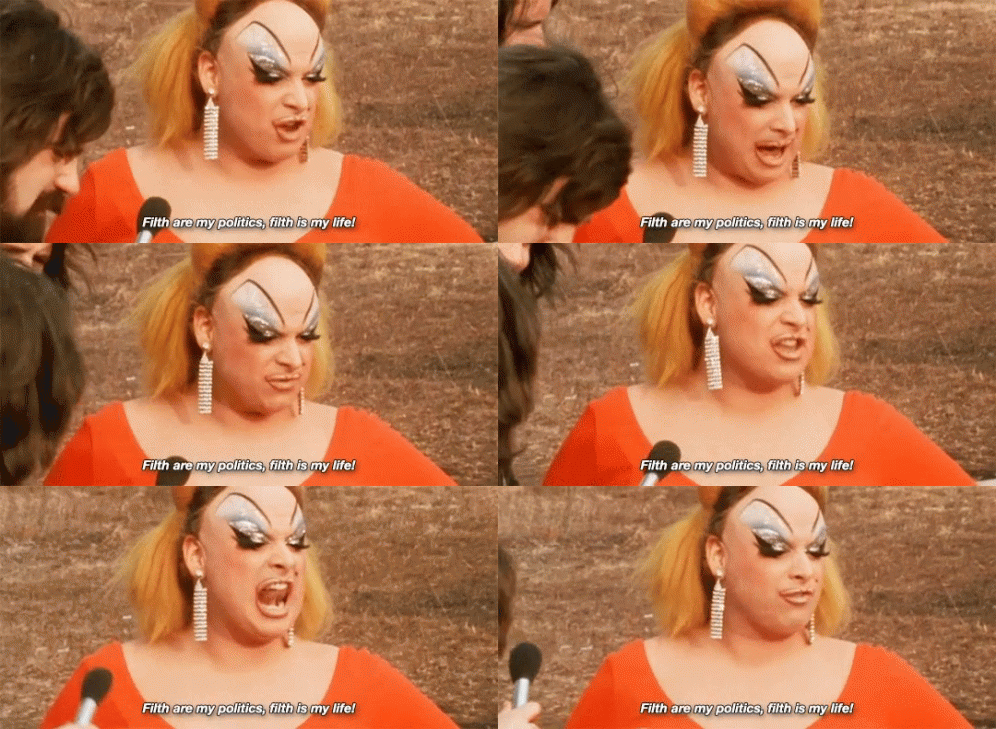
John Waters loves to highlight the perversities of taste through 60’s hairstyles. His language in cinema doesn’t require a great deal of technical skill because of the choices made in subject are so visually appealing, and often meant to provoke that it almost compliments the explicitness to have it so poorly shot with such little reveal. With a budget of $12000, Waters relied on the concept of Pink Flamingos to be the body for his film, and that it was. Definitely an exercise in taste. I found myself wondering about how little shock I felt to see those scenes because of my own exposure to the internet, where as my own mom would probably not make it ten minutes into the film because of our differences in taste. Trash to others is not worth viewing, and definitely not worth reviewing, which is why it found its place among the midnight movies in 1972 upon its release. The underground nature of this movie is what borned its cult following. Having every type of taboo in one movie doesn’t exactly bring in families to the box office, but certainly piques interest in those who wished to see something different in its time. Midnight movies began as low-budget B-movies in the 50s that were aired for late-night programming and eventually became a phenomenon into the 70s for offbeat screenings that didn’t have a place among big-name films. My dad told me about seeing Night of the Living Dead as a midnight movie when he was in college, and how the shocking gore of it scared him shitless as a sophomore in college. Coolidge’s “After Midnight” online guide describes the nature of midnight movies in the 70s as “horrifying, weird, camp, avant garde, tripped-out, and cult films.”  in which Pink Flamingos would check almost every box. Into the 80s, the midnight movie began to take on a purely camp take, in which its aesthetic value was determined by its bad taste and irony. Pink Flamingos is an excellent example of camp, and how its is counter-modernist in all its glory. Being kitschy, kinky, incestuous, and just disgusting, the shock value of many of the scenes were iconic for the time it was released. Susan Sontag describes the appeal in camp being very personal, in that we all relate to the disgustingness of camp culture even if its not directly obvious. Being felt to be the “bad taste” of society would also draw one to enjoy these types of movies, which is why Pink Flamingos is also considered a queer classic. Being unacknowledged by the film industry led queer movie watchers to find indentity in less celebrated movies, and reappropriate their meanings to be personal. Pink Flamingos needs no reappropraition as the kinks and such were anything but heterosexual. Waters used a small group of uninhibited actors and actresses in their particular roles as misfit characters, including Waters childhood friend Glenn Milstead who would embody Divine the Queen of Filth. Filth is a repeated word in the film, one that is celebrated and coveted, which is only highlighted by the gaudy trailers, dresses, and (of course) hairstyles that Waters stylistically uses to portray his stories.

Feature-Waters.-Top-image-750x400

Mary Vivian Pearce can step on me with that choker

I loved the movie and I loved watching it again in class; it let me appreciate more of the visual value in Waters choices. It’s no hairspray, but being able to stomach the majority of the Filth in the movie makes one feel a bit accomplished for finishing it. I love the value of kitsch, and I want a pink trailer (and every outfit Cotton wears).


Filthy, Obscene, Grotesque, Kitschy. We love it!

This was a successful and integral week in cult films class. First off we had great readings that really put films we’ve watched and this weeks movie, Pink Flamingos, in great perspective. They gave a great understanding of camp (especially Sontags’ ‘Notes on camp’ and Ross’ ‘Uses of Camp’), and all its uses and reasons for. Secondly, those presentations! Damn y’all really rocked it, Emma and Spencer set a great bar for upcoming presentations and kept us entertained and enthused. Like who knew Disney would produce -what seemed to be- a beautifully recognizably dark ass animated film. Whoa did it look spooky! Go Disney for stepping out of their normalities, too bad it wasn’t well received. Props guys! Lastly this weeks screening, wowza what a ride. This movie was horribly obscene yet hilarious and unsettling yet enticing. As Schlegel  says “its all part of the charm,” referring to the singing asshole scene.

Image result for John waters pink flamingos gif

A quick synopsis on this wild ride Pink Flamingos

Two baby selling kidnapping freaks (Connie and Marbles) claim to be filthier than Divine. Divine being the acclaimed filthiest person alive. She and her family then try to sabotage Connie and Marbles with a slew of horrifying events, leading to murder!      DUN DUN DUUUUUNNNNN.


Image result for pink flamingos asshole scene

an icon, so odd. I love it.

The article titled “Transgression and Freakery” spoke upon taboo, the grotesque, the abject, and the pure vs the impure. Transgression oozes all over Pink Flamingos, straight up threatening social normalities and morality. The casual approach to everything in the film is asking for the viewers to have some emotional response (the abject), whether it be  shock, confusion, anger, or complete silence. I had to keep reminding myself that this movie was made to offend, and though I was trying not to be, it was unavoidable, this movie was fucking gross and horrific at some points. IM SORRY but who has the nerve to make the viewing of someone being raped with a bloody chicken in a barn… comical? But again it was made to make me feel these types of ways, which also angers me. SO MANY MIXED FEELINGS!!!! Objectively I can totally understand why this film is so noteworthy in film history. Waters broke boundaries and had confidence in his “passionate failure. ” As they noted in the “Transgression and Freakery” article, Pink Flamingos was able to engage with taboos and have no social repercussions.

Image result for John waters pink flamingos divine going into towngif


Let’s speak upon kitsch and camp to round up this rant about this weeks class. Though Waters wasn’t “intending” to have camp and kitsch, oh boy was Pink Flamingos flooded with it. Camp has -as Sontag says- “a decretive art,” which is recognizable in this film. Extravegance and theatrical nature is also relevant among camp and kitsch.

Okay there’s my take on this film, I’m going to have to revisit this one, and do some more research to develop a full formed opinion. Im excited for next weeks movie and the readings. This week really set the stakes high, so we’ll see how next week compares.

Trash Is In Good Taste

This week was a really interesting one, and it’s my favorite one so far.  We watched John Waters masterpiece Pink Flamingos and I was totally blown away.  Then we discussed How transgression is described in cult films and the art of camp.  After that we had two presentations on some movies that I happen to love.  All in all, this week felt really great as far as class participation.  People were reacting out loud with gasps and groans of disgusts along with laughs during our screening, and the class seemed much more engaged in the discussions that we were having about the readings.  The presentations were really well done and there was a lot to love about both movies presented.  I think I’ll start with the movie presentations.  The first movie that was presented was Troll 2.  This is a movie I’ve seen multiple times and it’s one of my brother’s favorite movies.  He’s a huge fan, and even likes the first Troll which I learned has absolutely nothing to do with the sequel.  The production of the movie looks hilarious, and I really want to see the documentary on it.  The director seems really funny and he thinks it’s not a bad movie but I’m just glad he made a movie like it, we need more movies like it.  The next movie we talked about was The Black Cauldron.  This is one of my favorite Disney movies (along with another movie Disney wants you to forget, Atlantis!)  The presentation was super concise and I like that it was focused on the Dark Ages of Disney, which Disney desperately wants people to forget.  I personally think they should embrace that period, there’s quite a bit to be learned from that period and it’s ridiculous that Disney just doesn’t care about it.

220px-Troll_2_poster.jpg

Now I want to talk about Pink Flamingos.  Wow.  Just wow.  I absolutely loved it.  I’ve got a thing for amateur movies where I want to watch as much of them as possible.  Having seen some of John Waters later works, I couldn’t believe this was the same guy who did Hairspray.  I mean, seriously?!  He is just so talented, to say nothing of the excellent cast in this movie.  This movie made me feel like I needed to take a shower afterwards and I loved every second of it.  I almost want to say this should be the first movie shown to people in this class just because of how shocking it is, but based off of some other people’s blog posts, I think it’s better that we worked our way up to it because I’m surprised some people even stuck around for it.  My favorite scene was the singing asshole scene.  It was just so shocking and funny to me.  I was losing it and laughing so hard it was great.  If I could crack open John Water’s head and see what goes on in there I still don’t think I’d get it.  He’s a genius.  I mean WOW.  I won’t talk much more about it because I still don’t think I’ve had enough time to comprehend it yet, but I’m absolutely showing my brother it.  He’ll love it.

4521c3895c8dd26016f0c16469f5b06c.png

Eww Cult

This week has been by far the most hilarious week of them all as our feature film was not only John Waters Pink Flamingos 1972. This is truly the filthiest movie alive as it’s plan was to do so. Waters only had around a total of $12,000 and a love for film but lack in technical skill. Waters wanted to create a piece that would shock and scare the everyday viewer with just as many awful cliches that you can think of. The plot is just as filthy as it’s intentions are. Following the proclaimed “filthiest person alive” a drag queen by the name of Divine who lives with their family in a trailer hidden away. A baby hustling, sex servant owning, kidnappers, public flasher, elementary school heroin plug couple believe they are the filthiest and attempt to claim the title of filthiest people alive. Starting a battle between the two sides and creating mayhem with as much filth on the way.

From the dead chicken sex to the singing ass holes. John truly didn’t miss out on anything as he completes it with a grand finale of Divines attempt of proving that they are truly the filthiest by eating fresh hot dog shit. This film was a true masterpiece of the worst. One of the most important aspects of the film was the amateurish way in how it was made. John loves film so he knew what to do with a little. Creating long scenes where the actors must say all of their lines at once. And bad sound and long scenes with great music make for great scenes with a realistic amateur aesthetic.

Of coarse when we watch Pink Flamingos we have to be talking about camp. All about bad taste and it’s ironic value, Pink Flamingos takes that to the extreme. Susan Sontag noted on number 56 “Camp taste is a kind of love for human nature. It relishes, rather than judges, the little triumphs and awkward intensities of “character.”. . . Camp taste identifies with what it is enjoying. People who share this sensibility are not laughing at the thing they label as “a camp,” they’re enjoying it. Camp is a tender dog feeling.” Camp isn’t a joke it’s a compliment. It’s a warm hug when you’re feeling gross. It’s humanity but the weird parts of it and that’s ok.

Another part of this week’s discussions where about transgression and freakery in cult cinema. All about what would normally be beyond the limits and breaks the laws of mortality. As in to relationship to Pink Flamingos this makes total sense as it break down all barriers of what would be seen as socially acceptable. In The Cult Film reader it’s says “Human bodies provide a ready point of reference for audiences. Therefore, the high visibility of freakery has attracted lots of analogies between freaks-on-screen and freaks-in-the-audience.” When speaking about triggering an audience the body is one of the most powerful ways to do so and was exactly done so by Waters.

Get More Out of Life: See A Fucked Up Movie

Debates surrounding cult cinema most often address how a cult film breaks boundaries of morality, challenges prohibitions in culture, disputes commonsense conceptions of what is normal and acceptable, and how as a result they confront taboos. - Mathijs and Sexton

Life advice from John Waters

“Transgression and Freakery,” an excerpt from Cult Cinema: An Introduction by Ernest Mathijs and Jamie Sexton, highlights two common ways that cult cinema confronts taboos. A taboo is “a cultural prohibition, an act seen as morally wrong.” Often seen as reflections on the contamination of perceptions of purity, taboos generally tend to be bodily fluids. As Douglas says, “the traffic between the inside and outside of the body correlates strongly with what cultures see as taboos. A crucial element here is that of any substance that allows for the crossing of borders between the inside and outside of the body.” Such substances include tears, sweat, blood, pus, urine, semen, spit, menstruation, lactation, or feces.

For a film to be considered transgressive, it has to violate law or morality – it must pass beyond the limits imposed by society. Water’s 1972 exploitation comedy, Pink Flamingos, is a movie that has no sense of boundaries. Although exploitation has become harder to execute as it forges with mainstream cinema culture, Waters film is still as transgressive today as it was then. Even if you rule out certain elements that our society may have become desensitized to, such as nudity, masturbation, and incest, Pink Flamingos still touches on a variety of taboo topics: rape, cannibalism, the consumption of feces, etc. Transgression can take place in terms of content, attitude, or style; however, regardless of how it achieves transgression, this idea lays at the center of the construction of cult films.

“It still works, I know that. It didn’t get nicer; it might have even gotten more hideous. Even people who think they’ve seen everything are sort of stunned by it. They may hate it, but they can’t not talk about it. That was the point. It was a terrorist act against the tyranny of good taste.”

– John Waters in an interview with Vanity Fair, discussing Pink Flamingos forty-five years after its initial release (2017).

Waters chose to approach transgression by directly challenging good taste, which I feel makes this film transgressive in every aspect of the word. The content, which centers around characters who are literally fighting for the title of “the filthiest person alive”; the attitude, with Waters purposefully trying to outrage the masses; and the style, which is nothing if not competently excessive in every regard – each of these mediums on their own would have laid the groundwork for a cult film, but when paired together, they create a film that is almost timeless in its reception.

The transgression of reason -which J.P. Telotte describes as “the love for unreason” – is an incredibly important aspect of how a cult film is received. When a film confronts and embraces taboos, when it crosses boundaries of time, custom, form, and good taste, it violates our sense of the reasonable; and this is exactly what appeals to the film cultist. We’re allowed to vicariously delve into dangerous territory, but when it’s all said and done we can fall back on our reality – a world of reason. Transgression in a film challenges our ideas of morality, it puts us into a world of “what ifs,” and it sheds light onto an aspect of human nature that isn’t deemed pretty enough to be reflected in mainstream cinema. I feel that this explains why Pink Flamingos was such a cult hit then, and why it still packs a punch today. None of us want to be Divine, but we’re enthralled by her and by the world in which she lives, because both directly challenge everything we know not only about our own world, but about ourselves and the societal standards that have always been imposed on us.

In the words of John Waters, "Get more out of life. See a fucked up movie."

More on Camp

I’d like to start out by saying the cult film presentations have been great so far, really well done. I had forgotten how bad Troll 2 was, I hadn’t considered its’ cult potential before but it now makes sense considering the only reason I had watched it before was because of a review that had lauded its badness. While I hadn’t heard of The Black Cauldron, the presentation piqued my interest, mainly the fact that Disney’s target audience for this film was teens. Having seen fantasy themed animations at the high (Wizards) and low (Lord of The Rings) end of the age spectrum, I’m curious to see the where middle ground lies in terms of dark themes and ‘age-appropriate’ content.

This week Meg and I led the reading discussion in class, my readings being Transgressions and Freakery and Susan Sontag’s Notes on Camp. As far as Sontag’s piece, we hit the key points in class: camp is the celebration of human failure, leaning away from a judgmental view and instead holding an appreciation its’ effort and exuberance. In other terms; an act of love. While we talked about camp sensibility, there’s a few more elements of Sontag’s notes that I thought were helpful in understanding what qualifies as ‘camp’. In general, camp loves that which is created with serious intent but is unable to be taken seriously by others. But that does not mean that all projects that fail in seriousness ca be considered camp, they must also meet its’ specific aesthetic. Note 28 explains this best,

“28.  Again, Camp is the attempt to do something extraordinary in the sense, often, of being special, glamorous. (The curved line, the extravagant gesture.) Not extraordinary in the sense of effort. Ripley’s Believe-It-Or-Not items are rarely campy. These items, either natural oddities (the two-headed rooster, the eggplant in the shape of a cross) or else the products of immense labor (the man who walked from here to China on his hands, the woman who engraved the New Testament on the head of a pin), lack the visual reward – the glamour, the theatricality -that marks off certain extravagances as camp.”

Camp has an added flare to it, a sense of something being “too much”, but also must stand by that quality and not stray from it in the slightest. Sontag describes it as a sense of fantasy or theatricality, which is important to remember because camp is also the rejection of meaning. What camp ignores in concept it focuses on in style and the idea of surface detail, this relates back to camps playfulness. Reading about the style of camp can be tricky to understand, what helped me the most in recognizing camp quality were Sontag’s numerous tangible examples of camp:

swan lake

Swan Lake for its theatricality 

camplamp

Tiffany Lamp for its gaudiness

crystal doorknob

crystal doorknob for its frivolity

highreleifvase

Vase in high relief for its exuberance


IMG_5689

Novelty liquor bottle (yes, they exist)

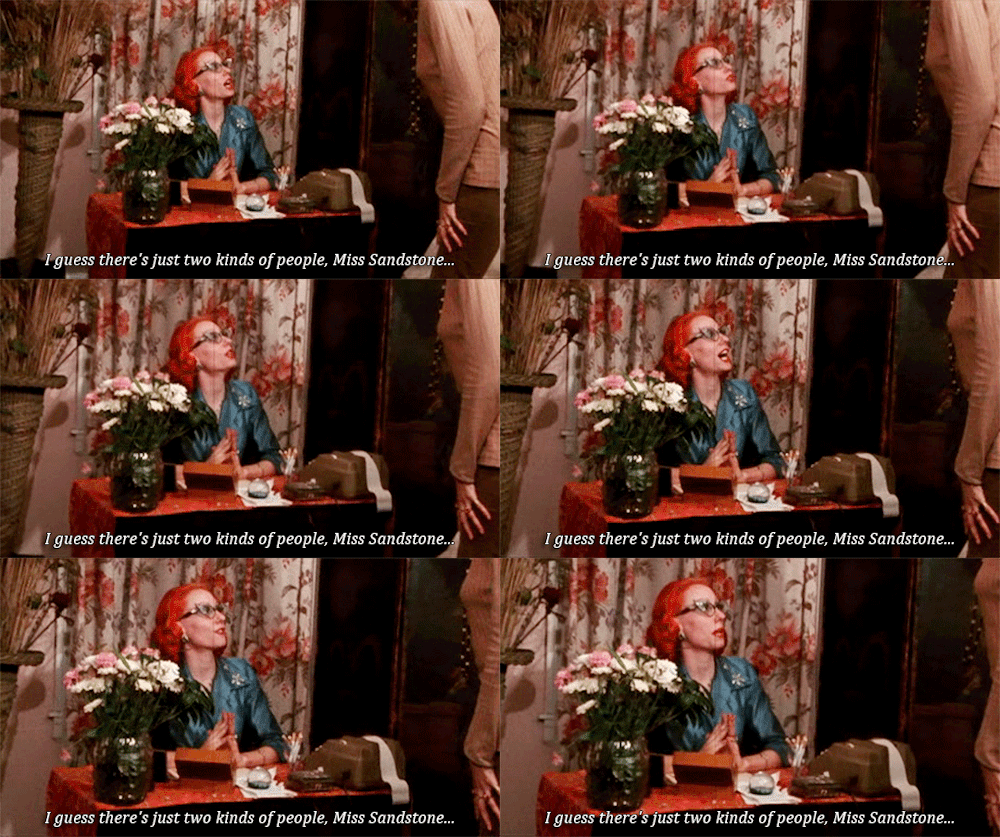
We also watched the John Waters film Pink Flamingos, featuring poor production, poor acting, and the magnificent Divine. The film is set in Maryland as Divine plans for her upcoming birthday party and living as the ‘filthiest person alive’. Though, filth feels like an understatement. When Connie and Raymond, two perverts, threaten Divine’s title (and set her pink trailer on fire), Divine employs the help from her son, Crackers, and friend, Cotton, to set things straight. This is a mellow description for Pink Flamingos but, for the number of crazy situations, it’d be hard to adequately describe how repulsive the film actually is. Don’t get me wrong, I enjoyed the film; it was humorous, odd by all standards, and had a great soundtrack….but, I have to admit, some scenes I wasn’t as fond of. But it was John Waters intent to create a film that was outright nasty, in this week’s reading Transgressions and Freakery we learned that it would fall under the category of a ‘sick film’. Sick films are beyond transgressive and test the audience’s ability to sit through their duration, making them strong contenders for cult status.

Cult of Bad Taste

It seems fitting to speak about camp in depth this week, after a screening of Pink Flamingos (1972) and a Sontag reading. Generally, camp is a certain mode of aestheticism. Camp is seeing beauty in the banal, like an inflatable chair. It’s the combination of popularity, vilgarity and innocence. The essence of camp is it’s love of the unnatural, it’s the idea of, “It’s good because it’s awful.” I think that this video does a great job at explaining what exactly camp is:

The note which stood out the most to me in our reading of Sontag’s “Notes on ‘Camp'” was note #10:

Camp sees everything in quotation marks. It’s not a lamp, but a “lamp”; not a woman, but a “woman.” To perceive Camp in objects and persons is to understand Being-as-Playing-a-Role. It is the farthest extension, in sensibility, of the metaphor of life as theater.

Susan Sontag in “Notes on ‘Camp'”

Because camp is so naïve in nature, it is incredibly difficult to produce something which is “campy,” and have it be as satisfying as naïve camp. The best examples of camp are unintentional. A big part of what makes things camp is that they are unintentionally camp. Sontag describes this beautifully in her 19th note:

The pure examples of Camp are unintentional; they are dead serious. The Art Nouveau craftsman who makes a lamp with a snake coiled around it is not kidding, nor is he trying to be charming. He is saying, in all earnestness: Voilà! the Orient! Genuine Camp does not mean to be funny. Camping–say the plays of Noel Coward–does.

Susan Sontag in “Notes on ‘Camp'”

This week’s screening–Pink Flamingos–was the film that established John Waters’s name as a master of camp. This was my first time watching Pink Flamingos and, while Pink Flamingos was not exactly what I expected (I thought that the ‘flith’ of it all would be more toned down) I loved it and had a wonderful time watching it. It was hilarious, original–still in 2020–and kept me engaged throughout the entire thing. It’s not every day that you see a singing asshole, and it was hard not to love Divine.

The film’s trash-aesthetic was great, it’s hard to believe that John Waters didn’t really know what he was doing at the time, nor that it was all done on such a small budget. In fact, according to production designer Vincent Peranio, the art department’s budget was about $200. Half went to purchasing the trailer, half to decorating it. “And then after that, we would just steal things.”

We finished the week off well with two great presentations–Emma and Spencer–who both presented on films I have not seen but am now dying to see, Troll 2 (1990) and The Black Cauldron (1985). It was so clear in both of the presentations that they really love the films that they chose to present on. Troll 2 sounded hilarious, and it was really interesting to learn that it was only named Troll 2 in an attempt to piggy-back off of another film’s success. It was also really interesting to learn about Disney’s dark secret and big failure.

Pink Flamingos

The film of the week was Pink Flamingos and surprisingly, I really enjoyed it. This is different from any other film I’ve ever watched. The film was about a couple that runs a baby making company that give the babies to lesbian couples that want a child, trying to compete with divine for the tittle of being the filthiest people alive. In the beginning, I was questioning why the family lived in a trailer. By the end I understood why. Divine was a person not to be messed with. Once Divine received that package with the turd, the film started to get interesting. The dialogue in the film was very entertaining. The soundtrack from beginning to end had me feeling fierce but not as fierce as Divine. There were so many times that divine tripped wearing her heels but I looked past it because she was Divine, I don’t want to get on her bad side. I don’t want her to come lick my belongings and have them reject me. The Insect was something I didn’t expect at all. I didn’t know what to expect in this film. I didn’t watch a trailer, I just saw the gif someone put up of Divine in one of the past posts.  I saw more than I bargained for, from the butthole scene to the insemination to incest to the castration to the cannibalism. That family is not to be messed with.

In the reading Notes on Camp by Susan Sontag, she literally has notes and it is not written in essay styles. Camp is not created to be serious even though it is about serious topics. It is not easy to make camo intentionally. Camp depends upon the perception of innocence, parody that doesnt recognize itself. This means that camp is an aesthetics of distance of ambivalent identification also explains why it’s hard  to mass produce camp objects. More specifically, camp requires the perception of naive extravagance, a sense that the artist doesn’t realize that he’s too much to be taken seriously. 

In Andrew Ross’ uses of camp, people think that camp is new and original but most people knew about it. There are different audiences for camp, not simply the gays. Historical definition of camp situates itself in relation to dominant power dynamics at any one time. Bad taste is actively produced by middle class people who are working to reject inherited values. 

“Transgression is any act that violates law and morality more broadly it refers to the act of passing beyond any imposed limits”  while freakery is “The complexity of studying how cult films break or challenge taboos by pinpointing the process of transgression”. Taboo crosses between impure and purity. Taboo scenes get an emotional response from audiences because things can be seen as gross and grotesque. Sick films took taboo and transgression to the extreme weather it is negative or positive. 

Cult consumption states that “ Audiences are at the core of the study of cult cinema”. What the audience likes is what gets the most people watching it. In certain times, violence, subculture and censorship and sex were problematic for certian audiences.

The Devine Light

When I heard we watching Pink Flamingos I class I got very excited, purely for the rest of the class’s reaction. To my surprise, there was a lot less gasping ad laughing than I expected especially around the chicken sex scene In which they actually killed the chicken (and ate it later). While I realize most people will not have the same appreciation for Pink Flamingos, and as dirty of a film as it is, the class viewing was about the sixth time I’ve seen it. Much like “It’s a Wonderful Life” around Christmas time this movie plays on thousands of screens during the month of June.

Image result for pink flamingos gif

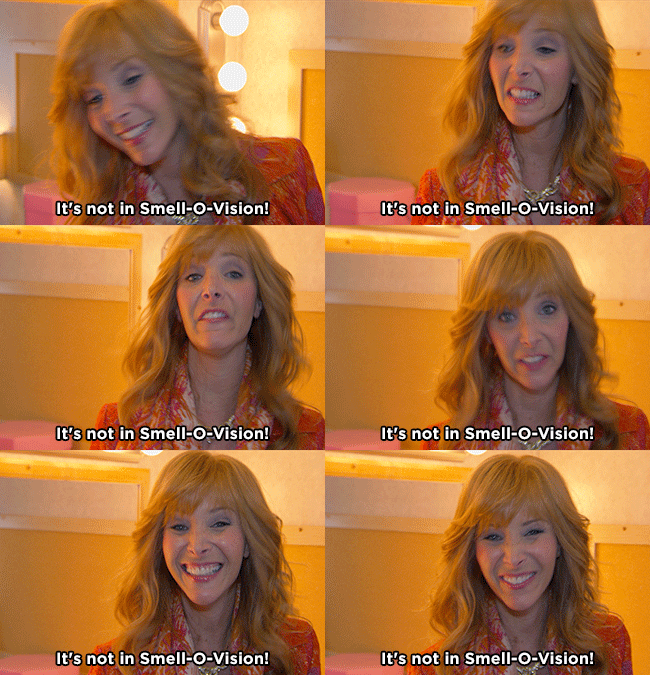
While Waters did not shy away from the dirty, I feel the beauty of this film is severely overlooked. With most scenes being done In a single shot gives a prolonged almost uncomfortable experience besides what’s happening on screen. The shot of the burning trailer is one that specifically sticks with me, whether it’s the length of it or just the fact that fire is pretty I do not know. This movie comes at you any disgusting way Waters could think of; heterosexual sex, people eating, shit eating, chicken fucking, incest, torture, madness, mutilation, kidnapping, rape, murder and finally the selling of babies- all of which invites laughter and In my case, received it. I almost thought Waters could go further, maybe if he had conceived of “Polyesters” Smell-O-Vision before making this movie we would actually be able to smell how dirty this movie is!

Image result for smellivision gif

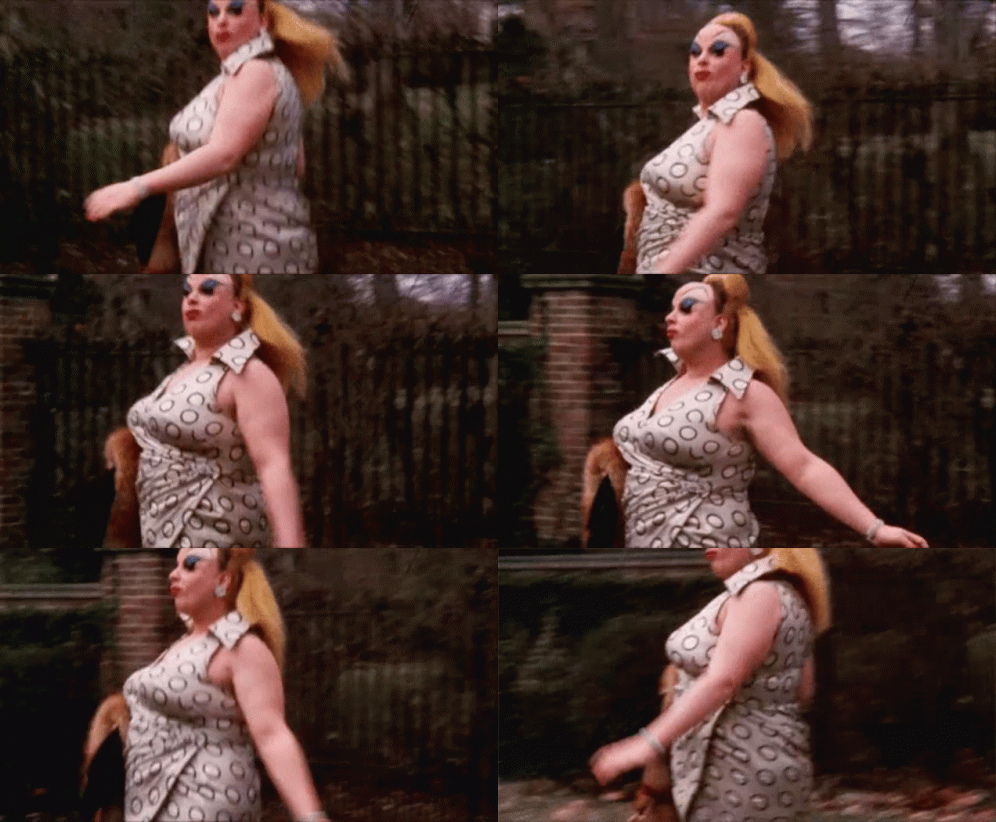
One thing I admire from Waters is showing this tale of dirtiness as an adjacent from homosexuality. The film is a great, ironic and raw timestamp for queer culture. This sense of perversion that surround it at the time, which is then taken to this extreme in order to create a great critique of the current social and political states of the ’70s. Giving a big middle finger to the church with Devine declaring “I am God” when asked about religion, which to the queer community she basically was. Outside of Pink Flamingos both John Waters and Devine served as iconic outlets for queerness and self-expression, not giving a fuck about what anybody else thought and being unapologetic about it.Image result for pink flamingos gif

While I feel Sontag breezed over the importance of drag and queerness in camp her definition of it is one that to me has sounded the most accurate. Andrew Ross’s response to her essay starts off how I believe hers should have. With the story of Judy Garland’s death and the night the stonewall riots which kicked off an explosion of queer voices in art, John waters being one of them. The current state in which drag is represented in the media is a turn in the wrong direction In my opinion. While the presence of “Drag Race” is important, it commercializes and “cleans up” the art of drag that was first brought to the public screens through John Waters and most of his films.

Image result for pink flamingos gif