Tag Archives: Pink Flamingos

The Pope of Trash, The Prince of Puke, The Duke of Dirt, The Sultan of Sleaze


Screen Shot 2020-02-21 at 5.55.57 PM

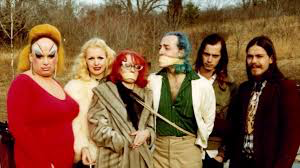
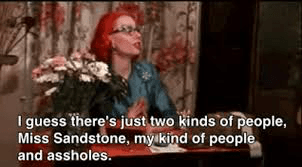
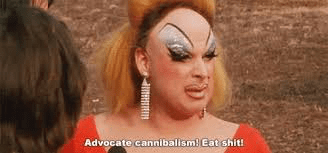
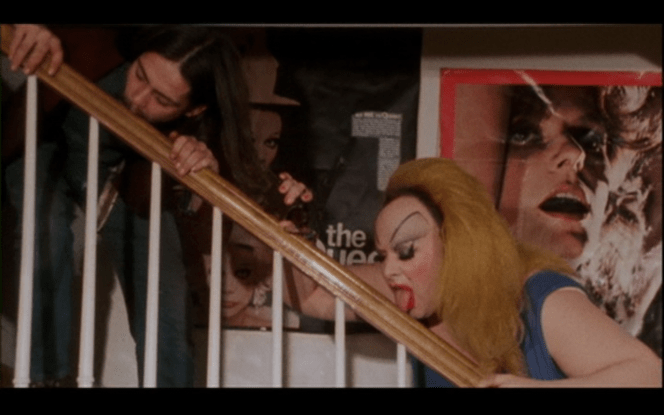
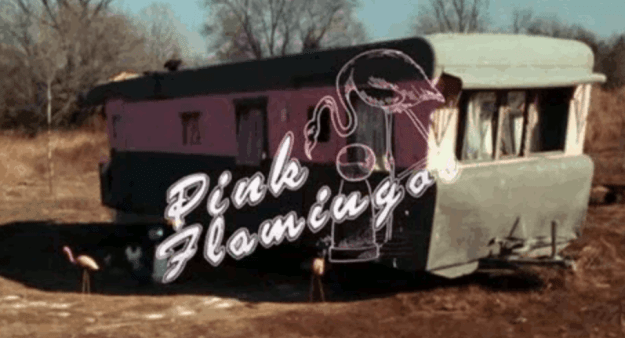
In class, we watched a midnight movie cult classic, Pink Flamingos A film by cult and camp enthusiast John Waters. Waters, an avid cinema lover wanted to create his own film that transgresses cultural norms and basically involves every taboo you can think of. This film definitely did just that, with changing times comes different standards for what is transgressive or provocative, yet pink flamingoes have stood the test of time and to this day id says is as repulsive and vile as those seeing it in the 70s must have though. This is part of its charm though, cult films get followings because of their outrageous content, an outlet for people’s strange interests and desires, a way to allow people to connect. I admire this film for the ability it has to offend people, its a sort of snub to bourgeoise lifestyle. Its main characters are the complete opposite, trailer trash bottom of the barrel folk who commit atrocities such as eating dog shit, enslaving women, living in a playpen shocking eggs down their throats, like a complete snub to any sort of luxurious lifestyle and the upper class. I think this was something many people could connect to, although many viewers probably weren’t living that particular lifestyle, it’s nice to see the lower end of the cultural class being showcased in an entertaining yet oddly lovable way? I found myself rooting for Devine by the end of the film despite all of the horrible acts she committed.

Screen Shot 2020-02-21 at 5.49.47 PM

Moving on from the film itself we can begin to talk about CAMP! Camp is a celebration, a light-hearted way to enjoy things that are generally of bad taste, in Susan Sontags Notes on Camp, which is a collection of thoughts about the concept she speaks about how camp is taste, it’s for of enjoyment, a king of love for human nature, a mode of appreciation not judgment. She also talks about how you cant particularly create something or do something with the intention of being camp, I mean you can but it isn’t truly camp or what it embodies, Intending to be camp is not heartful of itself. There are two general types of camp, a naive camp which is camp being nonintentional, genuine enjoyment and intended camp which is exactly as it sounds.

Screen Shot 2020-02-21 at 6.21.19 PM

Now John Waters is well versed in camp, even sometimes called the “King of Camp” Much of his art involves camp culture as it is a genuine fun exploration of bad taste like he says about pink flamingos. He loves it, it is part of him, none of it is mockery or disgust it is pure fun. He thanks his parents for bringing him up with politeness and training him in the art of “good taste” so he had something to rebel against. Personally, I adore John Waters, he’s a wild guy who isn’t afraid to speak up about what he believes and cause a little scandal. He gives a lot of good advice to emerging artists. He deliberately thrives outside of the mainstream, something I admire and creates some damn wild films.

A fun way to end this blog is a collection of photos of John Waters which I find fitting.


Fifty Shades Of Pink

Watching the screening this week of Pink Flamingos, I was just thinking about how strange the film was and how stupid the plot was as a whole. During the course of the movie I kept thinking of the movie franchise Fifty Shades of Grey, and the reasoning for that will be explored later on. But back to the screening, another thing that kept coming to my mind while watching this movie was that I couldn’t believe how awful this movie was. It was a bad film, but it wasn’t as bad as Maniac was, at least this film was enjoyable to watch. 

Now you would think that I would be surprised by what was in the movie as a whole, but in actuality I wasn’t surprised at all. I mean I was surprised by the stuff, but I wasn’t surprised that the stuff that was in the movie was in the movie. There are so many movies nowadays that have weird stuff in it, and there are plenty of movies that come to my mind. One movie is The Hangover Part 2 and that is because the movie mentions that one of the main characters had sex with a transgender woman and he doesn’t remember it at all and we see this in the credits of the film with photos of their adventure being shown. Another movie that comes to my mind is The Human Centipede and I haven’t watched that movie ever, but I have heard how gross and disturbing that movie is to watch as a whole. I thought of these two films because they each feature something that is a highlight of the movie as a whole. Pink Flamingos features a transgender woman flashing one of the characters, while the other film features a guy having sex with a transgender woman. A main aspect of Pink Flamingos is the filthiest person alive and I thought of The Human Centipede because that film’s ideas that it presents is gross to think about and if you start to think about the film too much, you realise how gross the film actually is. 

Now for why I thought of the Fifty Shades of Grey franchise. This franchise was able to gross over one billion dollars at the box office over the course of three movies. Now I thought of this film because the whole franchise is based on the idea that it is porn for people with weird abusive fetishes and it is. A little fact about the books and the films is that the books are actually a fanfiction of the Twilight franchise. The movies are basically advertised as porn, and I haven’t seen the movies because I have heard how bad the franchise is and that the plot really doesn’t make any sense at all. I am comparing these two because I saw this film as a porn for people with weird fetishes and that is also how I see the Fifty Shades franchise, I see them both as a porn for people with weird fetishes. Now I mentioned that the Fifty Shades franchise was able to gross over one billion dollars over the course of three movies and this is because there was a lot of fans of the books, but also because there has never been a film franchise like Fifty Shades where the films use the idea of a abusive sexual relationship to carry the plot, just like how Pink Flamingos relies on the idea of filthiest person alive.

So I compared many films in this to Pink Flamingos, but I think the Fifty Shades franchise is the best comparison I can think of to compare to Pink Flamingos. Both films rely on weird fetishes people can have and use this to market to people and try to gain a profit. So, I wasn’t really surprised a film like Pink Flamingos exists because there are a lot of people out in the world that have weird fetishes and there are people out there that have marketed off of it.

as Raven Symone would say…ya nastyyyyy

by Sarah Baty

Image result for raven symone ya nasty

Pink Flamingos was one of the most interesting movies I have ever seen in my measly 21 years of existence. How did I go my entire life without watching this thus far I do not know. I immediately went to my friends apartment and exclaimed “boy do I have a movie for y’all.” With the main conflict of the story being a fight of “who is the filthiest” you know you’re in for a good time. Babs Johnson, known as Divine, held the title of The Filthiest Woman Alive and in my humble opinion, rightly so; however, Connie and Raymond Marble disagree. As a couple who runs a Baby Ring they believed that they were indeed more worthy of such a title. As the movie progresses so does the filth. In the end Divine ends victorious as she murders Connie and Raymond with news reporters present. Her and her family gallivant away to continue on their filth in the glorious city of Boise.

Image result for pink flamingos

Director John Waters rose to prominence in the early 1970’s for his transgressive cult films, Pink Flamingos being one of them. Something I found to be special about this movie is the way it is filmed. There isn’t a lot of cuts, when the characters are talking it is usually one continuous shot. I understand this had a lot to do with their small budget, but I think it gives the movie its special ~aura~ you could say. Usually a lot of cuts can make the scene feel extra chaotic; however, with the way the characters speak to each other (vulgar, loud, fast) the scenes are chaotic enough on these characteristics alone that any fast cuts just weren’t needed. The one scene they do make a lot of fast cuts on is Divine’s birthday party. Between singing buttholes, cannibalism, and other weird strange happenstances that occur, it’s quite possibly the most chaotic scene ever.

Image result for birthday party pink flamingos movie

Moving into our reading Transgression and Freakery, it discussed taboos and the term “carnivalesque.” Carnivalesque is a “unique instance in the social processes of meaning-making in which taboos are lifted and people are allowed to engage in what is otherwise culturally prohibited.” When doing something that is culturally prohibited you technically committed a transgression, an act that violates social norms. In reference to film, a transgressive movie is one that violates social norms, or threatens reality. Usually this is in relation to horror movies but I was high-key horrified coming out of class that night soooo. This is mainly because Waters did whatever the hell he wanted. The film is jam packed from start to finish with scenes that break social norms. No wonder people enjoy it so much because it is so wildly out of the box. This movie doesn’t even know what the box is, never heard of it, never seen it. If Carnivalesque refers to engaging in taboos without having any cultural repercussions, Pink Flamingos does just that. Breaking the norms and still becoming a cult film mainly for the affect it had on its viewers. The reading refers to affect and the importance of “the impact of films upon viewers in a physical and emotional sense,” Pink Flamingos stirs up many emotions and because of that it successfully entrapped it viewers.

Image result for pink flamingos movie

Pink Flamingos and Transgression and Freakery

This week, we watched Pink Flamingos. This movie was different than any other movie I have ever seen to say the least. The movie follows along Divine who is going under the name Babe Johnson but she is known for being the filthiest human alive. She lives in this trailer with her mom, Edie, son, Crackers and friend, Cotton. But, Connie and Raymond Marble who capture women and impregnate them eventually selling their babies to lesbian couples, are not happy she got the title of this and try to take the title by sabotaging her life in many weird ways. Eventually Divine or Babs, catches them after they burn down her trailer and ends up murdering them. The scenes in the movie are something very different and definitely out there compared to something that you would see in the theaters today.

John Waters did literally everything for this movie minus acting. The movie was made on a budget of $10,000 and you could tell. One thing that I noticed when watching the movie is that many of the scenes were taken all in one shot. Many of the scenes started on Babs and then would pan to someone else without a cut or would zoom in and then out. There was also the scene such as when the trailer was burning. The camera would just pan to the three characters and then to the trailer. But, even if there was a small budget it didn’t really matter. They didn’t need anything real lavish if she was known as the filthiest human alive after all. It also didn’t matter because even with it not getting picked up by any companies it eventually did and made $7 million in the box office. I see why this would be a cult classic and would want to be something everyone would like to see at the time it came out. There were times when it did make me laugh but there were times that I was also very disturbed. I walked out of class that night honestly being lost for words as to what I saw, but now I understand why it is loved by so many people.

We also discussed transgression and freakery this week. You can relate The film Pink Flamingos very closely with this reading. With this, we talk about what is taboo or almost odd about a film that brings out the emotions in us. Like I said, I found this film very different and could say odd that left me without words. I was for sure feeling different emotions after this. At the time, I think this movie would have threatened some social norms but it was what the people wanted to see. We also talked about how it can all depend on the country too and its societal norms. Many countries may think that something that is taboo here may not be there or what is normal to us here may be very taboo there. This can also agree with I think on how you are raised. I know many people that would be appalled by what they saw. Something that is taboo may be different to many other people going back to depending on how they were raised or even their education on film.

Cult Filth

See the source image

The film this week was one that I knew what I was coming, and that I thought I was ready for. However, I was sorely mistaken. I did not have the magnitude of respect for the “filth” that I was about to watch. When I say filth, I mean it in the most basic off-putting sense in which Rodger Waters intended his films to be. The filthy film that I am referring to is of course the notorious “Pink Flamingos.”

See the source image

One of the first things I noticed while watching this film was the single camera angle that Waters was forced to use due to his amateur career status, and low budget. While I watched the first few scenes, the single camera angle, and only being able to see the side of Divine’s face, was beginning to bother me. As the film wore on, it grew on me, and by the end and my reflection; I could not see this movie being shot any other way. It works for its time, and the techniques that were used while making it.

See the source image

After learning more about him, and watching one of his most famous works, I can agree that John Waters is not great at making movies, but he loves them. That love for cinema shines through even the most cringe worthy lines in this film.

See the source image

The cringy lines that I am talking about rest mainly with the noticeably long spouts of dialog by one character at a time. This occurred once again due to the singular camera angle that I spoke of before. with only one camera angle, there is no ability to edit scenes as you could with even an additional angle.

See the source image

One of the techniques that I was impressed with is this film’s MOS shooting, which we’ve discussed in previous classes and films. The moments in “Pink Flamingos” that were shot with MOS were honestly well done. They gave the film more of a landscape and set the stage of the film. When Divine or “Babs” and her son “Crackers” took a trip downtown, that montage of them driving and messing with people on the side of the road, enlarged the scope of the film so it wasn’t just limited to events at the trailer. Without these scenes, I don’t think that “Pink Flamingos” would be the film it is.

See the source image

The amount of unsettling images that this work of media portrays, is absolutely overwhelming. As we have all seen the film, I will not highlight exact scenes with descriptive language, but you all know the scenes I am referring to. I really couldn’t help but laugh at some of the outrageous material that I saw, all in all, I was in disbelief that this movie exists. That being said, I am still glad that it does.

See the source image

The reading that impacted me the most this week was “Transgressions and Freakery.” This reading described what transgressions are, and how they can take many different shapes. The biggest take away from it, is the concrete belief that “Pink Flamingos” is still transgressive to this day.

The Filthiest Film Alive

Wow, just wow. This film just left me speechless, I am not really sure what to say about this.

I cannot remember watching a film, especially in this class. Where I walked away with so much confusion and disgust. I am, a guy who likes inappropriate jokes that are a little edgy, but this film pushes even my limits. The comedian Daniel Tosh once said, “Sometimes I cross my own line, it’s how I know that I still have one.” This is how I felt after watching Pink Flamingos I feel as if I now know where my line is because this film crossed it. At the end, Professor Schlegel was looking for reactions and I felt so unsure. So many films I have watched, I Would go back and watch again. This is not one of those films. I could have gone a lifetime without seeing this film and I will never intentionally watch this one.  At the beginning of the semester we were warned that some of these were made to offend and this one did on so many levels.

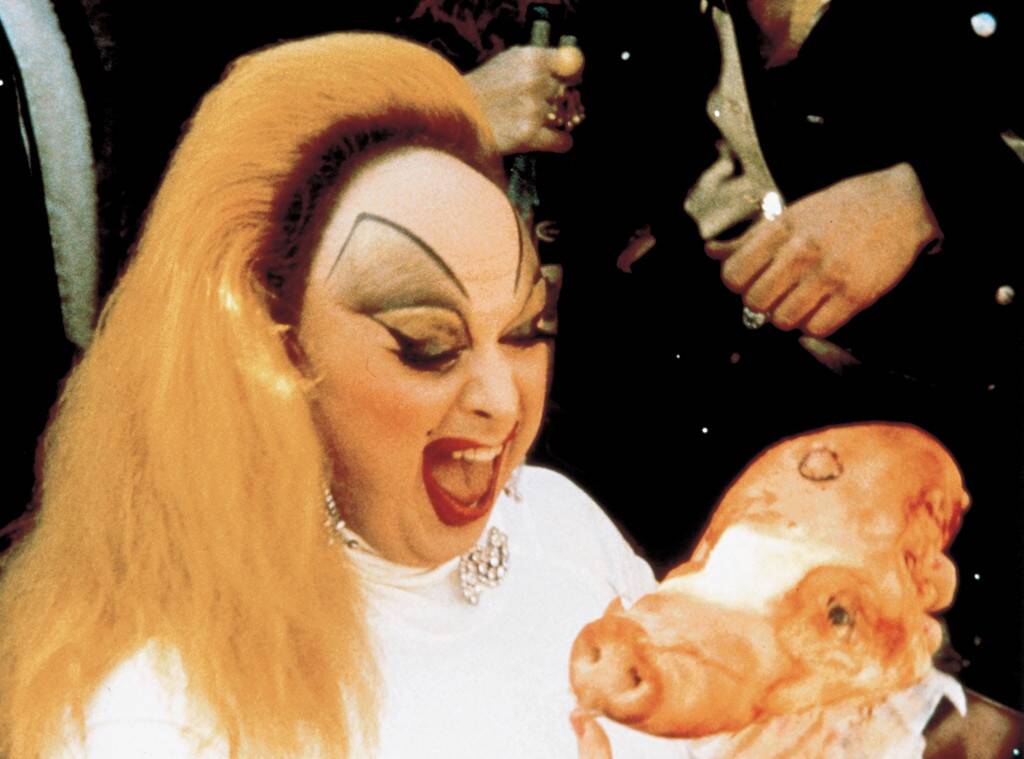
Let talk on a few of this offensive scene that we just experienced. I am not going to bother to talk about the eating dog shit part. Mainly due to the fact that we have heard many talks about this and how offensive it is, but in comparison to the rest of the film. This could be seen as just the icing on a disgusting cake. I just didn’t get why Divine had to keep looking at the screen with shit in her teeth. Just writing that makes my stomach uneasy. The scene where we see Raymond flashing women sitting on a bench was bad, but then when he tries again, and a transvestite flashed back at him was just shocking. That was not a twist I was expecting. Then we will move over to Divine’s birthday party, where we see how disgusting her friends are. I mean seeing someone spreading their cheeks to make their asshole sing is just wrong. How do you even cast someone for this? Before that we see Cotton putting on a show for Crackers by having sex with a girl and a chicken. Who even thinks of throwing a chicken into that? I’m going to guess that PETA was not a fan of that scene because it didn’t not look like they used fake chickens or that the chicken survived that scene. The last one, must be the one I was most shocked about. Seeing Divine give her son, Cotton, a blowjob at the Marble’s house. WTF!! How was this a good idea. I was just grossed out.

This poor house was not ready for Divine and Cotton, and the rest of us were not ready for what they were about to do

This film is the now the new standard for offensive films and I can see why it is a cult film.

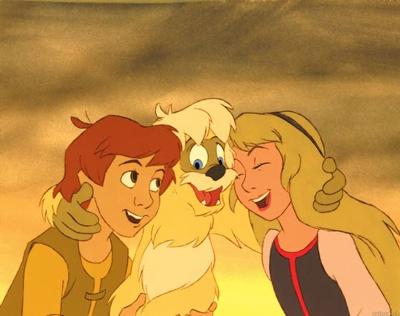
Now on to a less disturbing subject, the presentations. I am not going to talk too much on my own, Troll 2, just because I feel as if I have said enough on the film. My only hope is that I inspired others to watch this movie. Now on to The Black Cauldron or the black sheep of Disney. We have all grown up watching films by Disney and loved them all. To think that a film like this could steal our childhood away is scary. I am glad that they bounced back, and we still have such great movies from then. I do have to say that I do want to see it and makes me feel that this film can be more appreciated by an older audience. I think for most of must Disney did a good job to bury this film because I never heard of it and if it wasn’t for Emma I still would not know it.

I don’t know what this creature in the middle is, but it follows classic Disney to have such a cute supporting character. If this film was more of a hit, I bet a whole generation would have this as a stuffed toy to carry around like a teddy bear.

Pink Flamingos: Transgression and Freakery

Had a budget of about $12,000

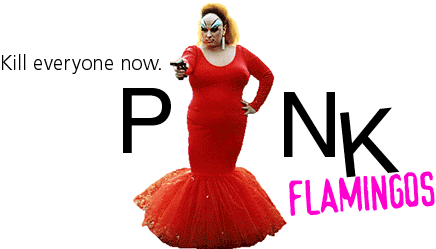
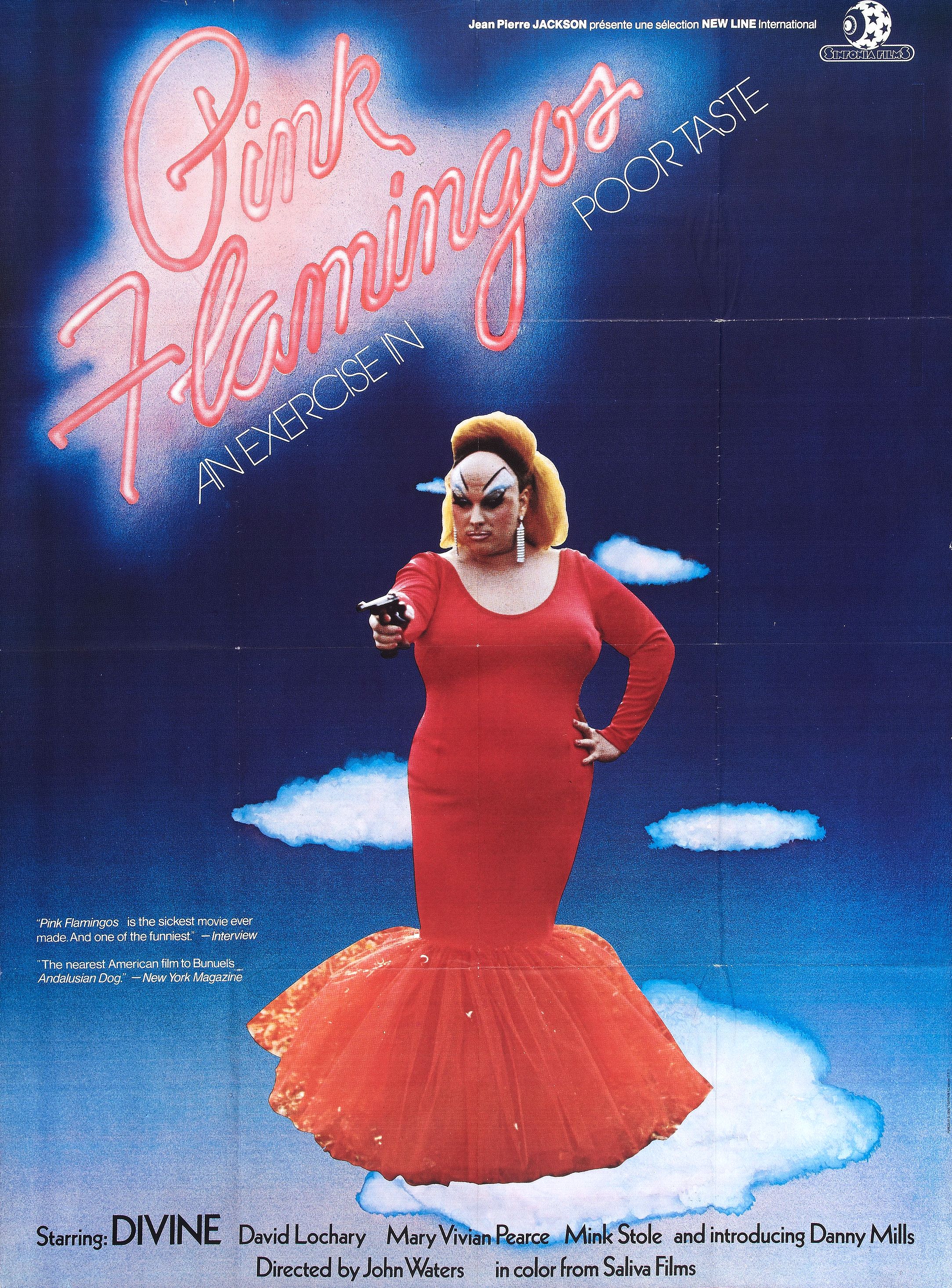
John Waters directed, produced, and wrote the 1972 cult film Pink Flamingos. The film is called “an exercise of poor taste” as it’s filled with “outrageousness ” with its transgressive nature. This was the perfect film to pair with our readings on transgression and freakery. Divine, our main character, a well-known Drag Queen, has been deemed “the filthiest person alive,” a title that seems to be very important to them and their rivals, the Marbles, Connie and Raymond, played by David Lochary and Mink Stole. The film is transgressive in the sense it exploits several taboo topics of the human body including: nudity, voyeurism, sodomy, masturbation, incest, rape, cannibalism, and murder. These harsh and intense topics are normally hard to talk about, which only furthers Waters’s pride in his truly disgusting film.

“Transgression and Freakery” by Ernest Mathiijs and Jamie Sexton was an enlightening reading. They define transgression as “any act that violates law or morality; more broadly it refers to the act of passing beyond any imposed limits” (Mathijs and Sexton). With the strict rules that society dictates that isn’t very hard to do. In Pink Flamingos transgression is set to an extreme octave, including freakery and abhorant topics that in turn categorizes the film as a “sick film.” Freakery shifts social ideologies to obscure naturalism and show the abject, the grotesque, and the impure. These major factors give way to the film, giving the audience an escape into a disturbing alternative reality. The challenges of reality faced in this film show how shallow the pool of normalcy is. Waters’s film makes one question how people can behave in such a way. The film goes to these extremes to reassure the audience that they are normal, this isn’t real, and that they get to enjoy these sick and twisted story lines in this cult film without fear of judgement.

To truly identify this film as a sick film we have to pause and look at the very last scene of it. Divine picks up dog feces and ingests it. A disturbing and disgusting moment that brings the incredulous movie to a close. The narrator, Mr. J, then calls Divine not only the filthiest person alive, but also the world’s filthiest actress.

What were they thinking? The film is still shocking in modern times, let alone in 1972. Although sex was a very public thing in the 1970s the other topics, like dressing in drag, were not considered socially appropriate, whereas now being a Drag Queen is more commonly accepted and empowered as we keep sex behind closed doors. As stated in class the world is becoming sanitized of sex. This cultural transformation is shocking, yet also exciting. The flip in social changes is enlightening, now that we keep sex hidden and encourage dressing in drag, among other ways of expressing oneself. It begs the question what Waters was trying to show. He is seemingly ahead of his time, capturing this glimpse of a different world, but even his extreme ideas in 1972 send us in 2020 for a loop. So where was he headed? What was he trying to say about the people then, and the people now? Pink Flamingos is a very new and very intense experience. However, its disturbing images and ideas are a gate way into understanding cult topics of sick films, freakery, and transgression.

John Waters the master behind it all.

Taboo, the discussion of impurity in the world, often relates to bodily fluids. The unknown, the inside is all impure because we don’t know about it. Society has dictated that the unknown is to be feared because it can’t be predicted or classified as anything. If taboo was looked up in the dictionary Pink Flamingos would be listed beside it. Although the film explores this freak show through humor it is touching on numerous taboo topics. The form of taboo we see in this film is abjection, “where cultural meaning collapses.” Anything considered normal does not exist. it is difficult to describe because language barely scratches the surface trying to accurately convey what is happening on screen.

Reception is the most important part of transgression. Culture changes and has drastically changed since the film was released in 1972. In 1972 the film shocked audiences as it does now. Pink Flamingos gained a cult following rapidly in the midnight circuit and still has one now. Modernity couldn’t tarnish Waters’s extreme ideas. His obscene film is still relevant and gets the reaction he was aiming for, which is the exact reason we appreciate and study the film academically. The film has more to say about us than we do about it.

Camp and Transgression Cinema

My favorite description of camp from this week’s readings comes from Susan Sontag’s essay Notes on Camp.

              No. 26 ‘ Camp is art that proposes itself seriously, but cannot be taken altogether seriously because it is too much.’

As someone who had never heard the term ‘camp’ until this semester I found Notes on Camp to be incredibly helpful. Like cult films, camp has numerous definitions. It walks a fine line between ‘quirky’ and just plan bad, or lacking in ambition, as Sontag describes. Camp’s most important role in regards to cult film is in viewer tastes. As we often discuss in class, it is a film’s audience that give it a cult status. Without a following, a bad movie is just that—bad. I would argue that the worst thing a film could be called is boring, as even the most exaggerated or transgressive films (Hi Pink Flamingos) still provide a form of entertainment in their portrayal of taboo or disturbing acts.

              No. 34 ‘ Camp taste turns its back on the good-bad axis of ordinary aesthetic judgment. Camp doesn’t reverse things. It doesn’t argue that the good is bad, or the bad is good. What it does is to offer for art (and life) a different-a supplementary-set of standards.’

              This concept of camp making a 180 in regards to taste is the hardest concept for me to grasp. If having camp taste doesn’t mean ironically liking something that mainstream society considers bad, then what does camp mean? Luckily Andrew Ross’s essay Uses of Camp helped me clarify a few things. Ross goes into the history of camp, and how it has be adopted by the underdogs of society as a way of ‘salvaging the privilege to influence canon tastes of mass culture.’ In the sense of a camp intellectual then, camp is the appreciation of things that are cast aside by the mainstream values of society. It’s liking something that others may consider tacky, and enjoying how your tastes go against the current tastes of the majority.  

              With that, let’s go into our screening for this week, Pink Flamingos. I will not lie. I will never, ever, watch this film again. I couldn’t even get halfway through it before I stopped watching it. However I respect Pink Flamingos for what it is—a shiny example of a transgression cult film. Everything about Pink Flamingos is taboo, appalling, or just plain revolting. As described in our reading of Transgression and Freakery, it all has to do with how a film affects audiences. While camp takes something quirky or bizarre and choices to see it in a different light, transgression tastes are those that come ‘out of a sincere sense of rebellion against what is perceived as a suffocating pressure from dominant morality.’ It’s the enjoyment of experiencing something taboo, because its taboo. Many cult films celebrate or feature transgressive acts or images. It was interesting seeing how all of these essays fit together, but Transgression and Freakery was the most informative after watching Pink Flamingos. But still. Never watching that again.

MOVIE: “Troll 2” – Claudio Fragasso (1990) | Maettina
Shout out to Spencer’s presentation of Trolls 2. I need to see it know!

Carnival of Cult

This week’s readings where all about understanding cult and what better way then using horror as an example. Some of horrors most recognizable and beloved films are recognized as bad films.These films might not be blockbuster hits but are seen as fan favorites because of the films off beat feeling or its originality or purely because its bad. The horror genre has its own dedicated cult following allowing for these spin offs and funky b movies to be made. Horror also tends to follow a certain pattern or formula, while these films don’t have a particular message they tend to stay conservative rather then attempt to break the mold of the classic horror structure.

Cult films and horror movies feel all too familiar together and there couldn’t have been a better film than Carnaval of Souls (1962). This film has all the makings of a classic horror but it breaks the mold and does it stunningly. The film follows Mary Henry (Candace Hilligoss) to a new home as a church organist after being the only seen survivor of a fatal car crash. On the way there she sees a far away structure that we later find out is an abandoned carnival. Mary also gets spooked by a scary looking man outside the window of the car but couldn’t find him after spinning out of control. Once settled in Mary meets her next door neighbor John Linden (Sydney Berger) a not so drunk drunk that attempts to win Mary over.

Personally, I thought the movie was visually very exciting. It was aesthetically appealing and beautifully shot, however, it was a bit slow for my taste. I completely understand the fact that the slow pace of the movie was to add to the creepy atmosphere, but it was a bit too slow for me. All of the scenes shot in the abandon pavilion were great, they were dreamlike and creepy, a very odd feeling to it all. The ending seemed quiet rushed, and I was not a huge fan, but I do understand that the whole beauty of the film was the journey we had to take for an obvious ending. The slow pace of the film, as well as the random appearances of “the man” create a very relatable feeling of paranoia and make for a beautiful psychological horror. Especially when Mary speaks about life being so much easier and so much more beautiful when it is daytime, and the feeling of isolation that comes with nighttime.

I guess this relates to my personal taste, another topic that we tackled this week. This week, I learned that taste is founded on the combination of cultural upbringing and education. I grew up watching fast-paced movies like the Fast and Furious franchise in my childhood. This might explain why slow-paced movies (no matter how gorgeous and entertaining I think it is) are hard for me to follow and stay interested in. Similar to the idea of form and function, where a movie might be made to satisfy popular demand and interests, and another might be made for a different reason than to satisfy popular demand.