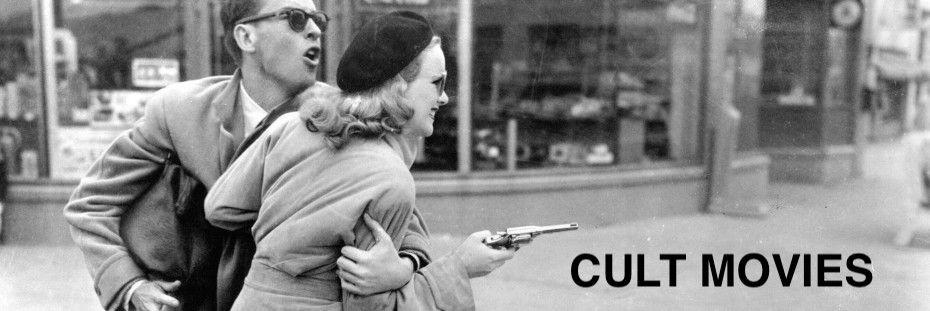
This week’s film was Detour (1945), directed by Edgar G. Ulmer as a B-movie film noir, starring Tom Neal as Al Roberts and Anne Savage as Vera. Detour follows the self-pitying and world loathing Al Roberts’ account of a trip to Hollywood gone wrong. The film starts off with Al’s recollection of the events that led up to the ‘detour’ that caused him to be to be hiding in the diner in the opening scene. For the entirety of the film Al narrates the scenes to the audience as he sees it, this can appear as an inner monologue but also as narration to the audience, as theorized by Andrew Britton in the reading “Detour”. Al’s character is deeply concerned with fate, but not the type of fate that answers a longstanding question or leads you to make the right decision, no, Al is concerned with all the ways that fate has screwed him over. It is not hard to feel as though the world is out to get you or feel as though you have bad luck, but Al takes it to the extreme. Al has low-motivation due to his constant battle with what he perceives as ‘bad luck’. After deeming his dream of becoming a successful piano player unachievable, he aims his little bit of ambition in a different direction; profiting off the success of others. When his decision to follow Sue and her dreams to Hollywood goes awry after a man he picks up a ride from, Charles Haskell, dies during the drive. Al then has to reshape his plan and steals Haskell’s identity. From here on it really goes downhill; meeting Vera, the only person who won’t deal with his nonsense, entering an aggressive and manipulative quasi-relationship with Vera, and then killing her in an odd and hard to believe way. Britton theorizes that Al’s narration is his way of providing reasoning for the audience, and himself, for his actions, ultimately disowning them because they were his only options. Al didn’t have to leave Haskell’s body on the side of the road, he didn’t have to steal Haskell’s identity, and he didn’t have to stay with Vera. The last one is a little tricky because of Vera’s aggressively manipulative manner but that is beside the point. He cannot blame “bad luck” and “fate” for his bad situations because they are abstractions and therefore not solid excuses.
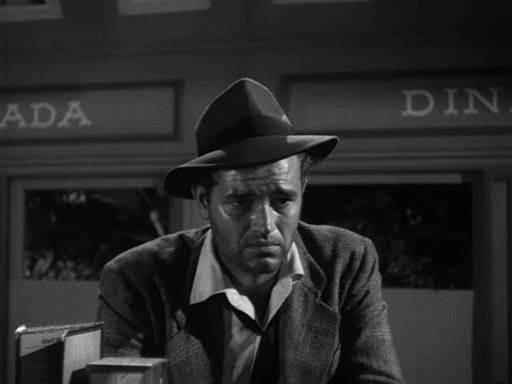
Mr. Pouty
This movie is driven by Al’s struggle with fate, he does not like his life and is constantly lamenting about his bad luck without making any effort to change it for himself. Most of the situations Al uses as examples of how fate is out to get him are trivial and he treats them that way too, with a “nothing new to me” attitude. There is a sense of irony in his situation because in a way, fate finally does bite him in the ass. And he sees it too when things really start to get bad; after each death for a split second we can see his panic and in his diner scene reflection that begins and ends the movie.
We talked in class about B-movies and what they usually consisted of: low-budget, short production time, unknown-actors/actresses, iffy plot. Detour is a shining star among B-movies and a prime example of their potential for innovation. Little money and little time breeds creativity, Ulmer was quite clever in the technical tricks he used to communicate with the audience. One particular shot that was so simple but showed Ulmer’s ability to work within the B-movie genre was when Al realized he had strangled Vera and the camera scanned the room, zooming in and out of focus on Vera’s belongings. In combination with the lens, Ulmer used cheap methods of set design to reshape reality. Without being told so, it wasn’t completely obvious that Ulmer used a fog machine to create a moody street scene.
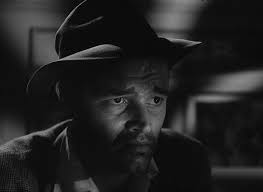
What was obvious, was Ulmer’s proficiency in the language of film and he shows it right off the bat as we start off Al’s flashback in the diner. Dark lighting creates a sense of mystery and the close-up on Al’s face is a classic technique used to communicate to the viewer what the character is feeling, aiming a strip of light at his eyes only enhances the drama. They say, “the eyes are the window to the soul.”
 Cult Movies
This article highlights some great details about Ulmer’s filming techniques, which are hard to catch because of the fast pace of the movie. It contributes to the dreamlike quality of the movie to have such vague settings and visual tricks.
LikeLike
I liked your response and I really liked how you talked about how they ad to use the low budget. If you pay attention to the film you can notice the low budget and how it impacted the whole film. I liked how you mentioned the way the film was filmed was so simple and that it was able to make the film better, especially the scene after Al kills Vera, the way it was shot worked perfectly and if they had a larger budget and tried to make it better, I don’t think the scene would have been the same.
LikeLike