I had a lot of fun with this week’s screening of Blacula. I remember back in History of Film learning about API and blaxploitation, and wanting to learn more about those films. Blacula was both more and less than what I expected. More, in that it was a truly great film with an engaging plot and cast, and less in that I wasn’t overwhelmed by the exploitation element.
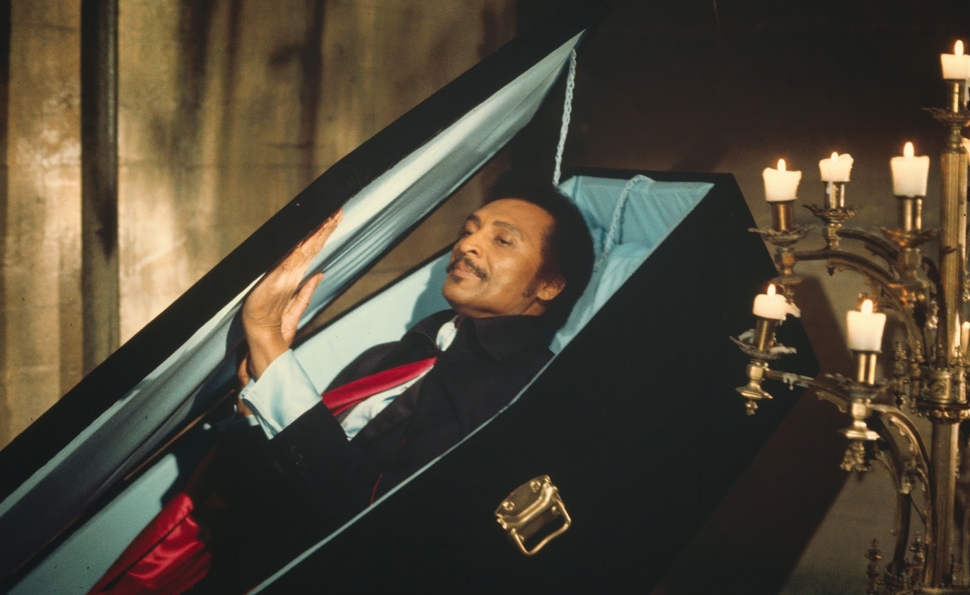
I knew I was gonna enjoy the film from the first scene. Let me say this—William Marshall as Mamuwalde is quite attractive. From that first scene Marshall sets up the film perfectly in his serious portal of the character, and at no point did I find the other actors lacking in enthusiasm. The biggest ‘o shit’ moment for me was the first scene where Dracula says “I would willingly pay for so beautiful of an addition to my householders as your delicious wife” after Mamuwalde discusses abolishing the slave trade. In that instant Dracula is no longer just a blood sucking monster, he’s also a white man oppressing the black community. I found it interesting, but a good call that the name ‘Blacula’ was only ever said once—and by Dracula. The name itself is so corny, but when Charles Macaulay delivers the line you know your meant to take it seriously. One of the readings for this week even pointed out that by ‘naming’ Mamuwalde Dracula is acting as a slave owner renaming his slaves. While Mamuwalde never refers to himself by that name, Dracula’s curse however does enslave the noble prince into a blood sucker himself, forced to act as the one who cursed him.
Our discussions this week were the best by far. I also found the essays more comprehensible that some of our previous weeks’ readings, mainly because the topics we discussed focused on representation of cultures and minority groups in film. “Rethinking Blacula: Ideological Critique at the intersection of Genres” by Brooks E. Hefner brought up an interesting topic that we didn’t get to discuss: Dr. Gordon Thomas. The equivalent of Dr. Van Hellsing (now that’s a bad ass name), Hefner states
“In theory, he [Gordon] should provide the viewer with an alternative hero in the Shaft/Slaughter mold in whom the viewer’s sympathies should lie. Instead, it is the romanticized Mamuwalde who is more likely to elicit viewer sympathy,”.

The essay goes on the say that while Mamuwalde was well received by black audiences, Gordon was seen an Uncle Tom figure, or taking on stereotypes of what a ‘proper black’ should be in the eyes of white society. Gordon is heavily compared to another famous Blaxploitation figure, John Shaft. The essay goes into great detail about how Shaft, while written as a black hero, is disconnected with Harlem, and is mostly involved in “only white and black middle-class settings…what is hinted at in the character of John Shaft becomes overtly expressed in the words of Gordon Thomas,”. Gordon openly states that he wants to move to the suburbs, which suggests that he wants to disconnect himself and his family from the black community of L.A. I think what really makes Gordon so different from Mamuwalde is in climax of the film. While Mamuwalde is seen taking out the L.A police forces one by one, it is Gordon who leads this final charge against the vampire. In this way, the final confrontation becomes more than a simple “heroes vs monster” show down. The essay goes on to say the “By the films conclusion, the black heroes have firmly positioned themselves as ideological opposites.”

Dr. Gordon Thomas 
John Shaft
The most shocking scene in the movie for me was when Tina was shot by a white officer. My reaction was “O my God, he shot her! The hostage! How could he take that shot?” That was the moment that really brought home the divide and horrible brutality of law enforcement towards black communities. The officer doesn’t show any reaction to shooting Tina, someone he knows to be innocent and a victim. He doesn’t care. And that was the scariest part of the film to me. That lack of consciousness shown by L. A. officers. While Mamuwalde only bites Tina to save her, it is Gordon and Peters who kills Tina in the final scene, solidify Gordon as an accomplish to the police force.
Blacula is such a great film to study, and for numerous reasons. I feel like I could talk about it forever. I really enjoyed this film. What started out as a simple money grab for AIP became one of the best classics, cult or otherwise.
 Cult Movies
I also found it funny that Dracula gave Mamuwalde his “name”. I found it odd that he wanted to curse him with the same issues and struggles that he deals with every day. I just though it was a little odd to do that and then lock him away for so long. Also, how did no one check the coffin before it left Transylvania. This seems like an overlooked part of the film. Why would you buy something that is locked and not even try to open it before moving it?
I agree with the fact that the officer shot Tina and didn’t seem to upset by the fact that he injured the hostage. How can you take that shot and not have a concern about hitting the innocent? This also plays into the idea that all of the officers are the same. We discussed how they all had on the same uniform with the white helmets to show they are all the same. I am not sure that the death of Tina can make Dr. Thomas the same as the police force. He was the only one who was worried about the black community and seemed to always fight for the little guy. Like when the one station lost he paperwork on Bobby and didn’t seem too concerned.
LikeLike
I really like that you focus on the culture in the film too, rather than just discussing the plot. Your thoughts are really insightful and strong. I agree with them a lot. I’m really glad we got to study this film I personally loved the original novel by Stoker, so watching a great rewriting of the novel is amazing.
Also, I know how much you like my GIFs. So, if you URL enter GIFs you can use them too. Add an image and if you use google you can copy the image address and paste that in the image URL link.
LikeLike