Blaxploitation Meets Dignity
"It may not actually be a trend as yet—it may simply be a superficial impression, based on several weeks of rather ordinary movie‐going—but it does seem as if the bottom has dropped out of the market for black exploitation films. I'm referring to those supercharged, bad‐talking, highly romanticized melodramas about Harlem superstuds, the pimps, the private eyes and the pushers who more or less singlehandedly make whitey's corrupt world safe for black pimping, black private‐eyeing and black pushing." - FILM VIEW; Are Black Films Losing Their Blackness?; VINCENT CANBY. April 25, 1976,
Blaxploitation emerged during the 1970s as a subgenre of the exploitation film. For the first time, black characters were painted as heroes and given the opportunity to become the focal subject of film, rather than sidekicks or villains. The subgenre was originally aimed towards urban African American audiences, but its popularity quickly crossed racial lines. There were many members of the targeted audience who appreciated seeing these new heroes, but many who felt that black communities were being displayed in a negative and stereotypical light. Protests against these films eventually led to the death of the blaxploitation movement in the late 1970’s. Today, there is still an ongoing debate addressing how blaxploitation affected the black community and its portrayal.
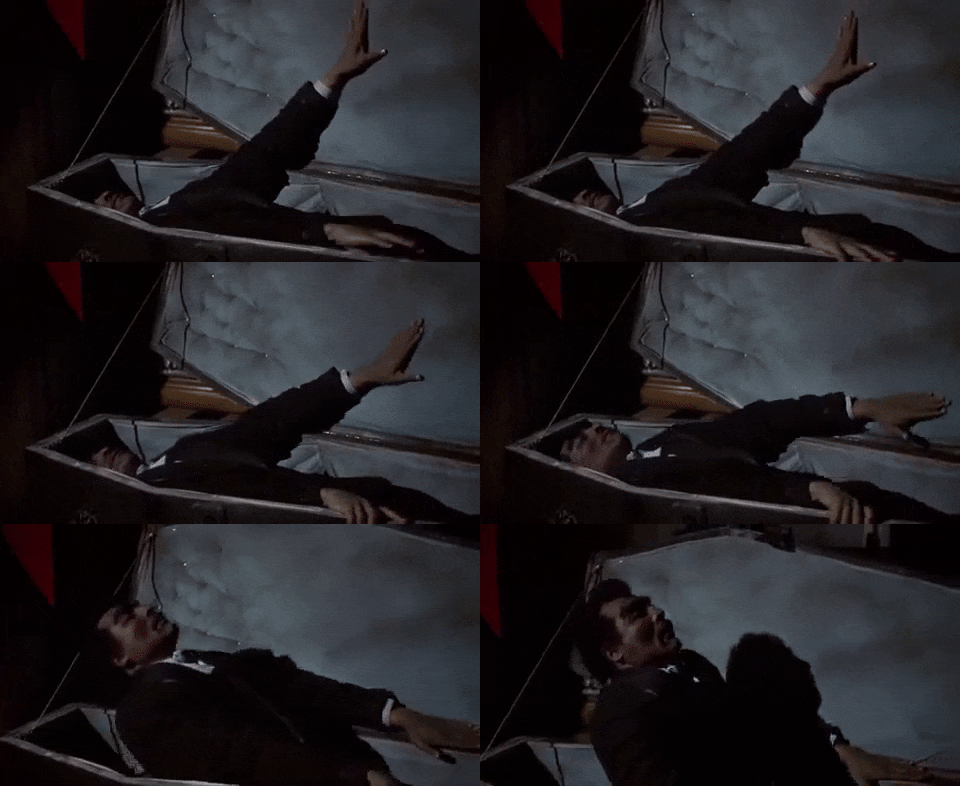
William Crain’s 1972 blaxploitation film, Blacula, brought blaxploitation into the horror genre. It tells the story of Mamuwalde, an African prince turned vampire after his failed attempt to gain Dracula’s aid in ending the slave trade. Although a blaxploitation film, there’s a solemnity about the story that makes it resonate deeper with the audience than one may expect. By the end of this week’s screening of Blacula, I found myself pleasantly surprised with the portrayal of characters and the acknowledgement that it had evoked genuine emotion.


I feel like what I enjoyed most about Blacula is the dignity that William Marshall brought to the character – his Shakespearean training shines through in the way he approaches the story of Mamuwalde. I’m not familiar with many blaxploitation films, but from what I understand they more often than not fall victim to portraying stereotypes; something that the early drafts of Blacula would have reiterated had the producers not been willing to experiment with form at Marshall’s request. In “Deadlier than Dracula!” Blacula and the Horror Genre, it’s said that he wanted to ensure that “the image of the first black horror monster contained a level of dignity.”
“I wanted the picture to have a new framing story. A frame that would remove it completely from the stereotype of ignorant, conniving stupidity that evolved in the United States to justify slavery” - Marshall, on Blacula (Martinez et al. 42)
Originally, producers wanted the main character to have a name that echoed that of a blackface white comedy team, which led to Marshall suggesting that the character’s previous life be one of nobility. He insisted that Blacula’s name should be Mamuwalde, and that he had been an African prince before falling victim to vampirism. It was his desire to see a character that didn’t embody every stereotype that blaxploitation films were known for utilizing. Although producers were initially hesitant with straying from what they knew would create revenue, they eventually embraced Marshall’s suggestions and thus the first black vampire emerged as a truly regal character.
I feel that Marshall is the driving force behind Blacula as a cult film. Without his presence, we’d most likely be watching a film centered around stereotype. Not all blaxploitation films feature actors who take their roles as seriously as Marshall took his, and it’s in the way that he approaches the character of Mamuwalde that sets the whole tone of the film. He brought an air of dignity to the character of Mamuwalde, which gives his story a seriousness and sympathetic edge that would have been impossible to convey without both the changes Marshall proposed and the talent he demonstrates.
 Cult Movies
What a lovely blog!You named this blog “Blaxploitation meets dignity,” which I also spoke about similar things. the video interview was a great perspective. I also this you inserted great quotes that sum everything up well.
LikeLike
Hey, I liked your blog! Great quote to introduce what we spoke about this week. I agree, William Marshall’s way of playing Mamuwalde made the movie.
LikeLike