
A look inside the cult following of the visionary director:

In the world of animation, Hayao Miyazaki is an unrivaled icon known for his creation of compelling characters, engaging stories and breathtaking animation. Over the years, Miyazaki has gained a significant cult following as the soul of animation. Miyazaki is generally the only anime filmmaker that the general public is familiar with and has been called the “auteur of anime.”
“Hayao Miyazaki is a filmmaker whose appeal goes way beyond fans of anime – that all too often impenetrable Japanese genre. His work includes some of the most charming kids’ movies you could hope to see: animated films which make Disney seem simple-minded.”
Mark Ellingham (The Rough Guide to Film, 2007)
In western culture, Hayao Miyazaki is often naïvely referred to as “The Japanese Walt Disney”. Disney, however, never actually sketched a single image in his animations. Unlike Disney, Miyazaki has a very hands-on approach to every one of his films, where he supervises them and draws on them.
In 1979, Miyazaki directed his first feature film, The Castle of Cagliostro, and then moved on to direct Nausicaä of the Valley of the Wind in 1984.
Initially, The Castle of Cagliostro was a total flop, earning just ¥600 million (on a ¥500 million budget). Soon after, however, the film gained a strong cult following and has remained a cult classic to Miyazaki fans and animation aficionados. Not only is this film cult, this film is cult to animation royalty, like John Lasseter who has said that he wishes he could trade places with people who had never seen the film before. The failure of Cagliostro has been described as the genesis of Studio Ghibli.

In 1985, Miyazaki co-founded Studio Ghibli (alongside, Toshio Suzuki, Isao Takahata and Yasuyoshi Tokuma), where he went on to direct some films which are now some serious cult classics, such as Castle in the Sky (1986), My Neighbor Totoro (1988), Kiki’s Delivery Service (1989) and Porco Rosso (1992).
These films were a success in Japan, but it wasn’t until Miyazaki’s Princess Mononoke‘s release in 1997 ( which won Japan Academy Prize for Picture of the Year) that Miyazaki started to grab the world’s attention. Princess Mononoke‘s distribution to the West greatly increased Miyazaki’s popularity and influence outside Japan.
Then, in 2001, Spirited Away was released, winning the Academy Award for Best Animated Feature and, since then, Miyazaki’s name has been engraved on the list of cult directors. His later films have enjoyed critical and commercial success, but it was Spirited Away that opened the world of Japanese animation to many and changed the international film industry.
Despite this hit, Miyazaki’s films are still somewhat of a niche thing outside of Japan. They do, however, come with a devoted cult following consisting of film buffs, Japanophiles and Studio Ghibli fans. This cult following has grown so much, in fact, that comic and pop-culture conventions that don’t have at least one cosplayer dressed as No-Face have become rare. No-Face has even become a common tattoo.
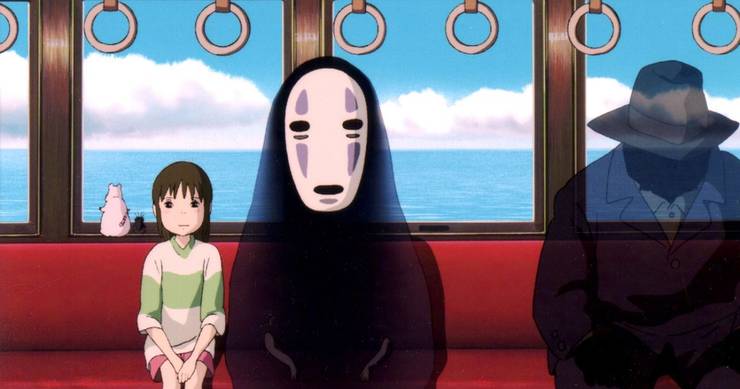
This cult following is remarkable, considering the poor international distribution. The films have always been somewhat difficult to find. Before November 2019, some Miyazaki films couldn’t be found on any streaming platforms (which, in 2020, should be an indicator of the distribution). In November, however, Netflix announced that an abundance of Studio Ghibli films would be available to stream shortly.
It’s not just the films that gained popularity and a cult following in the Western world, however. Miyazaki’s cult following has grown steadily since his earlier works, and his style of animation is now easily recognizable. You know when you’re watching a Miyazaki film–both from the visually aesthetic properties of the film and from the feelings that the films evoke.
The auteur theory arose in France in the late 1940s, fathered by the cinematic theories of Alexandre Astruc and André Bazin, and advanced by Bazin’s Cahiers du cinéma. The theory credits the director as the chief creative force of a film, much like the author of a book. Miyazaki is clearly an auteur, his style discernible throughout the globe. More so, however, Miyazaki is a cult auteur.

There is a chapter in “Cult Cinema: An Introduction” titled “The Cult Auteur” where Ernest Mathijs and Jamie Sexton expand on what exactly a cult auteur is. First and foremost, Miyazaki is a cult figure in itself. There is undeniably a cult of Miyazaki himself. His creative process is idolized by many and he is worshipped online for his demeanor and speech, often quoted.
Miyazaki is, however, a director who falls outside of convention–in his style of animation, his creative process, even his mannerisms in general. Firstly, Miyazaki does not work with a script. On the other hand, Miyazaki’s stories start with an image. He comes up with a character, or a specific image in mind, and mulls over that idea for weeks, even months. Then, he’ll work on creating an initial image. From there, he merely expands on that initial image and idea.
“My [creative] process is thinking, thinking and thinking—thinking about my stories for a long time,” he said with a wink, through a translator. “If you have a better way, please let me know.”
Miyazaki about his creative process

Next, Miyazaki’s animation is always marinated in both nostalgia and nature, a sort of yearning for the past. His films often feature strong female characters and protagonists. The rigidly defined ‘good’ and ‘evil’ don’t really exist in his films. Unlike Western cinema, conflict is now always the heart of a story for Miyazaki. In fact, Miyazaki says about good versus evil:
“The concept of portraying evil and then destroying it—I know this is considered mainstream, but I think it is rotten. This idea that whenever something evil happens someone particular can be blamed and punished for it, in life and in politics is hopeless.”
Miyazaki

Additionally, Miyazaki is famous for his eccentricity. When he’s working on a film, which has been the subject of multiple documentaries, Miyazaki is exceptionally hard on himself, working until each image, character and idea is executed perfectly. When he finished a film, he retreats to the countryside, where he lets himself rejuvenate without any distractions. Most famous of all, however, Miyazaki has announced his retirement from making feature-length films several times, and he’s returned every time.
In 2013, Miyazaki announced his retirement at a press conference saying, “I’ve made a stir before by saying I’m quitting. So people don’t believe me. But this time I mean it.” In 2017, he announced the title for yet another final feature film. He’s so famous for retiring and then surfacing back up that, in 2016, it became the subject of a documentary about Miyazaki, titled Never-Ending Man.
With traits and habits like these, it’s no wonder that Miyazaki attracts a cult following, and with a style and process like his, it’s no wonder that Miyazaki is a true auteur.
Surprisingly, the “cult auteur” is not a mythological director that hides in the shadows of niche fandoms. The cult auteur has actually become a familiar figure in Hollywood–think of, for example, Quentin Tarantino and David Lynch. More so, Miyazaki is what has come to be described as a “romantic” cult auteur.
Miyazaki is a director who, whether you want to admit it or not, has paid attention to his international cult status. While he is seen as a national treasure in Japan, he is very much idolized across the globe, and has come to recognize his mythological status. He, for example, likes to cause a ruckus by announcing his retirement. He likes that he is notorious for declining interviews. He’s aware that his mannerisms may come off as stand-offish. He has cultivated the image he has of a creative genius, with an extremely turbulent process.
Since Miyazaki is, of course, a co-founder of Studio Ghibli, Miyazaki fans are in extension, Studio Ghibli fans. Studio Ghibli and Miyazaki have cultivated such a strong cult following that Tokyo has tapped into the market of Studio Ghibli fans. For some, Tokyo has even become a holiday destination for the sole purpose of indulging in some Ghibli magic. There’s even an official Studio Ghibli museum and store.

Here are some of the cool Ghibli things you can indulge in in Tokyo:

GHIBLI MUSEUM

TOTORO CREAM PUFFS

WHISPER OF THE HEART FILM LOCATION
Of course, there are many more things for Miyazaki cult followers to do, like visiting the Ghibli clock designed by Miyazaki, going to see the Studio Ghibli corporate office (no visitors allowed inside, but a cult fanbase doesn’t care), and visiting The Edo-Tokyo Open Air Architectural Museum where Miyazaki got much of his inspiration for Spirited Away.
The cult Studio Ghibli fanbase is also impatiently awaiting the opening of Ghibli Park, a Studio Ghibli theme park in Aichi Prefecture, Japan, set to open in 2022. The park is said to have a dining area inspired by Spirited Away, Satsuki and Mei’s House, and a Princess Mononoke Village, proudly boasting a sculpture of the Tatarigami spirit monster.


Miyazaki’s cult following is an extremely dedicated one, that has produced a lot of art inspired by Miyazaki’s work. Some has recreated small scale buildings from Miyazaki films, like the bathhouse in Spirited Away. Others are using props from the film to photograph and create movie posters.


Miyazaki’s cult following grows much further than just people who grew up watching his films. His cult following ranges from Japanophiles to people who just love his work to people who are in the field of animation and idolize him.
As a matter of fact, one of the famous Hollywood faces to idolize and have a deep respect for Miyazaki is Pixar’s John Lasseter, who has said about Miyazaki:
“I love his films. I study his films. I watch his films when I’m looking for inspiration.”
John Lasseter
It’s no secret that Miyazaki has a cult following, and can be seen as a cult director. His work has touched the hearts of many, including other famous animators. He remains one of the most influential figures in animation, to this day, and his style remains undefeated. Miyazaki repeatedly manages to induce a child-like feeling in everyone who is sucked into his films, and he will remain an iconic figure for a long time.
There’s a quote floating around the internet that says something like, “Disney movies touch the heart, but Studio Ghibli films touch the soul.” While the quote might be extremely cheesy, it’s not wrong.
 Cult Movies
Wow.
I grew up watching Spirited Away. I would rent it every week from our library, and would sometimes watch it back to back, for days. My parents were freaked out by how the parents got turned into pigs, but recently I forced my mother to watch it with me. And she was awed by the film. She kept saying, “Wow, this film is so deep. Did you understand this when you were little?” And the amazing this is, I did understand Spirited Away then. Miyazaki makes his films in a way that even a six-year-old can understand the lessons he’s trying to teach.
You’re a great writer. And it’s awesome to meet another fan!
LikeLike